
The origin of the trench boot lies directly in the harsh conditions of World War I. Developed as essential gear for soldiers, particularly officers, these boots were engineered to withstand the brutal environment of trench warfare. Their design was a direct response to the need for durable, protective, and reliable footwear in the most demanding circumstances.
The trench boot’s journey from a critical piece of WWI military equipment to a modern style icon is a story of functional design meeting timeless aesthetics. Its original purpose—durability and protection—remains the foundation of its appeal today.
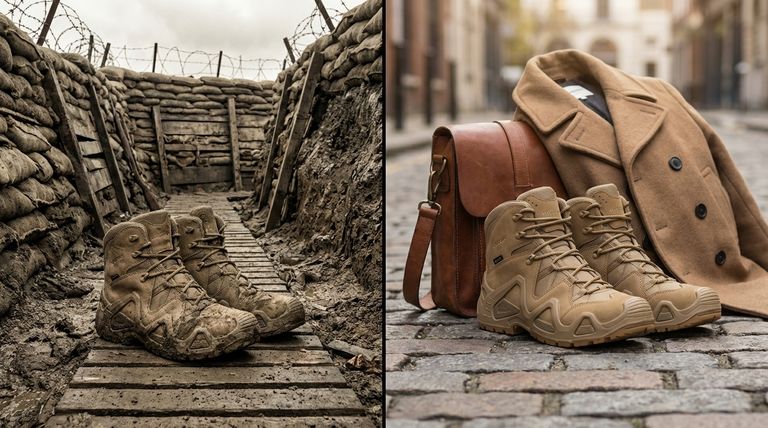
From Battlefield Necessity to Modern Icon
The transition of the trench boot from military issue to a wardrobe staple is rooted in its purpose-built design. What was once engineered for survival has become a symbol of rugged refinement.
The Problem of the Trenches
The battlefields of World War I presented a unique and punishing environment. Soldiers faced constant exposure to mud, water, and uneven terrain, which destroyed standard-issue footwear and led to debilitating foot conditions.
A new type of boot was needed—one that could offer superior protection, support, and durability against the elements.
Designed for Protection
The original trench boots, also known as "officer boots," were built with function as the absolute priority. Their taller profile protected the ankle, while thick leather and robust construction provided a barrier against moisture and debris.
Every element of the design served a practical purpose aimed at keeping a soldier's feet as dry and supported as possible.
The Evolution into a Style Staple
After the war, the functional and rugged aesthetic of the trench boot began to influence civilian fashion. Its clean lines, strong profile, and association with resilience gave it an enduring appeal.
Modern interpretations often feature a slightly lower profile than their military ancestors but retain the core design DNA that makes them instantly recognizable.
The Anatomy of a Modern Trench Boot
While the context has changed, the key features that define a trench boot are direct descendants of the original military design.
Goodyear Welt Construction
Many high-quality trench boots are made using a Goodyear welt. This is a method of construction where the boot's upper is stitched to a leather strip (the welt), which is then stitched to the sole.
This technique creates an exceptionally durable and water-resistant boot that can be resoled multiple times, extending its life significantly.
Supportive Lacing and Profile
The generous lacing system is a hallmark feature, providing a secure and highly customizable fit that supports the ankle. This was critical for stability when navigating treacherous ground.
Modern versions retain this feature, often paired with a slightly taller heel that provides a confident stance and comfortable stride.
Refined Materials
While the originals were purely utilitarian, modern trench boots often blend ruggedness with comfort. Many are now lined with soft materials like sheepskin leather, offering a comfortable fit from the first wear.
The use of premium leathers for the exterior ensures durability while allowing the boot to develop a unique patina over time.
Understanding the Trade-offs
The trench boot's robust construction brings with it a unique set of considerations that are important for any potential owner to understand.
Break-in Period
Boots built with thick leather and a Goodyear welt construction often require a break-in period. The stiff materials need time to soften and mold to the shape of your foot.
While this initial period can be challenging, it results in a truly customized and comfortable fit that lasts for years.
Cost vs. Longevity
Handmade, well-constructed trench boots represent a significant investment compared to mass-produced footwear. The materials and labor-intensive process contribute to a higher initial cost.
The trade-off, however, is exceptional longevity. A well-cared-for trench boot can last for decades, making it more economical in the long run than repeatedly replacing cheaper boots.
Style Versatility
As the references note, trench boots work well with casual and smart-casual outfits. Their military heritage gives them an inherently rugged character.
However, they are not formal dress shoes. Their robust profile means they are best suited for environments that don't require black-tie or strict business attire.
Making the Right Choice for Your Goal
To select the right trench boot, consider what you value most.
- If your primary focus is timeless style: The boot's military heritage provides a classic, rugged aesthetic that pairs well with denim, chinos, and other casual wear.
- If your primary focus is long-term durability: Seek out versions with Goodyear welt construction, as this is the hallmark of a boot built to last and be repaired.
- If your primary focus is out-of-the-box comfort: Look for models with soft leather linings, but remain aware that all high-quality leather boots will benefit from a gradual break-in period.
Ultimately, the trench boot's enduring appeal comes from its foundation of purpose-built design, offering a rare blend of history, durability, and style.
Summary Table:
| Feature | Origin (WWI) | Modern Interpretation |
|---|---|---|
| Primary Purpose | Survival in trench warfare | Rugged style and long-term durability |
| Key Construction | Robust leather for protection | Goodyear welt for resoling and longevity |
| Profile | Tall for ankle support | Slightly lower, refined profile |
| Comfort | Utilitarian, minimal comfort | Often lined (e.g., sheepskin) for comfort |
Ready to Supply Durable, High-Quality Footwear?
As a large-scale manufacturer, 3515 produces a comprehensive range of durable footwear for distributors, brand owners, and bulk clients. Our production capabilities encompass all types of shoes and boots, including styles inspired by timeless classics like the trench boot.
We help you:
- Source with Confidence: Access reliable, large-volume production of high-quality footwear.
- Ensure Durability: Benefit from proven construction methods for products built to last.
- Expand Your Catalog: Offer your customers a wide variety of styles from a single, trusted partner.
Let's discuss your footwear needs. Contact our team today to explore how we can support your business.
Visual Guide

Related Products
- Durable Military Combat Boots with Water Drainage for Wholesale & OEM
- High-Traction Suede Tactical Boots Wholesale & Custom Manufacturing
- Durable Leather High-Ankle Tactical Boots for Wholesale & Custom Manufacturing
- Durable Leather Tactical Boots Wholesale & Custom Manufacturing for Brands
- Wholesale Tactical Boots High-Traction & Reflective for Bulk & Brand Orders
People Also Ask
- Why must gait validation for military applications be conducted in combat boots? Ensure Data Accuracy for Soldiers
- What are the common types of combat boots? Find the Right Boot for Your Mission
- What factors should be considered when choosing military boots for hiking? Durability vs. Weight for Your Terrain
- What are the key considerations when choosing military boots? Prioritize Compliance, Environment & Fit
- How should the midfoot and heel fit in military boots? Achieve a Snug, Secure Fit for Blister Prevention
















