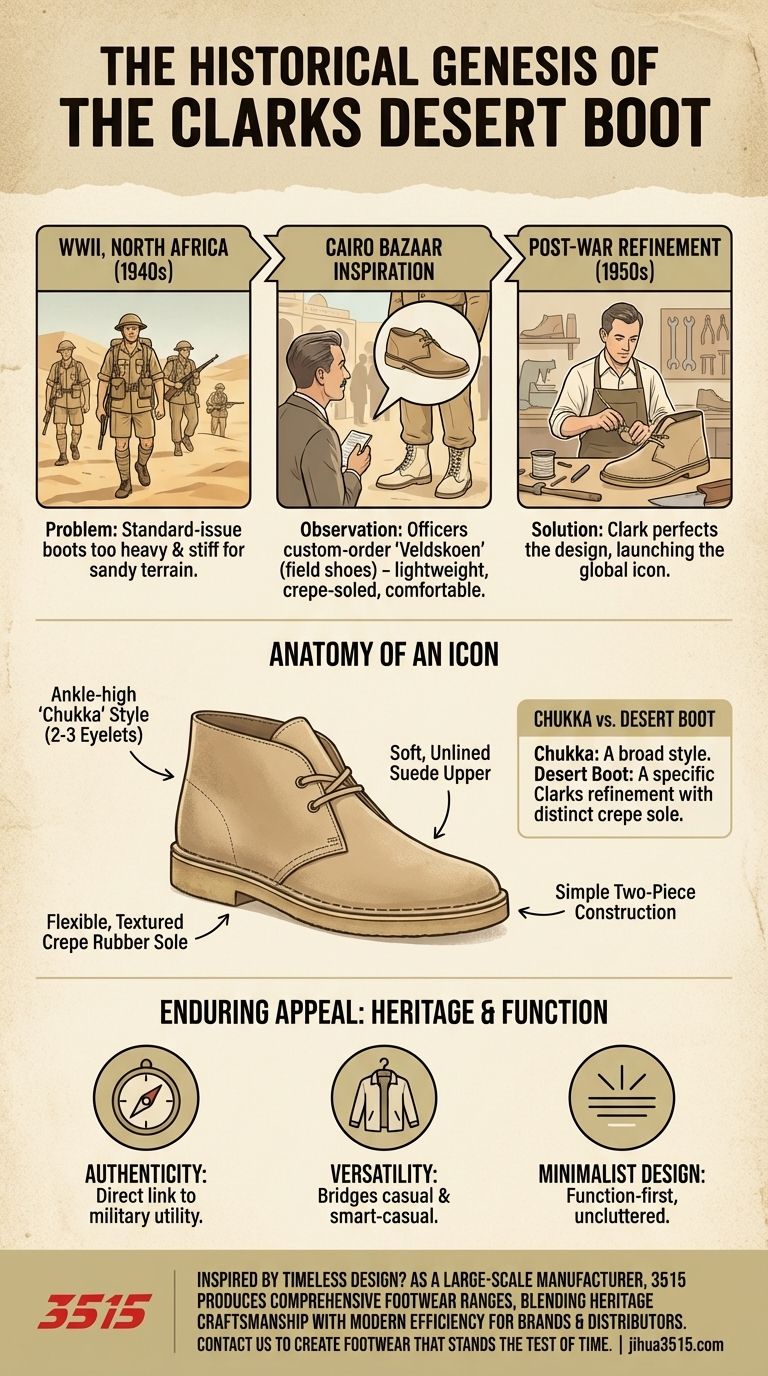
The Clarks Desert Boot was born from military necessity during World War II. While serving in North Africa, Nathan Clark, a member of the Clarks shoe-making family, observed British officers wearing simple, crepe-soled suede boots. These were custom-made in Cairo's bazaars and were far better suited to the sandy terrain than their standard-issue military footwear. He brought this functional design back home, refining it into the iconic boot we know today.
The enduring appeal of the Clarks Desert Boot is not a matter of fashion trends, but of authentic function. It is a direct descendant of a boot perfected for utility in the harsh conditions of the desert, a history that defines its simple, practical, and timeless design.

The Military Genesis: A Solution for the Sand
The origin story of the Desert Boot is rooted in solving a practical problem for soldiers. It wasn't designed in a studio; it was proven on the battlefield.
The Problem with Standard-Issue Boots
During the North African campaign of WWII, British soldiers found their heavy, stiff military boots to be cumbersome and hot in the desert. They were ill-suited for the fine sand and offered little comfort or flexibility.
Inspiration in a Cairo Bazaar
Officers of the British Eighth Army noticed the superior footwear worn by South African soldiers and local traders. These were lightweight, ankle-high boots, typically made from a rough suede upper attached directly to a springy crepe rubber sole.
A Boot Called Veldskoen
This original design was based on the South African veldskoen, meaning "field shoe." These were known for their rugged simplicity and comfort, making them an ideal blueprint for desert wear. Officers began having them made-to-order by cobblers in Cairo.
Nathan Clark's Vision
As an officer in the Royal Army Service Corps, Nathan Clark recognized the brilliance of this simple, functional design. He understood that its comfort and unique construction had commercial potential far beyond its military origins.
Understanding the Key Distinctions
The history of the Desert Boot is often intertwined with other footwear terms. Clarifying them is essential to understanding what makes the Clarks design unique.
The Chukka Connection
The Desert Boot is technically a type of chukka boot. A chukka is characterized by its ankle height and simple design, typically with two or three eyelets for lacing. The term itself is believed to have originated from the game of polo.
The Clarks Refinement
While Nathan Clark did not invent the chukka or the original desert-style boot, he perfected and popularized it. Clarks introduced the boot to a global civilian market in the 1950s, codifying the specific design—often a two-piece suede construction on a crepe sole—that became a worldwide icon.
From Utility to Style Icon
After the war, the Desert Boot gained widespread popularity as a stylish, comfortable, and casual alternative to the traditional stiff leather shoes of the era. It became a symbol of understated, practical style.
Making Sense of the Heritage
The background of the Clarks Desert Boot informs its lasting appeal. It is not just a shoe, but a piece of design history.
- If your primary focus is authenticity: The Desert Boot is a genuine article, a direct link to a utilitarian design forged from the needs of soldiers in World War II.
- If your primary focus is versatile style: Its simple, clean lines are the reason it bridges the gap between casual and smart-casual wear so effortlessly.
- If you appreciate minimalist design: The boot's two-piece construction and uncluttered silhouette are a direct result of its function-first origins.
Understanding this history reveals why the Desert Boot remains a masterclass in purposeful, timeless design.
Summary Table:
| Key Aspect | Description |
|---|---|
| Origin | WWII North Africa, inspired by British officers' custom boots from Cairo bazaars. |
| Inspiration | Based on the South African veldskoen (field shoe) for desert terrain. |
| Creator | Nathan Clark of the Clarks family, who refined the design post-war. |
| Key Features | Lightweight suede, crepe rubber sole, ankle-high with 2-3 eyelets (a chukka style). |
| Legacy | Evolved from military utility to a global symbol of minimalist, versatile fashion. |
Inspired by timeless designs like the Desert Boot? As a large-scale manufacturer, 3515 produces a comprehensive range of footwear for distributors, brand owners, and bulk clients. Our production capabilities encompass all types of shoes and boots, blending heritage craftsmanship with modern efficiency. Let us help you create footwear that stands the test of time. Contact us today to discuss your production needs!
Visual Guide
Related Products
- Wholesale Lightweight Tactical Boots Custom Manufacturer for Desert & Combat Use
- Durable Military Combat Boots with Water Drainage for Wholesale & OEM
- Durable Spiked Camouflage Boots Wholesale & Factory Production
- Wholesale High-Traction Camo Boots - Custom Manufacturer for Brands
- Durable Leather Tactical Boots Wholesale & Custom Manufacturing for Brands
People Also Ask
- What are the common types of combat boots? Find the Right Boot for Your Mission
- What specialized protections do tactical boots offer? Maximize Endurance with High-Performance Footwear
- What is the role of high-frequency acquisition hardware in technical skill analysis for outdoor and tactical boots?
- How is the compatibility of polymer materials demonstrated in smart footwear? Enhancing Tactical & Training Performance
- What are the different types of tactical boots available? Find the Right Boot for Your Mission