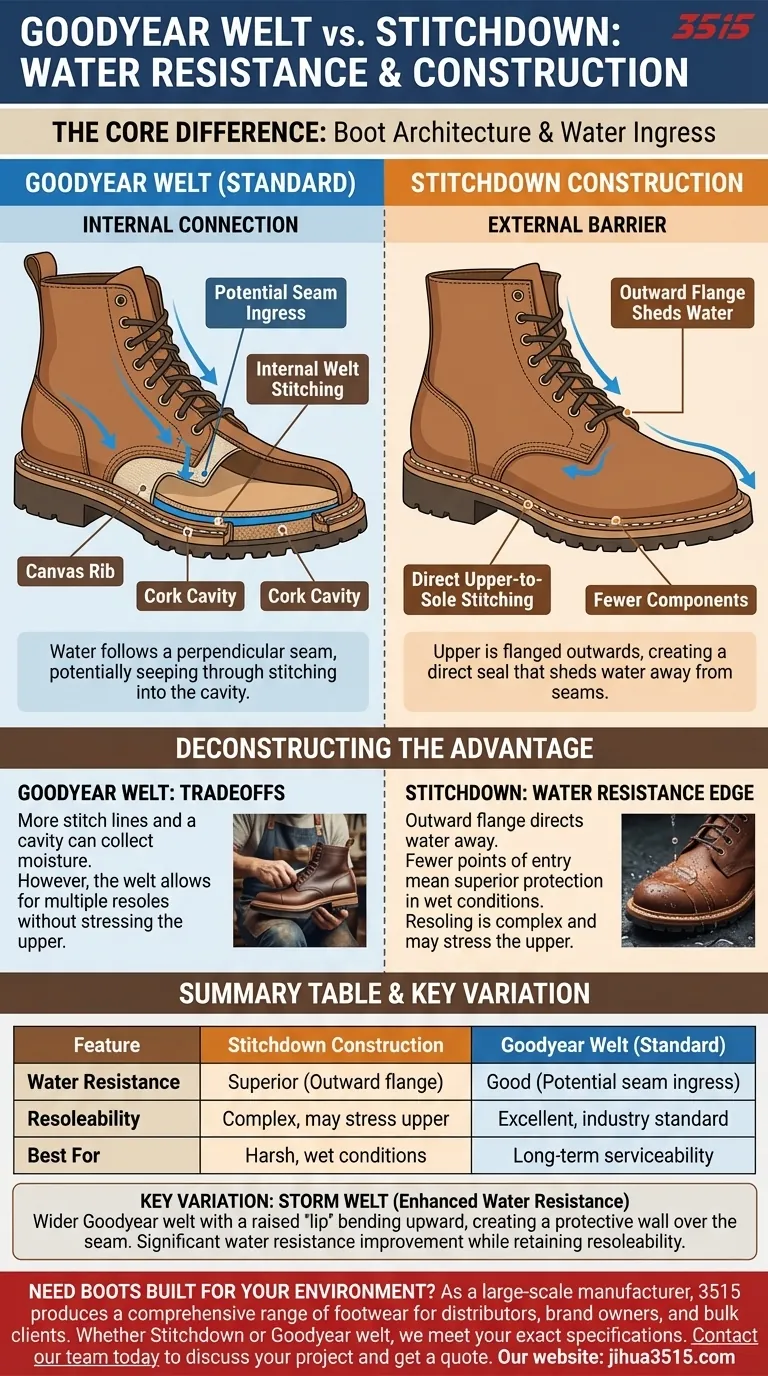
In terms of pure water resistance, Stitchdown construction is generally superior to a standard Goodyear welt. Stitchdown construction flanges the leather upper outwards and stitches it directly to the midsole, creating a more direct and sealed path for water to shed away from the boot. A Goodyear welt, by contrast, relies on an intermediary strip of leather (the welt) stitched to the upper and insole, creating seams that can be a potential point of water ingress.
The core difference isn't just about stitching; it's about the architecture of the boot's base. Stitchdown creates an external, overlapping barrier against water, while a standard Goodyear welt creates an internal connection that is more easily resoled but offers less inherent moisture protection at its seams.
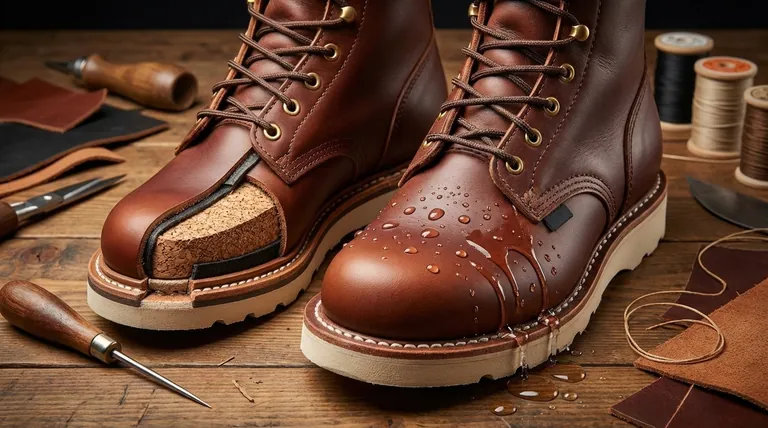
Deconstructing the Construction Methods
To understand why one is more water-resistant, we need to visualize how each method assembles the boot. The key area of concern is the junction where the upper (the main body of the boot) meets the sole.
How a Goodyear Welt Works
A Goodyear welt uses a strip of leather called the welt as a connector.
First, the upper is pulled down over a "last" (a foot-shaped mold) and attached to a canvas rib on the insole. The welt is then stitched through the upper and into this canvas rib.
Finally, the outsole is stitched to the bottom of the welt. This creates a strong, resoleable boot but leaves a small cavity and multiple stitch lines.
How Stitchdown Construction Works
Stitchdown construction eliminates the intermediary welt.
The leather of the upper is turned outward at the bottom, creating a flange that lays flat against the midsole.
This outwardly turned flange is then stitched directly down onto the midsole and outsole. This creates a simpler, more direct seal that naturally sheds water away from the seams.
Why Stitchdown Has the Edge in Water Resistance
The architectural differences lead to clear advantages for Stitchdown in wet environments.
The Outward Flange Advantage
The single most important factor is the outward-facing upper. In a Stitchdown boot, water running down the leather is directed over and away from the seam where the upper meets the sole.
In a Goodyear welt, the seam is more of a perpendicular junction, which can allow moisture to sit and potentially seep through the stitching over time.
Fewer Potential Points of Entry
Stitchdown construction typically involves fewer primary components at the base. By stitching the upper directly to the sole, it creates a more unified structure with fewer gaps for water to penetrate.
A Goodyear welt's cavity is often filled with cork, which is excellent for comfort but still represents a space where moisture could theoretically collect if the welt seam is compromised.
Understanding the Trade-offs
Choosing a boot is never about a single feature. While Stitchdown is often more water-resistant, the Goodyear welt remains a dominant construction method for good reason.
Resoling and Longevity
The primary benefit of a Goodyear welt is its ease of resoling. Because the outsole is stitched to the welt and not the upper, a cobbler can remove and replace the sole multiple times without affecting the boot's core structure. This can significantly extend the life of the footwear.
Resoling a Stitchdown boot is possible, but it is often more complex and may put more stress on the upper itself over repeated repairs.
Specialized Welt Variations
It's crucial to note that not all Goodyear welts are created equal. A Storm Welt (or "split-reverse" welt) is a specific type of Goodyear welt designed to enhance water resistance.
A Storm Welt is wider and has a raised "lip" that bends upward, creating a protective wall over the seam between the upper and the welt. This variation significantly closes the water resistance gap between Goodyear and Stitchdown construction.
Making the Right Choice for Your Goal
Your decision should be based on your primary use case and priorities for the footwear.
- If your primary focus is maximum water resistance for harsh, wet conditions: Stitchdown construction is often the more reliable choice out of the box.
- If your primary focus is long-term serviceability and ease of multiple resoles: A standard Goodyear welt provides a proven, durable platform that any skilled cobbler can repair.
- If you want a balance of water resistance and serviceability: Look for boots with a Storm Welt, which offers enhanced moisture protection while retaining the key benefits of the Goodyear welt method.
Ultimately, understanding the construction method empowers you to choose footwear that is truly engineered for its intended purpose.
Summary Table:
| Feature | Stitchdown Construction | Goodyear Welt (Standard) |
|---|---|---|
| Water Resistance | Superior - outward flange sheds water | Good - potential seam ingress |
| Resoleability | Complex, may stress upper | Excellent, industry standard |
| Best For | Harsh, wet conditions | Long-term serviceability |
| Key Variation | N/A | Storm Welt (enhanced water resistance) |
Need Boots Built for Your Environment?
As a large-scale manufacturer, 3515 produces a comprehensive range of footwear for distributors, brand owners, and bulk clients. Whether you need the superior water resistance of Stitchdown or the long-lasting, resoleable design of a Goodyear welt, we have the production capabilities to meet your exact specifications.
Contact our team today to discuss your project and get a quote.
Visual Guide
Related Products
- Durable Leather Work Boots Wholesale Manufacturer & Custom Factory
- Durable Rubber Sole Outdoor Shoes Wholesale & Custom Manufacturing
- Advanced KPU Athletic Safety Shoe with Steel Toe Cap Anti-Slip Rotary Lacing System
- Wholesale Durable Camouflage Canvas Shoes with High-Traction Cleated Rubber Sole
- Custom Safety Shoe Manufacturer for Wholesale & OEM Brands
People Also Ask
- What are the common workplace hazards that can be mitigated with the right work boots? Protect Your Workforce
- How can you ensure consistent comfort in work boots? Focus on Fit, Materials & Ergonomics
- What are the differences between Lace Up, Zip Sided, and Pull On work boots? Find Your Perfect Fit for Safety & Convenience
- How do subjective norms influence the marketing of work boots and tactical footwear? Leverage Social Identity for Sales
- Which brands are known for high-quality work boots? A Guide to Durable, Safe Footwear