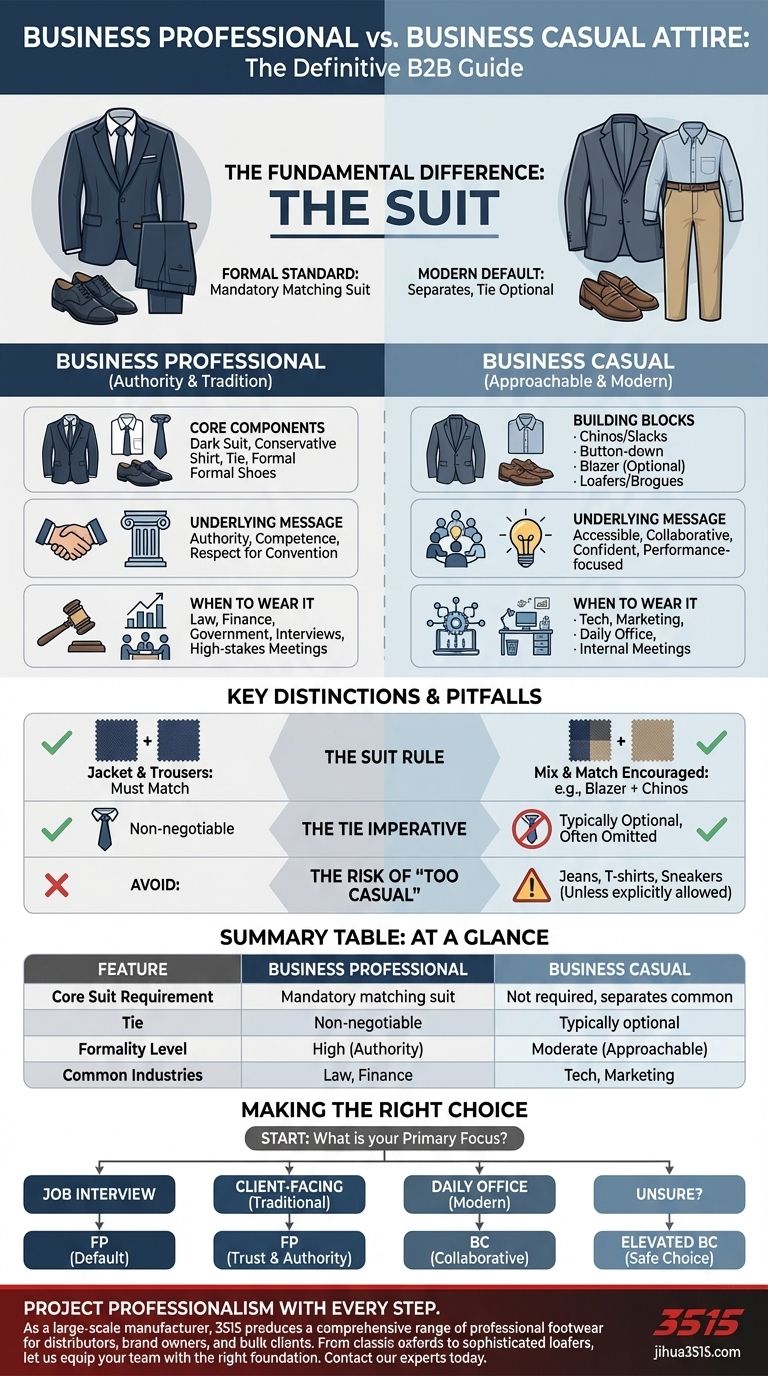
The fundamental difference between business casual and business professional is the requirement of a suit. Business professional is the most formal dress code, demanding a full matching suit, dress shirt, and tie. Business casual offers more flexibility, replacing the suit with dress pants or chinos and a button-down shirt, often without a tie.
Think of it this way: Business professional is a uniform designed to convey tradition and authority. Business casual is a wardrobe designed to balance professionalism with approachability and modern workplace culture.
Deconstructing Business Professional: The Formal Standard
Business professional attire is built on a foundation of tradition and respect. It is an unambiguous signal of seriousness, common in industries where client trust and gravitas are paramount.
The Core Components
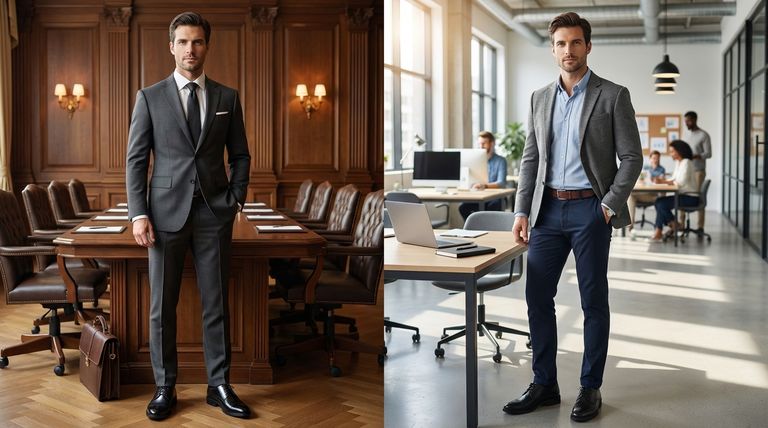
A business professional wardrobe is prescriptive. It almost always consists of a dark-colored suit (navy, charcoal, black), a conservative dress shirt (white or light blue), a tie, and formal dress shoes like leather oxfords.
The Underlying Message
This dress code communicates authority, competence, and a respect for established convention. It is designed to minimize distraction and place the focus squarely on the business at hand.
When to Wear It
Business professional is the expected standard in fields like high-finance, law, and government. It is also the safest and most appropriate choice for formal job interviews, board meetings, and critical client presentations.
Defining Business Casual: The Modern Default
Business casual has become the dominant dress code in most modern offices. It navigates the space between strict formality and weekend casual, aiming for a look that is polished yet comfortable.
The Building Blocks
The core of business casual is a pair of chinos or dress slacks paired with a collared button-down shirt. A sport coat or blazer can be added to elevate the look, but a tie is typically omitted. Footwear can range from loafers to brogues.
The Underlying Message
This style projects a professional who is accessible, collaborative, and confident. It suggests a work environment that values performance and creativity over rigid hierarchy.
When to Wear It
Business casual is ideal for daily office wear in a vast number of industries, from tech to marketing. It is also appropriate for internal meetings and less formal client interactions.
Key Distinctions and Common Pitfalls
Understanding the nuances prevents missteps that can send the wrong message. The primary risk is misjudging the context and appearing either disrespectful (underdressed) or out of touch (overdressed).
The Suit Rule
For business professional, the jacket and trousers must be a matching set made from the same fabric. For business casual, you are encouraged to mix and match items, such as a navy blazer with gray wool trousers or khaki chinos.
The Tie Imperative
A tie is a non-negotiable component of business professional attire. In a business casual setting, a tie is almost always optional and often best left off to avoid appearing overly formal for the environment.
The Risk of "Too Casual"
The most common mistake with business casual is leaning too far into the "casual" side. Jeans, t-shirts, polos, and sneakers are typically not appropriate unless the company culture explicitly allows them. Always err on the side of being slightly more dressed up.
Making the Right Choice for Your Goal
Your attire is a form of professional communication. Use this framework to ensure you are always sending the right message.
- If your primary focus is a job interview: Default to business professional unless you are explicitly told otherwise, as it shows you are taking the opportunity seriously.
- If your primary focus is a client-facing role in a traditional industry: Business professional is the standard for building trust and projecting authority.
- If your primary focus is daily office work in a modern company: Business casual is the appropriate choice to align with a collaborative and less formal culture.
- If you are ever unsure of the dress code: Choose an elevated business casual look (dress slacks, a blazer, and a crisp dress shirt) as it's easier to remove a blazer than to conjure one up.
Ultimately, dressing appropriately is about showing respect for the situation, your colleagues, and yourself.
Summary Table:
| Feature | Business Professional | Business Casual |
|---|---|---|
| Core Suit Requirement | Mandatory matching suit | Not required; separates are common |
| Tie | Non-negotiable | Typically optional |
| Formality Level | High (Authority, Tradition) | Moderate (Approachable, Modern) |
| Common Industries | Law, Finance, Government | Tech, Marketing, General Office |
Project Professionalism with Every Step
As a large-scale manufacturer, 3515 produces a comprehensive range of professional footwear for distributors, brand owners, and bulk clients. Our production capabilities encompass all types of formal shoes and boots, from classic leather oxfords for a business professional look to sophisticated loafers perfect for business casual attire.
Let us help you equip your customers or team with the right foundation for any dress code. Contact our experts today to discuss your footwear needs and discover how we can support your business.
Visual Guide