
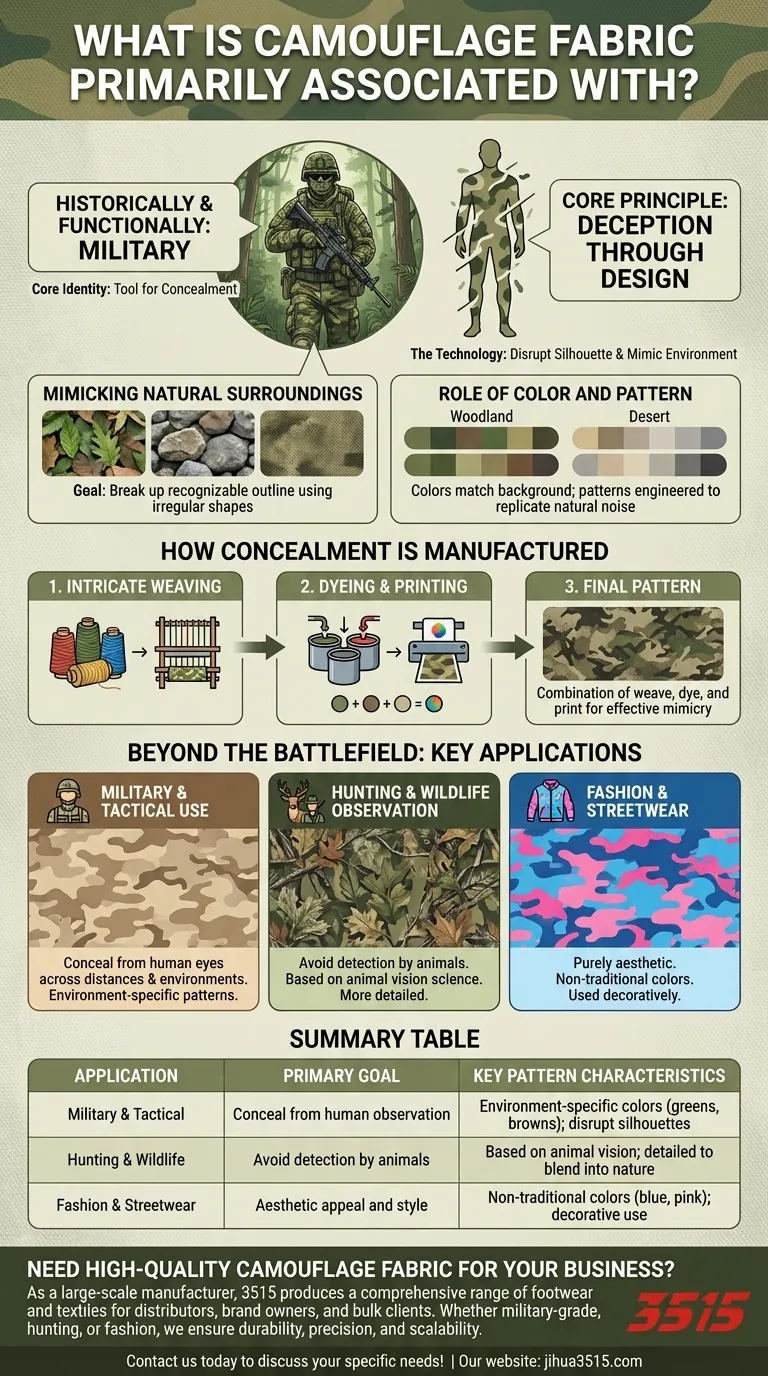
Historically and functionally, camouflage fabric is overwhelmingly associated with the military. Its core identity is rooted in its use as a tool for concealment, employing globally recognized patterns designed to help personnel and equipment blend seamlessly into their operational environment.
While its military connection is undeniable, the true purpose of camouflage fabric is technological: to disrupt the human silhouette and mimic the colors and textures of a specific environment. The choice of pattern is never arbitrary; it is always dictated by the intended function, whether for tactical concealment, hunting, or fashion.
The Core Principle: Deception Through Design
The effectiveness of any camouflage pattern rests on its ability to deceive the eye. It is a calculated application of visual disruption principles applied to a textile.
Mimicking Natural Surroundings
The primary goal of camouflage is to break up the recognizable outline of a person or object. The human brain is exceptionally good at identifying silhouettes, so patterns with irregular shapes and splotches disrupt these lines, making the form harder to spot.
The Role of Color and Pattern
Colors are chosen to match the background environment. A woodland pattern will use a palette of greens and browns, while a desert pattern will use tans and grays. The specific shapes and their arrangement are engineered to replicate the "noise" of a natural setting, like the interplay of light and shadow on leaves or rocks.
How Concealment is Manufactured
Creating effective camouflage fabric is a precise process that goes beyond simply printing a pattern. It involves a combination of weaving and dyeing techniques to achieve the desired effect.
Intricate Weaving and Dyeing
The process begins by weaving colored threads together to create a base fabric. This is followed by intricate dyeing and printing processes where specific color combinations and patterns are applied.
Engineering the Final Pattern
The final pattern is not just an artistic choice but a technical one. The combination of the base weave, the dyed colors, and the printed shapes work together to create a material that effectively mimics its intended surroundings.
Beyond the Battlefield: Key Applications
While the military is its most prominent user, the function of camouflage has been adapted for several other distinct purposes. The design of the pattern changes significantly depending on the goal.
Military and Tactical Use
This is the most common association. Military patterns are designed to provide concealment from human eyes across a wide range of distances and environments.
Hunting and Wildlife Observation
Hunters use camouflage to avoid being detected by animals. These patterns are often more detailed and based on scientific studies of animal vision, which can perceive color and contrast differently than humans.
Fashion and Streetwear
In fashion, camouflage is purely an aesthetic. The pattern is removed from its functional context and used for its visual appeal, often appearing in non-traditional colors like blue, red, or pink.
Making the Right Choice for Your Goal
Selecting the right camouflage is entirely dependent on your objective.
- If your primary focus is military or tactical simulation: Select a pattern specifically designed for the environment you'll be operating in, such as woodland, desert, or urban.
- If your primary focus is hunting: Choose patterns scientifically engineered to deceive animal vision, as these often outperform standard military patterns for this purpose.
- If your primary focus is fashion: The choice is entirely aesthetic, allowing you to select any pattern or color variation that suits your personal style.
Ultimately, camouflage fabric is a powerful example of how textile technology can be engineered to manipulate visual perception.
Summary Table:
| Application | Primary Goal | Key Pattern Characteristics |
|---|---|---|
| Military & Tactical | Conceal personnel and equipment from human observation | Environment-specific colors (e.g., greens, browns, tans); designed to disrupt silhouettes at various distances |
| Hunting & Wildlife | Avoid detection by animals | Patterns based on animal vision science; often more detailed to blend into natural settings |
| Fashion & Streetwear | Aesthetic appeal and style | Non-traditional colors (e.g., blue, pink); pattern used decoratively rather than functionally |
Need high-quality camouflage fabric for your business?
As a large-scale manufacturer, 3515 produces a comprehensive range of footwear and textiles for distributors, brand owners, and bulk clients. Whether you require authentic military-grade patterns for tactical gear, specialized designs for hunting apparel, or custom fashion prints, our production capabilities ensure durability, precision, and scalability.
Contact us today to discuss your specific needs and leverage our expertise in functional and aesthetic fabric solutions!
Visual Guide
Related Products
- Wholesale High-Traction Camo Boots - Custom Manufacturer for Brands
- Wholesale Durable Camouflage Canvas Shoes with High-Traction Cleated Rubber Sole
- Wholesale Durable Camo Canvas Shoes with High-Traction Rubber Soles
- High-Traction Suede Tactical Boots Wholesale & Custom Manufacturing
People Also Ask
- What are the key features of the new line of camo boots? Built for Extreme Cold & Rugged Terrain
- Are camo boots necessary for hunting success? Prioritize Performance Over Pattern
- How does the Rank Score Test identify the primary causes of premature failure in tactical and work boots? Key Insights
- What is the technical logic behind using closed-eye testing for tactical boots? Unlocking Peak Footwear Stability
- What shoes to wear for a security job? Durable, Protective Footwear for Long Shifts



