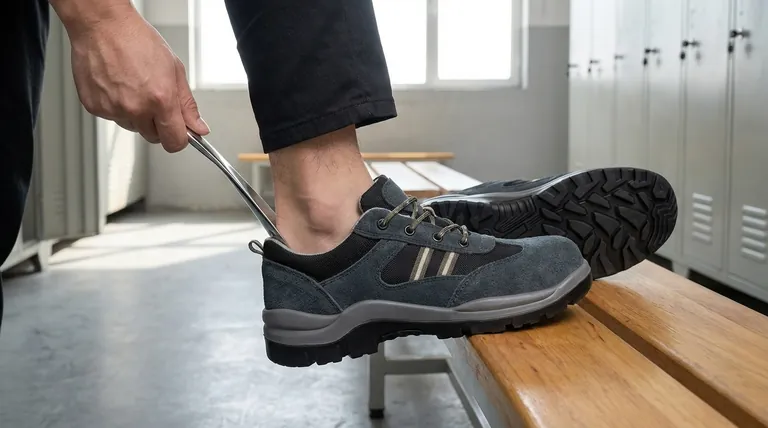
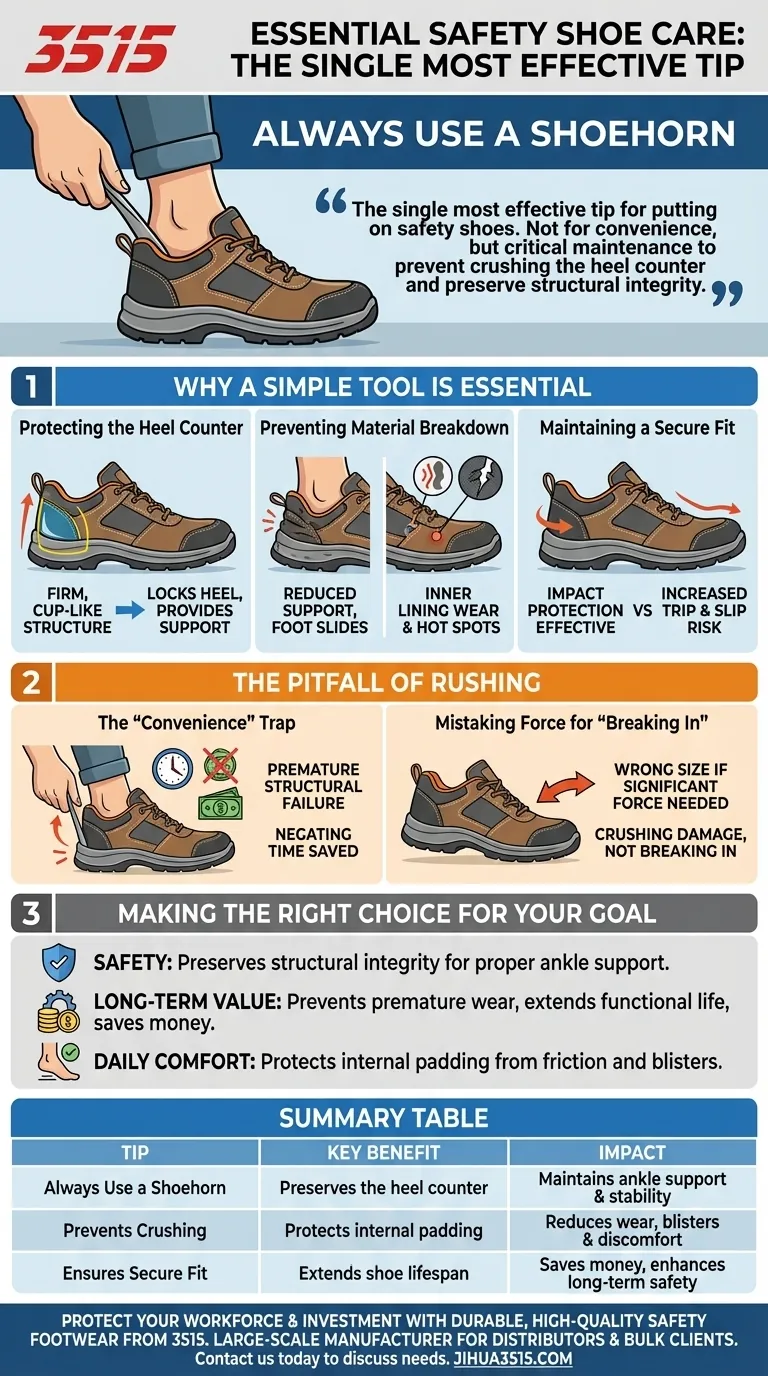
The single most effective tip for putting on safety shoes is to always use a shoehorn. This simple tool is not about convenience; it is a critical piece of maintenance that prevents the crushing of the shoe's heel counter, preserving the structural integrity and protective features of your footwear.
While it may seem like a minor detail, using a shoehorn is the most important habit you can adopt to protect the structural support, fit, and lifespan of your safety shoes. Forcing your foot in compromises the very features designed to keep you safe.
Why a Simple Tool is Essential for Safety Footwear
The rigid structure of a safety shoe is its most important feature. Unlike casual footwear, every component is engineered for protection. The common act of forcing your foot into the shoe actively works against this engineering.
Protecting the Heel Counter
The heel counter is the firm, cup-like component built into the back of the shoe. Its purpose is to lock your heel in place, providing critical ankle support and stability.
When you repeatedly crush this area with your foot, you permanently damage it. The counter softens and deforms, significantly reducing its ability to support your ankle and prevent your foot from sliding inside the shoe.
Preventing Material Breakdown
Forcing your foot in also creates immense friction and stress on the shoe's inner lining and padding. This repeated strain wears down the materials, leading to rips and compressed padding.
This interior damage not only makes the shoe uncomfortable but can also lead to painful blisters and hot spots as your heel rubs against uneven, worn-out surfaces.
Maintaining a Secure Fit
The primary function of a safety shoe is to protect you from impact, compression, and punctures. This protection is only effective if the shoe fits securely.
A damaged heel counter results in a loose, improper fit. This looseness can become a safety hazard in itself, increasing the risk of trips, slips, or the foot shifting dangerously during an impact.
The Pitfall of Rushing
In demanding work environments, speed often feels like a necessity. However, taking a few extra seconds to put on your shoes correctly is an investment in both your safety and your finances.
The "Convenience" Trap
Forcing your foot into a shoe is a habit born from a desire for speed. This short-term convenience leads directly to long-term costs.
You will find yourself replacing expensive safety footwear far more often due to premature structural failure, negating any time saved. More importantly, you will be working in compromised equipment that may not perform as expected in an accident.
Mistaking Force for "Breaking In"
A new pair of safety shoes should fit snugly but comfortably from the start. If you have to exert significant force to get your foot inside, the shoe is likely the wrong size or shape for your foot.
Attempting to "break in" a shoe by crushing the heel will only damage it. Always prioritize getting a professional fitting, as recommended by safety experts, to ensure you start with the correct size.
Making the Right Choice for Your Goal
Integrating a shoehorn into your daily routine is a simple discipline with significant benefits. How you frame this habit depends on your primary concern.
- If your primary focus is safety: Using a shoehorn preserves the heel's structural integrity, which is non-negotiable for proper ankle support and stability on the job.
- If your primary focus is long-term value: This simple habit prevents premature wear and tear, directly extending the functional life of your footwear and saving you money.
- If your primary focus is daily comfort: Protecting the heel's internal padding with a shoehorn prevents the friction, blisters, and general discomfort caused by damaged materials.
Ultimately, treating your safety shoes with care is fundamental to ensuring they can protect you effectively throughout their intended lifespan.
Summary Table:
| Tip | Key Benefit | Impact |
|---|---|---|
| Always Use a Shoehorn | Preserves the heel counter | Maintains ankle support and stability |
| Prevents Crushing | Protects internal padding | Reduces wear, blisters, and discomfort |
| Ensures Secure Fit | Extends shoe lifespan | Saves money and enhances long-term safety |
Protect your workforce and your investment with durable, high-quality safety footwear from 3515. As a large-scale manufacturer, we produce a comprehensive range of safety shoes and boots for distributors, brand owners, and bulk clients. Our production capabilities ensure you receive footwear engineered for maximum protection and longevity. Contact us today to discuss your safety footwear needs and discover the 3515 difference.
Visual Guide
Related Products
- Premium Suede Sport Safety Shoes for Wholesale & Bulk Orders
- Premium Lightweight Safety Shoes for Wholesale & Bulk Orders
- Wholesale Anti-Smash & Puncture-Proof Safety Shoes Custom Manufacturing for Brands
- Premium KPU Injection Athletic Style Safety Shoes
- Premium Safety Shoes with Rotating Buckle Safety Sneakers
People Also Ask
- What industries have specific OSHA footwear requirements? Ensure Compliance & Protect Your Workforce
- What are the primary functions of professional safety shoes? Maximize Safety in Water Supply Confined Spaces
- What role do specialized safety shoes play in preventing falls? Engineering Stability in Industrial Environments
- How do complex outsole tread designs in safety shoes work with coated floors? Master Slip Resistance Engineering
- How does professional industrial cleaning equipment maintain the performance stability of safety shoes? Pro Maintenance