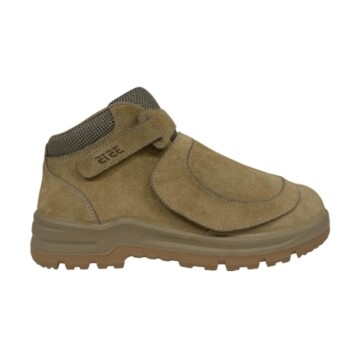
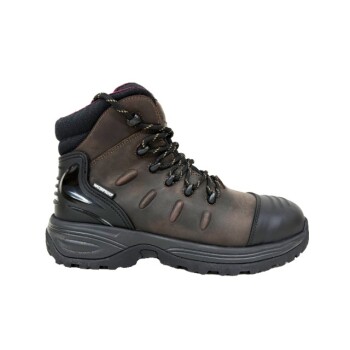
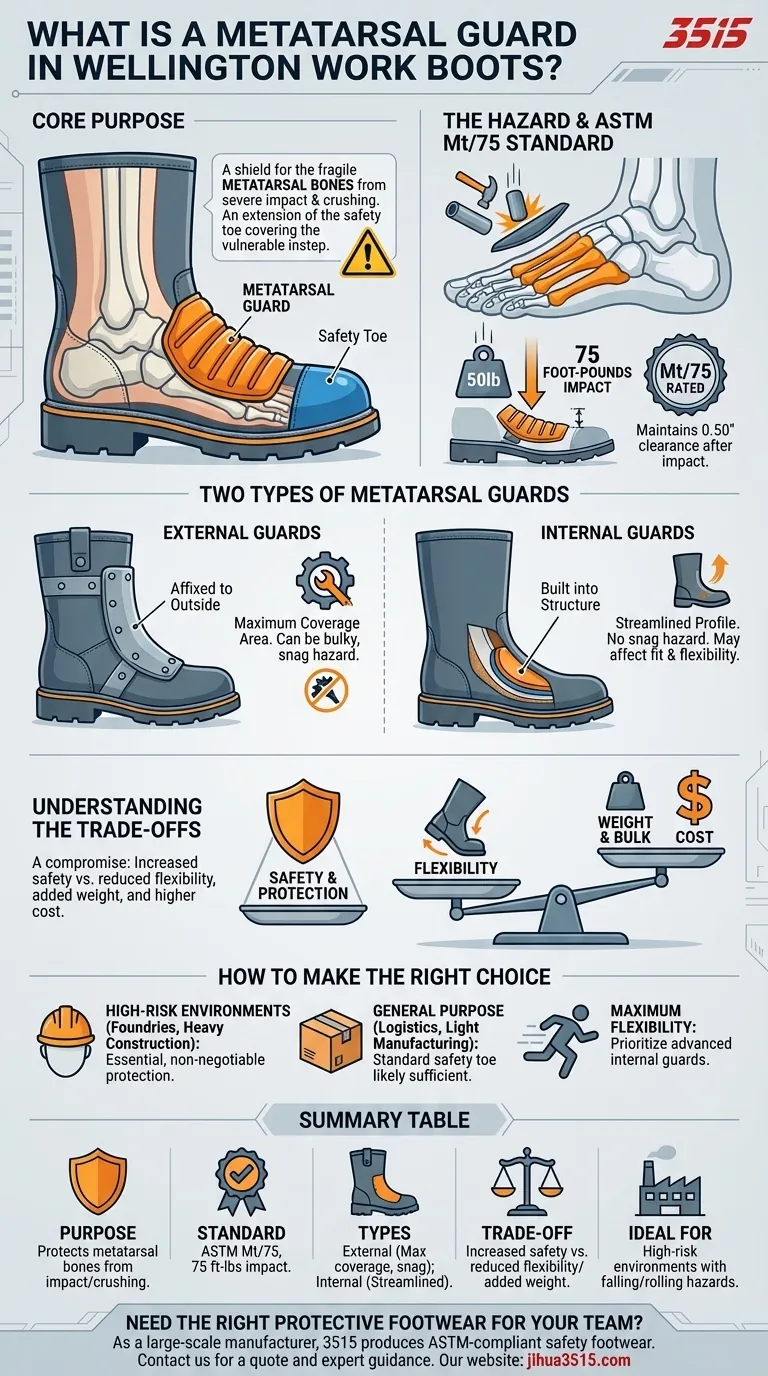
At its core, a metatarsal guard in a Wellington work boot is a shield designed to protect the top of your foot—specifically the long, delicate metatarsal bones—from severe impact and crushing injuries. It is an extension of the safety toe cap, providing a zone of protection that covers the instep area, which is left vulnerable by a standard steel or composite toe.
A metatarsal guard is a critical safety feature for any job with a significant risk of falling or rolling objects. While a standard safety toe protects your toes, the metatarsal guard shields the rest of your foot, but this added protection involves a direct trade-off with the boot's flexibility, weight, and cost.
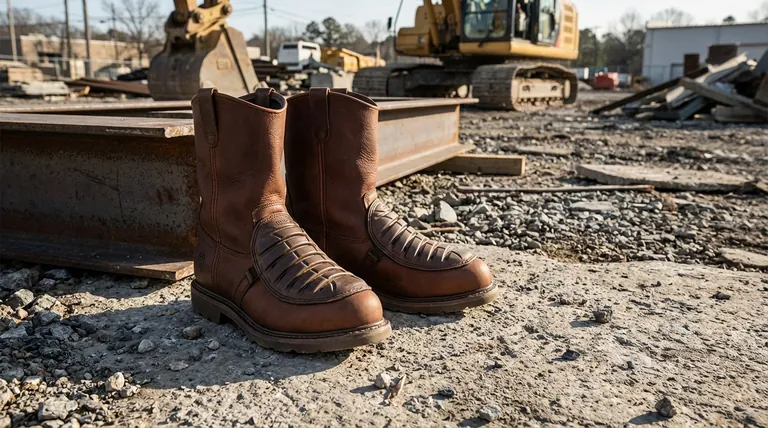
How Metatarsal Guards Provide Critical Protection
To decide if you need this feature, you must first understand the specific hazard it is engineered to prevent. It goes far beyond the capabilities of a standard safety toe.
Beyond the Safety Toe
A safety toe cap, whether steel or composite, only protects the very end of your foot. It leaves the five long metatarsal bones that connect your toes to your ankle completely exposed.
These bones are fragile and can be easily fractured by a direct impact from a falling tool, a rolling pipe, or a compression accident.
The Anatomy of the Hazard
Metatarsal guards are designed for high-risk environments where objects can fall or be dropped. This includes foundries, construction sites with heavy materials, logging operations, and any work involving heavy machinery.
The guard deflects the energy from a direct blow, distributing the force away from the delicate bone structure of your instep.
Understanding the Safety Standard (ASTM Mt/75)
Legitimate metatarsal guards are rated according to an industry standard, typically marked as Mt/75. This is a crucial indicator of its protective capability.
The Mt/75 rating certifies that the guard can withstand an impact of 75 foot-pounds.
During the test, a 50-pound weight is dropped from a specified height onto the guard. The guard passes if it maintains a minimum clearance of a half-inch (0.50") after impact, ensuring your foot is not crushed. This standardized test provides a reliable measure of protection.
The Two Types of Metatarsal Guards
Metatarsal protection is typically integrated into a boot in one of two ways, each with its own set of characteristics.
External Guards
As the name implies, an external metatarsal guard is a shield affixed to the outside of the Wellington boot. It sits on top of the boot's upper material.
These are often seen as providing the maximum possible coverage area. However, their external placement can make them prone to snagging on workplace debris and they can feel bulky.
Internal Guards
An internal metatarsal guard is built directly into the boot's structure, sitting between the outer material and the inner lining.
This design offers a more streamlined profile with no snag hazard. While modern internal guards made from advanced materials offer excellent protection, some users find they can affect the boot's overall fit and flexibility more than external designs.
Understanding the Trade-offs
Adding armor to any piece of equipment involves compromise. A boot with a metatarsal guard is no different.
Safety vs. Flexibility
The primary trade-off is protection versus comfort. The rigid guard inherently reduces the boot's ability to flex at the instep.
This can make tasks that require squatting, kneeling, or climbing ladders feel more restrictive and less comfortable over a long day.
Added Weight and Bulk
Adding a protective plate of steel, aluminum, or composite material inevitably increases the boot's weight. While often a minor increase, this extra weight can contribute to foot fatigue over an 8- to 12-hour shift.
Cost and Availability
Boots engineered with certified metatarsal guards require more materials and a more complex manufacturing process. Consequently, they are typically positioned at a higher price point than standard safety toe boots.
How to Make the Right Choice
Your specific work environment and daily tasks are the only factors that matter when selecting your level of foot protection.
- If your primary focus is working in high-risk environments like foundries, heavy construction, or welding: A metatarsal guard is essential, non-negotiable protection and likely a workplace requirement.
- If your primary focus is general-purpose work with minimal drop hazards, such as in logistics, light manufacturing, or agriculture: A standard safety toe is likely sufficient, allowing you to prioritize comfort and lower weight.
- If your primary focus is maximum flexibility for dynamic movement: You should specifically look for boots with internal guards made from advanced, flexible composite materials, as traditional external guards may be too restrictive.
Choosing the right boot is about accurately matching the tool to the task, ensuring your PPE provides precisely the protection you need without hindering your work.
Summary Table:
| Feature | Description |
|---|---|
| Purpose | Protects the metatarsal bones on the top of the foot from impact and crushing injuries. |
| Protection Standard | ASTM Mt/75 rating, withstands an impact of 75 foot-pounds. |
| Types | External Guard: Maximum coverage, potential snag hazard. Internal Guard: Streamlined profile, integrated into boot structure. |
| Key Trade-off | Increased safety vs. reduced flexibility and added weight. |
| Ideal For | High-risk environments like construction, foundries, and logging with falling/rolling object hazards. |
Need the right protective footwear for your team?
As a large-scale manufacturer, 3515 produces a comprehensive range of safety footwear, including Wellington boots with certified metatarsal guards, for distributors, brand owners, and bulk clients. Our production capabilities ensure you get durable, ASTM-compliant boots tailored to your specific workplace hazards.
Contact us today for a quote and expert guidance on selecting the optimal safety boots for your needs.
Visual Guide
Related Products
- Premium Suede Metatarsal Guard Safety Boots Work Shoes
- Premium Grain Leather Safety Boots for Bulk Supply
- Durable Leather Work Boots for Wholesale & Custom Manufacturing
- Durable Moc-Toe Wedge Work Boots | Wholesale Manufacturing for Brands
- Durable Goodyear Welt Leather Work Boots for Wholesale & Private Label
People Also Ask
- How does metatarsal protection in safety footwear work? The Essential Guide to Foot Safety
- What is a metatarsal guard in safety boots? Essential Protection for Your Entire Foot
- How do metatarsal guards enhance work shoe safety? Prevent Crushing Foot Injuries on the Job
- What does the 'MT' in ASTM F2413-18 stand for? Essential Metatarsal Protection Explained
- What is metatarsal protection in safety boots? Essential Defense for Top-of-Foot Hazards