
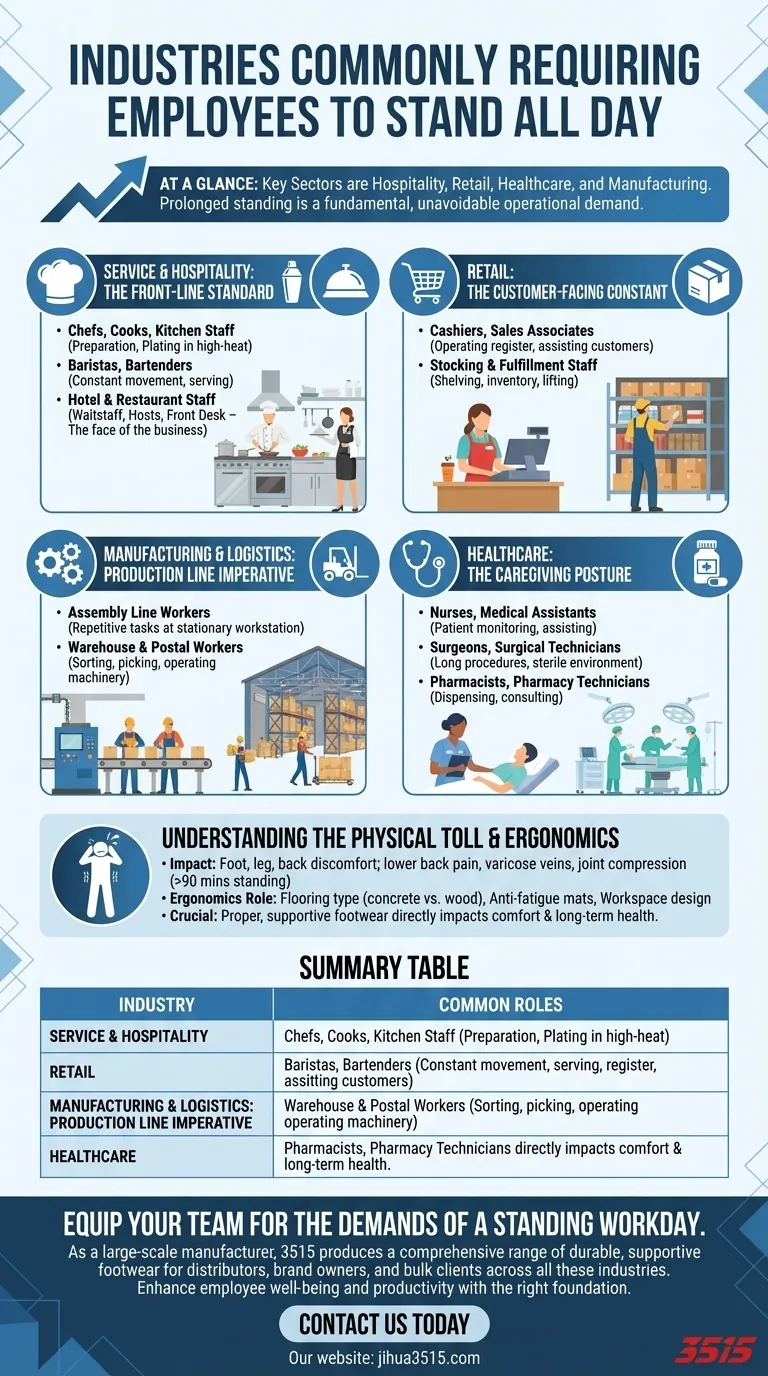
At a glance, the industries that most commonly require employees to stand all day are hospitality, retail, healthcare, and manufacturing. These sectors are built around direct service, production, or patient care, making prolonged standing a fundamental and often unavoidable part of the job.
The need for prolonged standing is not a niche requirement but a core operational demand across a vast and diverse range of essential, front-line industries that power our economy and daily lives.
Service and Hospitality: The Front-Line Standard
Jobs in the service and hospitality sectors are almost entirely performed on foot. The nature of customer interaction and food/beverage preparation makes constant movement and standing a necessity.
Chefs, Cooks, and Kitchen Staff
From preparation to plating, kitchen work requires staff to be on their feet for entire shifts, often in high-temperature, fast-paced environments.
Baristas and Bartenders
These roles involve constant movement behind a counter, serving customers, mixing drinks, and managing inventory, leaving virtually no time for sitting.
Hotel and Restaurant Staff
Waitstaff, hosts, and hotel front desk agents are the face of the business. Their roles are active, involving seating guests, taking orders, and ensuring a positive customer experience, all while standing.
Retail: The Customer-Facing Constant
The retail environment is designed around customer accessibility and product visibility, which means employees are typically required to be standing and available on the sales floor.
Cashiers and Sales Associates
Whether operating a register or assisting customers throughout the store, these employees spend the vast majority of their shifts standing in one place or walking the aisles.
Stocking and Fulfillment Staff
Behind the scenes, employees who stock shelves, manage inventory, or fulfill online orders from a retail location are constantly on their feet, lifting and moving products.
Manufacturing and Logistics: The Production Line Imperative
In manufacturing, warehouse, and logistics settings, the workflow is built around assembly lines and the movement of goods, making standing the default posture for most operational roles.
Assembly Line Workers
These individuals perform repetitive tasks at a stationary workstation, requiring them to stand for hours to maintain efficiency and reach.
Warehouse and Postal Workers
Sorting packages, picking orders, and operating machinery within a large warehouse facility necessitates continuous standing and walking on hard concrete floors.
Healthcare: The Caregiving Posture
Providing direct patient care is an active, mobile job. Healthcare professionals across many disciplines spend nearly their entire workday on their feet, moving between patients and treatment rooms.
Nurses and Medical Assistants
The core of nursing involves patient monitoring, administering medication, and assisting with daily needs, all of which require constant movement and standing.
Surgeons and Surgical Technicians
Surgical procedures can last for many hours, requiring the entire surgical team to stand with intense focus in a sterile operating room.
Pharmacists and Pharmacy Technicians
These roles involve dispensing medication and consulting with patients, which is primarily done while standing behind a counter to access inventory and computer systems.
Understanding the Physical Toll
Prolonged standing is not just a matter of comfort; it's a significant ergonomic challenge with real health implications that both employees and employers must address.
The Impact on the Body
Standing for more than 90 minutes at a time can lead to discomfort in the feet, legs, and back. Over long periods, it can contribute to issues like lower back pain, varicose veins, and joint compression.
The Role of Ergonomics
The work environment plays a critical role. Factors like the type of flooring (e.g., concrete vs. wood), the availability of anti-fatigue mats, and the design of the workspace can either worsen or mitigate the physical strain.
The Importance of Proper Footwear
Supportive, well-fitting footwear is arguably the most critical piece of equipment for any employee in a standing-intensive role. It directly impacts comfort, posture, and long-term health.
Key Considerations Based on Your Goal
- If you are a prospective employee: Be aware of the physical demands and invest in high-quality, supportive footwear before you start the job.
- If you are an employer or manager: Prioritize employee well-being by providing anti-fatigue mats and allowing for regular, short breaks to sit and rest.
- If you are a safety or HR professional: Implement ergonomic assessments to identify and mitigate risks associated with prolonged static postures in your workplace.
Understanding which roles require standing is the first step toward creating safer and more sustainable work environments for everyone.
Summary Table:
| Industry | Common Roles Requiring Prolonged Standing |
|---|---|
| Hospitality | Chefs, Bartenders, Waitstaff, Hotel Staff |
| Retail | Cashiers, Sales Associates, Stocking Staff |
| Manufacturing/Logistics | Assembly Line Workers, Warehouse Staff |
| Healthcare | Nurses, Surgeons, Pharmacy Technicians |
Equip your team for the demands of a standing workday. As a large-scale manufacturer, 3515 produces a comprehensive range of durable, supportive footwear for distributors, brand owners, and bulk clients across all these industries. Our production capabilities encompass all types of safety shoes and boots designed for comfort during long shifts. Enhance employee well-being and productivity with the right foundation—contact us today to discuss your footwear needs!
Visual Guide
Related Products
- Wholesale Comfortable Business Casual Shoes Custom Manufacturing
- Durable Canvas Work Shoes with Rubber Lug Sole | Wholesale Manufacturer
- Durable Leather Moc Toe Work Boots for Wholesale & Custom Manufacturing
- Durable Goodyear Welt Leather Work Boots for Wholesale & Private Label
- Durable Rubber-Soled Utility Shoes for Wholesale & Custom Brand Manufacturing
People Also Ask
- What are the key characteristics of business casual shoes? Achieve Polished Versatility for Your Wardrobe
- Which types of shoes should be avoided with business casual attire? Maintain a Polished Professional Image
- What should be considered when selecting shoes for a casual business setting? Achieve the Perfect Balance of Style and Comfort
- What is the recommended approach to trying on business casual shoes? Ensure a Perfect Fit for Your Workday
- What are some types of business casual shoes? Build a Versatile & Professional Footwear Wardrobe



















