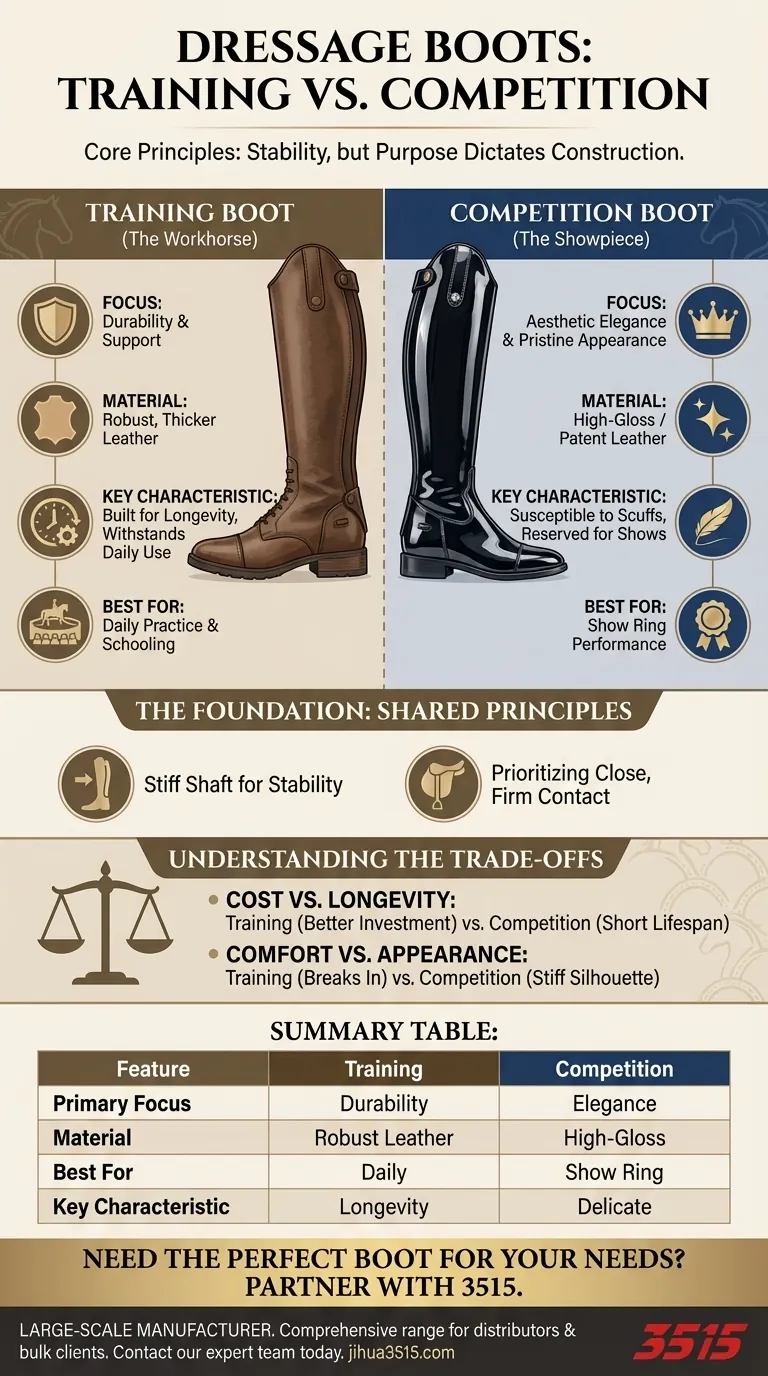
At their core, dressage training boots are engineered for durability and support, while competition boots prioritize aesthetic elegance and a pristine appearance for the show ring. Though built on the same principles of rider stability, their intended use dictates their final construction and material choices.
The fundamental difference isn't in the core design, which always emphasizes stability, but in the purpose. Training boots are the durable workhorse for daily practice, while competition boots are the polished showpiece reserved for performance.
The Foundation: Shared Principles of Dressage Boots
Before examining the differences, it's crucial to understand what unites both boot types. The unique demands of dressage dictate a specific, non-negotiable boot structure.
The Stiff Shaft for Stability
Both training and competition boots feature a very firm, reinforced outer shaft. This stiffness minimizes flexion in the rider's ankle, promoting a longer, quieter leg position essential for clear communication with the horse.
Prioritizing Close and Firm Contact
The hard leather construction is not just for stability. It creates a firm surface for the rider's leg against the saddle and horse, allowing for subtle, precise aids to be transmitted effectively.
Designed for Daily Work: The Training Boot
A training boot is a tool built to withstand the rigors of daily schooling. Its features are chosen for longevity and function over flash.
Focus on Durability
These boots are constructed with robust, often thicker leather that can handle consistent use, sweat, and frequent cleaning. Seams may be reinforced to prevent wear and tear from constant friction.
Emphasis on Support
While still stiff, training boots often incorporate features for rider comfort during long hours in the saddle. This might include more supportive footbeds or a slightly more forgiving fit to accommodate daily wear.
Built for Presentation: The Competition Boot
Competition boots are designed to complete the elegant picture of horse and rider in the show ring. Their value is in their visual perfection.
The Role of Aesthetics
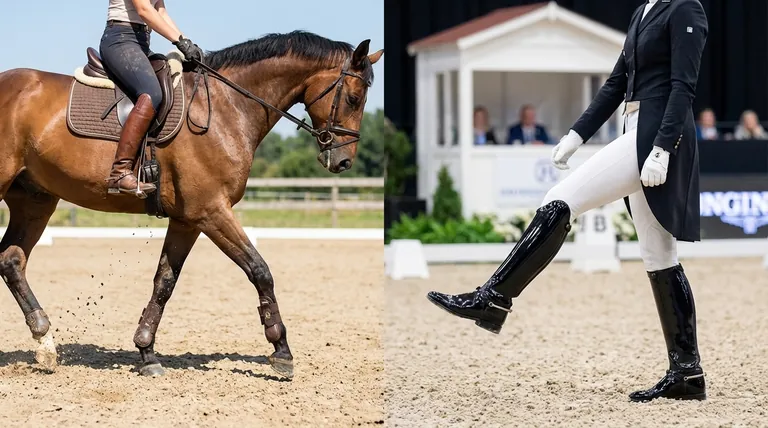
This is where the most obvious differences appear. Competition boots often feature a high-gloss or patent leather finish, decorative trim, crystal embellishments, or a more dramatic "Spanish top" cut for a visually elongated leg.
A Pristine, Delicate Finish
The shiny finish that makes these boots stand out is also their weakness. It is highly susceptible to scuffs, scratches, and dulling, which is why they are preserved exclusively for shows and not used for daily training.
Understanding the Trade-offs
Choosing between boot types—or deciding if you need both—involves balancing practicality with presentation.
Cost vs. Longevity
Using expensive, polished competition boots for daily training will drastically shorten their lifespan and ruin their appearance. A sturdy pair of training boots is a better long-term investment for schooling.
Comfort vs. Appearance
Many riders keep their competition boots exceptionally stiff to maintain a perfect silhouette. Training boots, through daily use, will naturally break in and often become more comfortable for extended periods.
Making the Right Choice for Your Goal
Selecting the appropriate boot is about matching the equipment to the specific demand of training or competing.
- If your primary focus is daily training and durability: Choose a dedicated schooling boot made from sturdy, non-patent leather designed to withstand hard work.
- If your primary focus is peak appearance in the show ring: Invest in a separate pair of high-shine competition boots and reserve them only for shows.
- If you can only have one pair for now: Select a boot with a classic, clean design in high-quality traditional leather that offers durability for training but can be polished to a high shine for a competition.
Ultimately, understanding this distinction allows you to invest wisely, protecting your equipment while ensuring you have the right tool for both practice and performance.
Summary Table:
| Feature | Training Boot | Competition Boot |
|---|---|---|
| Primary Focus | Durability & Support | Aesthetic Elegance |
| Material | Robust, Thicker Leather | High-Gloss/Patent Leather |
| Best For | Daily Practice & Schooling | Show Ring Performance |
| Key Characteristic | Built for Longevity | Susceptible to Scuffs |
Need the Perfect Boot for Your Needs? Partner with 3515.
As a large-scale manufacturer, 3515 produces a comprehensive range of equestrian footwear for distributors, brand owners, and bulk clients. Whether you require durable boots built for daily training or elegant boots designed for the show ring, our production capabilities cover all types of equestrian footwear.
Let us help you provide the right tool for every rider's goal. Contact our expert team today to discuss your specific requirements.
Visual Guide
Related Products
- Wholesale Comfort Dress Shoes with Dial Closure for Custom Manufacturing
- Classic Leather Derby Dress Shoes Wholesale & Custom Manufacturing
- Wholesale Perforated Comfort Dress Shoes | Custom Derby Shoe Manufacturer
- Wholesale Patent Oxford Dress Shoes | Custom & Bulk Manufacturing
- Wholesale Breathable Perforated Leather Derby Dress Shoes for Custom Brands
People Also Ask
- How do comfort dress shoes differ from traditional dress shoes? Discover the Ergonomic Advantage
- Which dress shoe styles are suitable for wearing with jeans? A Guide to Smart-Casual Style
- What features make dress shoes suitable for standing all day? Achieve All-Day Comfort with Anatomical Design
- What are the benefits of resoling dress shoes? Extend Life & Boost Comfort
- What recent trends have influenced traditional dress shoe designs? The Shift to Modern Comfort