
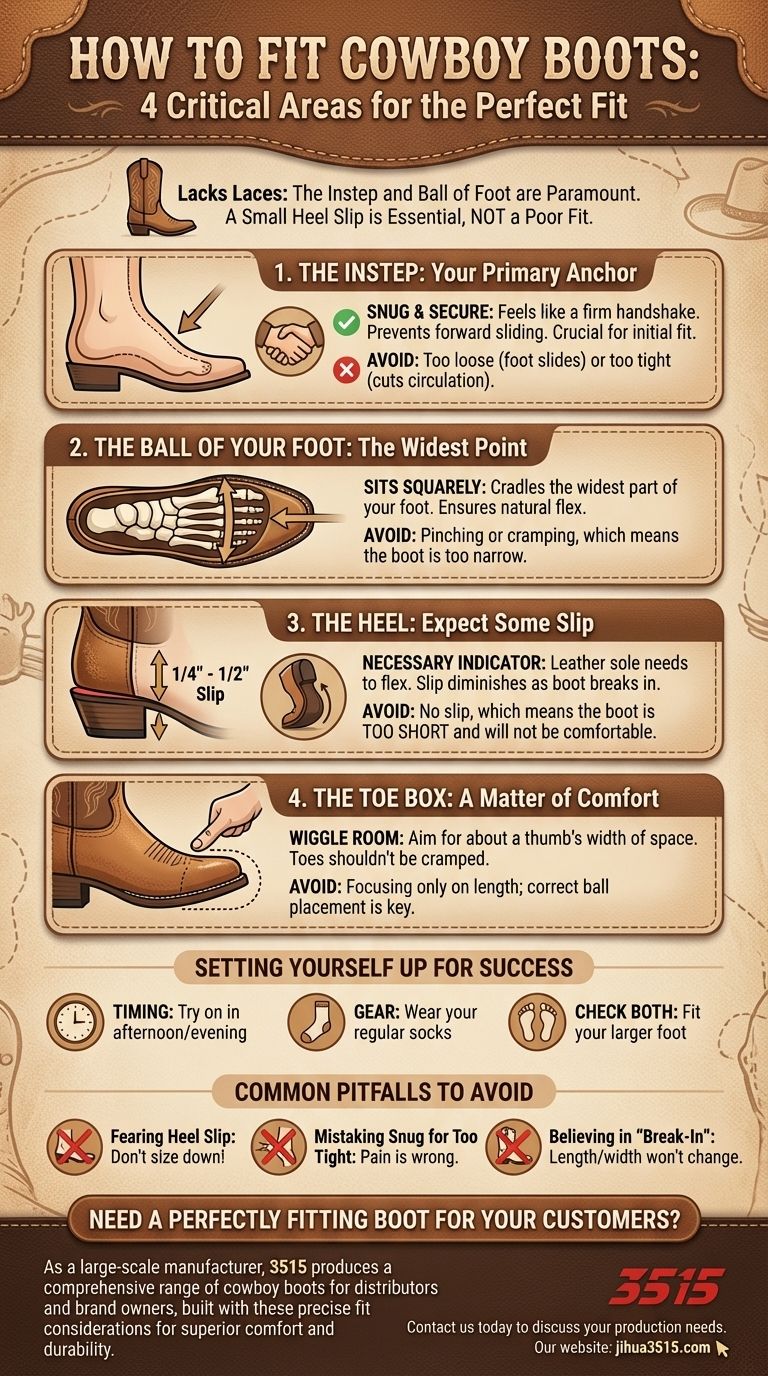
To ensure a proper fit when trying on cowboy boots, you must focus on four critical areas: a snug fit over the instep, the correct placement of the ball of your foot, a slight amount of heel slip, and adequate room in the toe box. The most counterintuitive but crucial element is the heel slip; a new boot should lift slightly off your heel when you walk, as this indicates the sole has not yet broken in.
The central challenge in fitting a cowboy boot is that it lacks laces, making the fit over the instep and at the ball of the foot paramount. Unlike other shoes, a small amount of heel slip is not a sign of a poor fit, but rather a necessary indicator that the boot is the correct size before the sole has developed its flex point.
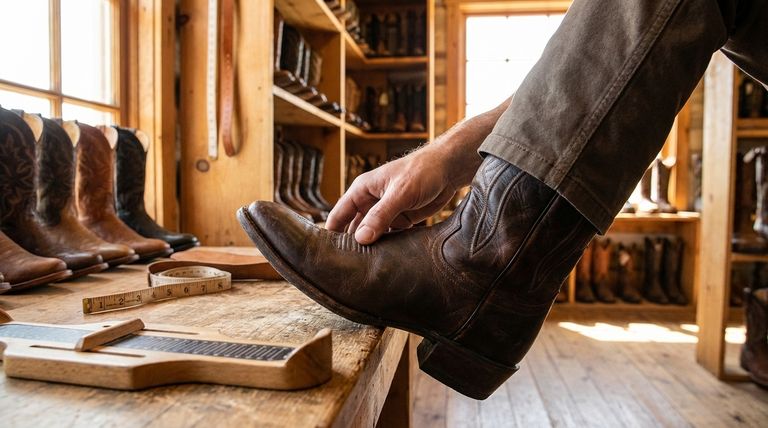
The Anatomy of a Perfect Cowboy Boot Fit
A great fit isn't about a single measurement; it's about how several key areas of the boot interact with your foot's unique shape.
The Instep: Your Primary Anchor
Because there are no laces, the instep is what secures the boot to your foot. It should feel snug and secure, like a firm handshake across the top of your foot.
If the instep is too loose, your foot will slide forward, and if it's too tight, it can cut off circulation. This is the most important area for initial fit.
The Ball of Your Foot: The Widest Point
The ball of your foot—its widest part—should sit squarely in the widest part of the boot. This ensures the boot will flex where your foot naturally bends.
You should feel the boot cradling this part of your foot without pinching or cramping it.
The Heel: Expect Some Slip
This is the most misunderstood aspect of cowboy boot fitting. A new, stiff-soled boot requires some initial heel slip, typically between a quarter and a half-inch.
This slip occurs because the leather outsole hasn't been flexed yet. As you wear the boots, the sole will break in, and the slip will diminish significantly. No slip at all often means the boot is too short.
The Toe Box: A Matter of Comfort
While you need enough room for your toes to wiggle freely, the exact distance from the end of the boot is less critical than in other footwear, especially with pointed-toe styles.
As a general rule, aim for about a thumb's width of space. However, as long as the ball of your foot is positioned correctly and your toes aren't cramped, the fit is likely right.
Setting Yourself Up for Success
To get an accurate assessment, you need to try on boots under the right conditions.
Timing is Everything
Always try on boots in the afternoon or evening. Your feet naturally swell throughout the day, and this ensures you're fitting them when they are at their largest.
Bring the Right Gear
Wear the same type of socks you plan to wear regularly with your boots. The thickness of a sock can dramatically alter the fit.
Check Both Feet
Most people have one foot that is slightly larger than the other. Always try on both boots and ensure the fit is correct for your larger foot.
Common Pitfalls to Avoid
Understanding common mistakes is just as important as knowing what to look for. These misconceptions often lead to buying the wrong size.
Fearing the Initial Heel Slip
Many first-time buyers mistake the necessary heel slip for a sign that the boot is too big. This causes them to size down, resulting in a boot that is painfully short and will never be comfortable.
Mistaking "Snug" for "Too Tight"
A new leather boot should be quite snug across the instep and the ball of your foot. Leather has natural give and will stretch and mold to your foot's shape over time.
However, "snug" does not mean painful. If you feel any sharp pinching or cramping, the boot is too narrow.
Believing a Boot Will "Break-In" to Fit
While the leather will soften and the sole will gain flexibility, the fundamental length and width of the boot will not change. A boot that is too short or too narrow from the start will always be too short or too narrow.
The Final Fit Check: Your Actionable Checklist
Use these guidelines to make a confident decision based on your needs.
- If your primary focus is all-day work comfort: Prioritize a perfect fit at the ball of your foot and ensure the boot provides proper arch support for your foot type.
- If your primary focus is a traditional fit: Ensure the instep is comfortably snug and you have a slight, consistent heel lift with each step you take in the store.
- If you are new to cowboy boots: Trust the process—a snug instep and some initial heel slip are the signs you're on the right track, not indicators of a poor fit.
By focusing on these key fit points, you can confidently invest in a pair of boots that will provide comfort and support for years to come.
Summary Table:
| Key Fit Area | What to Look For | Common Mistake to Avoid |
|---|---|---|
| Instep | Snug, secure fit like a firm handshake. | Sizing for a loose fit; this is the primary anchor. |
| Ball of Foot | Sits squarely in the boot's widest part. | Ignoring pinching or cramping in this area. |
| Heel | A quarter to half-inch of slip when new. | Sizing down to eliminate necessary initial slip. |
| Toe Box | Enough room to wiggle toes comfortably. | Focusing only on toe length instead of overall fit. |
Need a Perfectly Fitting Boot for Your Customers?
As a large-scale manufacturer, 3515 produces a comprehensive range of cowboy boots for distributors, brand owners, and bulk clients. Our expertise ensures every pair is built with the precise fit considerations detailed above, providing superior comfort and durability for your market.
Let us help you supply boots that fit right from the first step.
Contact us today to discuss your production needs and see how we can support your business.
Visual Guide
Related Products
- High-Traction Suede Tactical Boots Wholesale & Custom Manufacturing
- Wholesale High-Traction Camo Boots - Custom Manufacturer for Brands
- Wholesale Lightweight Tactical Boots Custom Manufacturer for Desert & Combat Use
- Durable Leather Tactical Boots Wholesale & Custom Manufacturing for Brands
- Wholesale Durable Mid-Cut Tactical Boots for Custom & Private Label Brands
People Also Ask
- Why is sequential analysis utilized to evaluate tactical boots? Master Dynamic Boot Development and Ergonomic Performance
- How does the material of tactical boots affect their performance? Choose the Right Material for Your Mission
- How do tactical boots differ from regular boots? Performance, Durability & Design Explained
- How do military uniforms and tactical boots impact the prediction of thermal risk? Essential Safety Insights
- What are the benefits of integrating FES and sEMG into tactical boots? Safety, Reliability & Field-Ready Performance


















