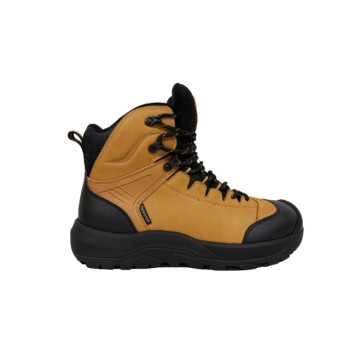
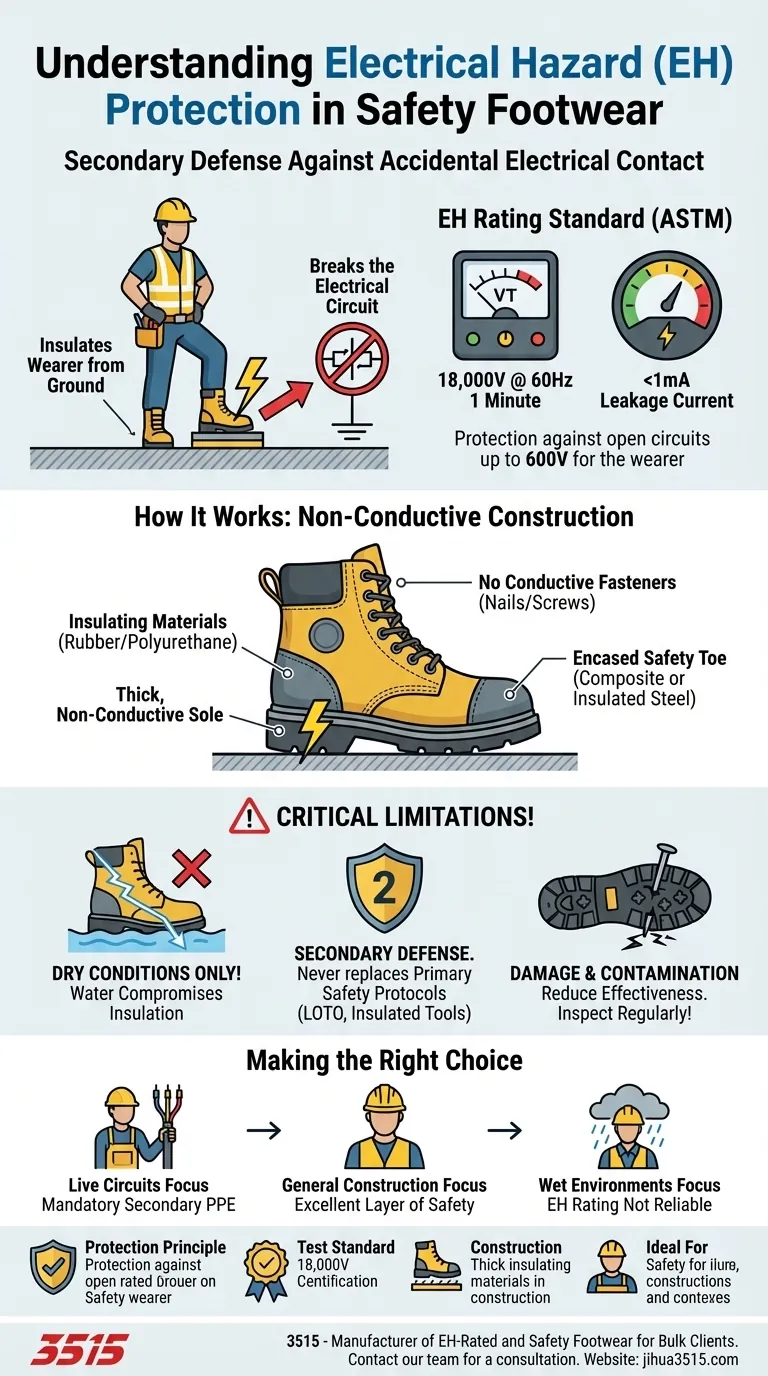
At its core, Electrical Hazard (EH) rated footwear is designed to provide a secondary source of protection against accidental contact with live electrical circuits. These boots are tested to withstand the application of 18,000 volts at 60 hertz for one minute with no current flow or leakage current in excess of one milliampere under dry conditions. This standard provides protection against open circuits up to 600 volts for the wearer.
The crucial takeaway is that EH-rated footwear serves as an insulator between you and the ground, intended to significantly reduce the potential for electric shock. However, its protective qualities are only effective in dry conditions and should never replace primary electrical safety procedures.
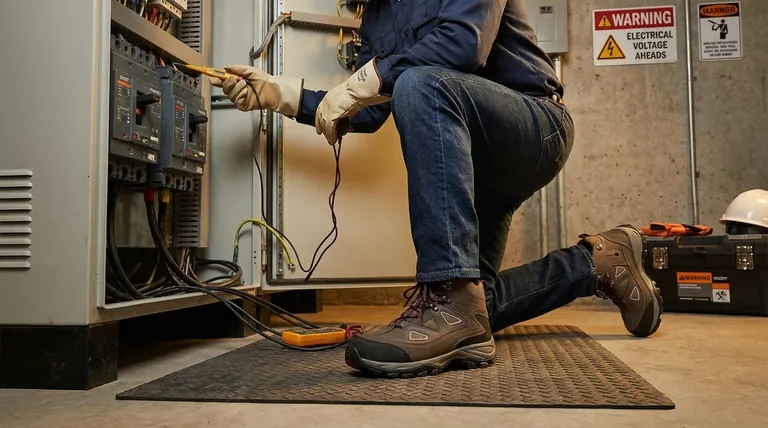
How EH-Rated Footwear Provides Protection
EH boots are engineered from the ground up to impede the flow of electricity. Their effectiveness relies on a specific combination of materials and construction methods designed to create a non-conductive barrier.
The Principle of Insulation
For an electric shock to occur, your body must complete a circuit. EH-rated footwear is designed to break that circuit by insulating you from the ground.
The thick, non-conductive sole acts as the primary barrier, preventing electricity from passing from a live source, through your body, and into the earth.
Non-Conductive Construction
The entire sole and heel construction of an EH-rated boot is made from materials that do not conduct electricity. This typically involves special rubber or polyurethane compounds.
No conductive materials, like nails or screws, can be used to attach the sole to the upper part of the boot, as this would create a path for electricity to travel.
The Role of Safety Toes
While many EH boots use composite safety toes made from non-metallic materials like carbon fiber or plastic, steel-toed boots can also achieve an EH rating.
In a properly constructed boot, the steel toe is fully encased in non-conductive material, ensuring it does not become part of an electrical circuit. However, many professionals in electrical fields prefer composite toes to eliminate the risk entirely.
Understanding the Critical Limitations
Trusting EH footwear requires understanding its limitations. These are not magic shields against electricity; they are specialized tools that work only under specific conditions.
The "Dry Conditions" Rule
This is the most critical limitation. Water is an excellent conductor of electricity. If your EH boots become wet, or you are standing in water, their insulating properties are severely compromised or negated completely.
The official ASTM standard for EH footwear is tested and certified exclusively for dry conditions.
It Is a Secondary Defense
EH-rated footwear is considered a secondary source of protection. It is your last line of defense against an accidental shock, not your first.
Primary safety protocols—such as de-energizing circuits, lock-out/tag-out (LOTO) procedures, and using insulated tools—are always the most important preventative measures.
Damage and Contamination Reduce Effectiveness
The protective barrier can be compromised. Punctures to the sole, excessive wear that thins the material, or the embedding of conductive materials like metal shavings can create a pathway for electricity.
Regularly inspect your footwear for damage to ensure its protective capabilities remain intact.
Making the Right Choice for Your Goal
Selecting the correct footwear depends on a clear-eyed assessment of your daily work environment and the specific hazards you face.
- If your primary focus is working directly with live or potentially live circuits: EH-rated footwear is a mandatory piece of secondary PPE, but it must be paired with primary electrical safety protocols.
- If your primary focus is general construction or industrial maintenance: An EH rating provides an excellent layer of safety against accidental contact with unforeseen electrical hazards.
- If your primary focus is working in consistently wet or damp environments: You cannot rely on the EH rating for protection, and you must prioritize other electrical safety measures.
Ultimately, understanding both the capabilities and the absolute limits of your equipment is the foundation of a safe work practice.
Summary Table:
| Feature | Key Detail | Limitation |
|---|---|---|
| Protection Principle | Insulates the wearer from the ground, breaking the electrical circuit. | A secondary defense, not a replacement for primary safety protocols. |
| Test Standard | Withstands 18,000V for 1 minute with minimal current leakage (under dry conditions). | Protection is only guaranteed in dry conditions. Wet boots offer little to no protection. |
| Construction | Non-conductive sole and heel; no conductive fasteners. Steel toes must be fully insulated. | Protection can be compromised by damage, punctures, or embedded conductive materials. |
| Ideal For | Work with live/potentially live circuits; general construction with unforeseen electrical risks. | Not reliable for consistently wet or damp environments. |
Ensure your workforce is equipped with the right protection.
As a large-scale manufacturer, 3515 produces a comprehensive range of EH-rated and other safety footwear for distributors, brand owners, and bulk clients. Our production capabilities encompass all types of safety shoes and boots, engineered to meet rigorous standards and protect your team.
Let's discuss your specific safety needs and how we can provide reliable, high-quality footwear for your operations.
Contact our expert team today for a consultation
Visual Guide
Related Products
- Puncture-Resistant Velcro Safety Boots for Wholesale & Custom Manufacturing
- Premium Wholesale Tactical Style Safety Shoes Boots with Quick Lacing
- Wholesale Anti-Smash & Puncture-Proof Safety Shoes Custom Manufacturing for Brands
- Wholesale Durable Safety Boots | Custom Steel Toe & Puncture-Resistant Manufacturing
- Custom Wholesale Leather Safety Boots Direct Factory Manufacturing
People Also Ask
- Why are industrial safety boots with steel toes necessary for machine operators? Essential Foot Protection for Safety
- What are the characteristics of steel toe safety boots? Maximum Protection, Key Trade-offs
- Is it true that steel toes can cause toes to get cut off? Debunking the Dangerous Myth
- What are the primary safety functions of safety boots with steel-toe designs? Essential Protection for Industry
- What are the different types of safety toe boots available? Choose the Right Protection for Your Job