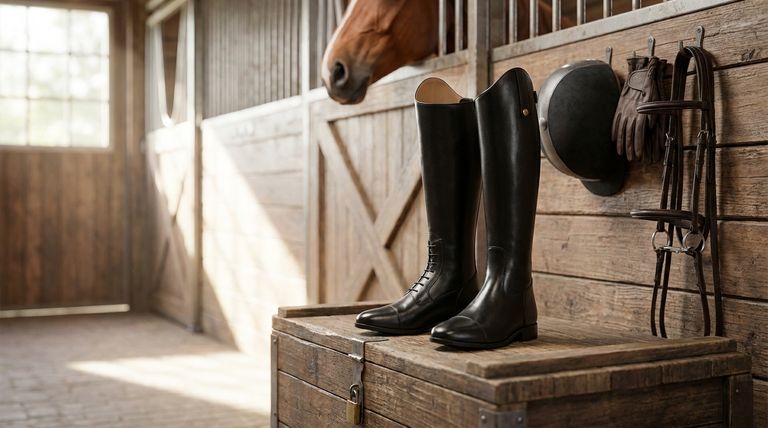
At its core, an equestrian tall boot is a piece of specialized equipment designed for three distinct purposes: protecting the rider's leg, enhancing communication with the horse, and upholding a traditional, formal appearance. Unlike standard fashion boots, every element of a tall boot, from its height and stiff construction to its specific cut, serves a deliberate function in the saddle.
The primary distinction of a tall equestrian boot is its dual role as both safety equipment and a tool for refined riding. Its design prioritizes leg stability, protection from saddle chafing, and a close contact feel, all while adhering to the aesthetic standards of specific equestrian disciplines.
Why Tall Boots Are Essential Equipment
A common misconception is that tall boots are purely for looks. In reality, their design is deeply rooted in rider safety, comfort, and performance.
Protection and Stability
The most fundamental job of a tall boot is to protect the rider's lower leg. The stiff outer leather shields the leg from pinching and chafing against the saddle's leather flaps.
This rigidity also provides crucial ankle and lower leg support, helping the rider maintain a stable and correct leg position.
Enhancing Rider-Horse Communication
A well-fitted tall boot creates a smooth, consistent surface against the horse's side. This eliminates the bulk of a shorter boot and half-chap, allowing for a closer contact feel.
This close contact enables the rider to give more subtle and precise leg aids, which is a cornerstone of effective riding.
The Formal Equestrian Aesthetic
Tall boots provide a clean, elongated, and polished silhouette that is a hallmark of formal equestrian disciplines. They create an uninterrupted line from the thigh to the heel, contributing to a professional and traditional look in the show ring.
Key Types of Tall Boots
While all tall boots share core purposes, they are not all the same. The two primary categories are distinguished by their ankle construction, which dictates their function.
Field Boots: The Athlete's Choice
Field boots are easily identified by the laces at the ankle. This feature provides greater flexibility, allowing the rider's heel to drop down comfortably.
This flexibility is essential for jumping disciplines like show jumping, eventing, and fox hunting, where riders use a shorter stirrup length and a more flexed ankle position.
Dress Boots: The Formal Standard
Dress boots (or dressage boots) have no laces and feature a much stiffer, more rigid construction up the front of the ankle.
This design promotes a very straight and still leg, which is the ideal in the discipline of dressage. Their seamless profile offers the ultimate formal and traditional appearance.
Understanding the Trade-offs
Choosing the right boot requires understanding the inherent compromises in their design. A boot built for one purpose will be less suitable for another.
Flexibility vs. Support
The defining trade-off is between the flexibility of a field boot and the rigid support of a dress boot.
Attempting to jump in a stiff dress boot can be uncomfortable and inhibit proper form. Conversely, a field boot's flexibility might be seen as less formally correct in a high-level dressage test.
The Break-In Period
The stiff leather required for support and protection means most new tall boots have a significant break-in period.
This process can be uncomfortable, but it is necessary for the boot to mold to the rider's leg. Softer, less expensive boots may feel better initially but will not offer the same long-term support and durability.
Making the Right Choice for Your Goal
Your riding discipline should be the primary factor in your decision.
- If your primary focus is jumping, eventing, or fox hunting: The ankle flexibility of a Field Boot is non-negotiable for safety and performance.
- If your primary focus is dressage: The rigid support and clean silhouette of a Dress Boot are the correct and expected standard.
- If you are a beginner or ride in multiple disciplines: A Field Boot is generally the more versatile and forgiving option to start with.
Ultimately, understanding the purpose behind each design feature empowers you to select the right tool for the job.
Summary Table:
| Feature | Field Boots | Dress Boots |
|---|---|---|
| Primary Use | Jumping, Eventing | Dressage |
| Ankle Design | Laced for flexibility | Stiff, rigid construction |
| Key Benefit | Flexibility for shorter stirrups | Support for a straight leg |
| Best For | Riders needing ankle movement | Riders requiring maximum stability |
Need High-Quality Equestrian Tall Boots for Your Business?
As a large-scale manufacturer, 3515 produces a comprehensive range of equestrian footwear for distributors, brand owners, and bulk clients. Our production capabilities ensure top-tier field boots and dress boots, crafted for superior protection, performance, and durability.
Let us help you equip riders with the right tools for their discipline. Contact us today to discuss your manufacturing needs!
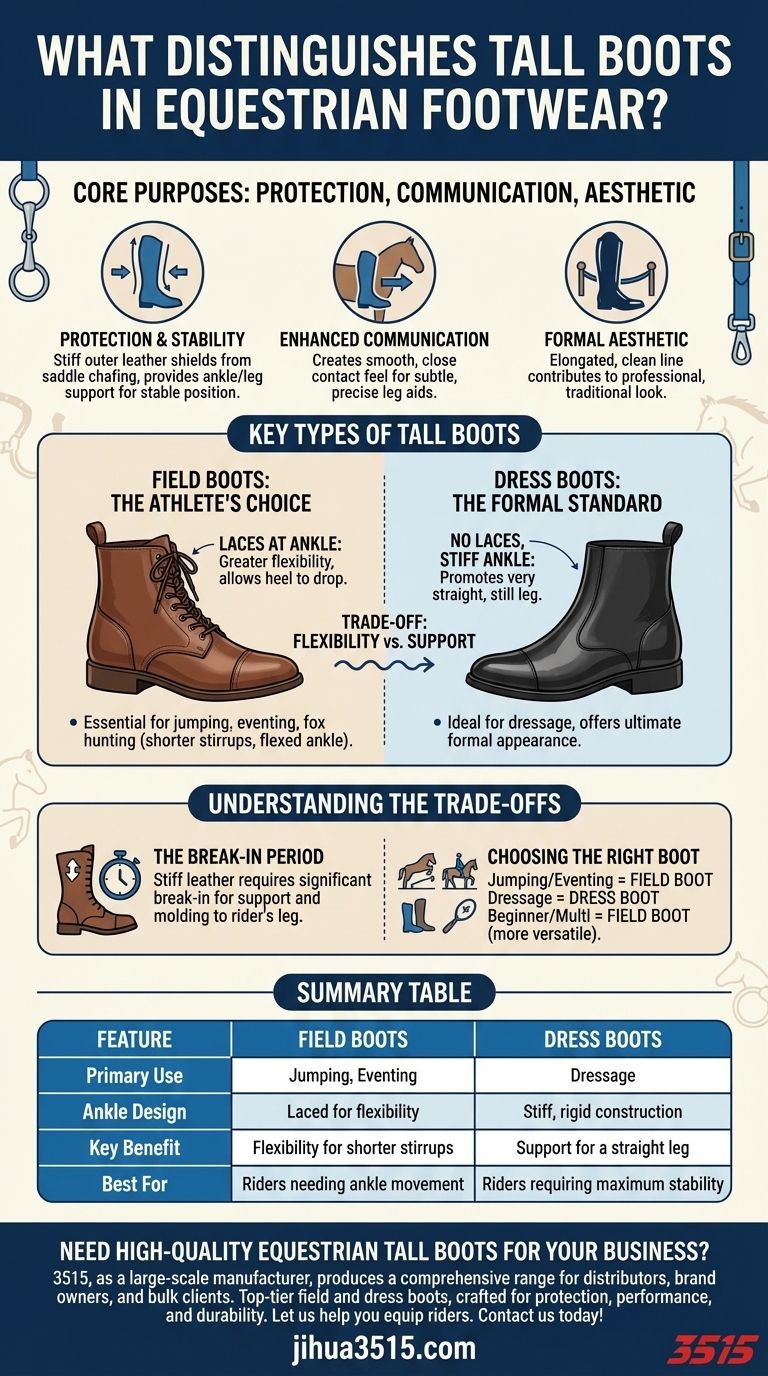
Visual Guide
Related Products
- Factory-Direct Wholesale Canvas Boots with High-Traction Rubber Soles
- Durable High-Ankle Tactical Boots Wholesale Manufacturer for Custom & Bulk Orders
- Durable Leather High-Ankle Tactical Boots for Wholesale & Custom Manufacturing
- Durable High-Ankle Tactical Boots for Wholesale & Custom Manufacturing
- Wholesale Tactical Boots High-Traction & Reflective for Bulk & Brand Orders
People Also Ask
- What types of jobs are canvas work boots suitable for? Ideal for Light-Duty, High-Mobility Roles
- What are the functional advantages of choosing rubber soles over leather soles for work boots? Superior Safety & Durability
- What are the advantages of rubber soles for work boots? Unbeatable Grip & Durability
- Why are slip-resistant soles important in work boots? Prevent Slips & Boost Safety
- What are the benefits and limitations of using canvas as a primary material for footwear? Key B2B Manufacturing Insights