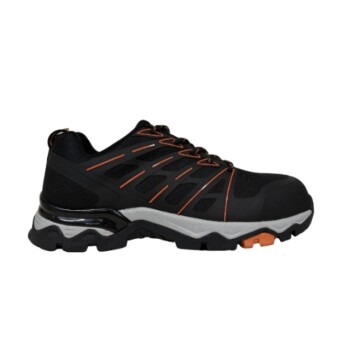
The primary challenge facing visual detection algorithms is low contrast caused by "camouflage obstacles." When personnel wear safety shoes or tactical boots that match the color of the factory floor—typically gray or dark tones—standard visual models struggle to distinguish the gear from the background. This lack of contrast prevents the algorithm from accurately defining the object edges, leading to detection failures.
Visual detection systems, particularly semantic segmentation models, rely on distinct color boundaries to separate objects from their environment. When footwear blends into the floor, these models lose critical edge definition, requiring reliance on spatial data rather than just color information.
The Mechanics of Camouflage Failure
The Limits of Semantic Segmentation
Many visual detection systems utilize semantic segmentation models. These algorithms attempt to classify every pixel in an image to identify objects.
However, these models depend heavily on color differences. When a dark boot is placed against a dark floor, the model interprets the pixels as a single continuous surface rather than two distinct entities.
Loss of Edge Definition
The specific technical failure occurs at the object edges. Without a sharp contrast in color or brightness, the algorithm cannot calculate where the floor ends and the shoe begins.
This results in the footwear becoming invisible to the system, treating the personnel’s feet as part of the background floor.
Strategies for Reliable Detection
Leveraging Depth Estimation
To overcome color blindness in algorithms, systems must bypass 2D color data. The most effective method is integrating depth estimation models.
These models judge physical distance based on spatial cues. Even if the shoe and the floor are the exact same color, the shoe physically protrudes from the floor, creating a spatial anomaly that depth sensors can detect.
Advanced Feature Extraction
If depth sensing is not available, the visual algorithm itself must possess high feature extraction capabilities.
Instead of relying solely on color, these advanced models analyze texture, patterns, and subtle lighting changes to infer the presence of an object. This requires significantly more sophisticated processing than standard color-based segmentation.
Understanding the Trade-offs
Computational Cost vs. Accuracy
Implementing high feature extraction requires more processing power. While it improves detection in low-contrast scenarios, it may increase the latency of the system, which can be critical in real-time safety applications.
Hardware Complexity
Relying on depth estimation often changes the hardware requirements.
While standard RGB cameras suffice for color detection, accurate depth estimation typically requires specific sensors or complex stereo-vision setups. This increases the cost and complexity of the physical installation on the factory floor.
Making the Right Choice for Your Environment
To ensure safety compliance in environments where gear blends with the floor, consider the following approach:
- If your primary focus is robust safety: Prioritize systems that utilize depth estimation models, as they rely on spatial cues that are immune to color camouflage.
- If your primary focus is software-only upgrades: Ensure your detection algorithms are tuned for high feature extraction, capable of analyzing texture and lighting rather than just color contrast.
Reliable detection requires moving beyond simple color analysis to understand the three-dimensional reality of the workspace.
Summary Table:
| Challenge Component | Impact on Detection | Recommended Solution |
|---|---|---|
| Color Contrast | "Camouflage" effect leads to pixel misclassification | Use High Feature Extraction models |
| Edge Definition | Models fail to distinguish footwear from the floor | Integrate Depth Estimation (Spatial Data) |
| Hardware Limit | Standard RGB cameras miss 3D spatial anomalies | Upgrade to Stereo-vision or Depth Sensors |
| Processing Power | Increased latency in real-time safety monitoring | Optimize algorithms for texture/lighting analysis |
Secure Your Workforce with High-Performance Footwear from 3515
In high-tech environments where visual detection and safety are paramount, the right gear makes all the difference. As a leading large-scale manufacturer serving global distributors and brand owners, 3515 provides comprehensive production capabilities for all professional footwear.
Our flagship Safety Shoes and Tactical Boots series are designed to meet rigorous industrial standards, ensuring durability and worker protection. From outdoor and training shoes to sneakers and formal dress shoes, we offer the bulk manufacturing expertise you need to scale your brand.
Partner with 3515 today to access premium footwear solutions tailored to your specific requirements.
References
- Marius Wenning, Peter Burggräf. Testing the reliability of monocular obstacle detection methods in a simulated 3D factory environment. DOI: 10.1007/s10845-022-01983-4
This article is also based on technical information from 3515 Knowledge Base .
Related Products
- Premium Suede Sport Safety Shoes for Wholesale & Bulk Orders
- Premium Lightweight Safety Shoes for Wholesale & Bulk Orders
- Wholesale Anti-Smash & Puncture-Proof Safety Shoes Custom Manufacturing for Brands
- Premium KPU Injection Athletic Style Safety Shoes
- Premium Safety Shoes with Rotating Buckle Safety Sneakers
People Also Ask
- What are the primary functions of professional safety shoes? Maximize Safety in Water Supply Confined Spaces
- What industries have specific OSHA footwear requirements? Ensure Compliance & Protect Your Workforce
- What role do specialized safety shoes play in preventing falls? Engineering Stability in Industrial Environments
- Why wear protective masks, gloves, and safety shoes in 5S Shine? Elevate Safety and Discipline
- What core functions do professional safety shoes serve? Enhance Construction & Industrial Safety Standards