
While there are many ways to classify hiking footwear, the most common and practical framework breaks them down into three core categories: trail running shoes, dedicated hiking shoes, and more robust hiking boots. Each serves a distinct purpose, balancing weight and flexibility against support and durability for different types of terrain and pack loads.
The choice in hiking footwear is fundamentally a trade-off between two factors: lightweight agility and protective support. Understanding where your needs fall on this spectrum is the key to selecting the right shoe for your adventure.
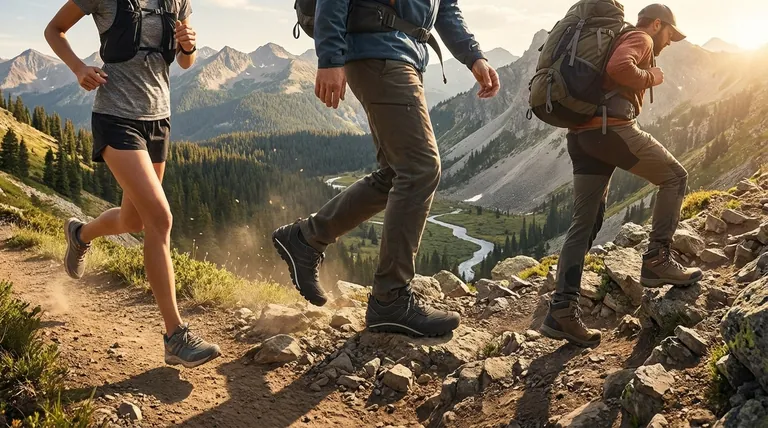
The Three Core Categories of Hiking Footwear
The primary distinction between hiking footwear types comes down to their construction, weight, and the level of support they provide for your feet and ankles.
Trail Running Shoes
Trail runners are the lightest and most flexible option. They are essentially running shoes enhanced with features for off-road use, such as more aggressive tread for better grip and slightly stiffer soles for protection against rocks.
They prioritize speed, breathability, and comfort on well-maintained trails, feeling much like a sneaker. Many thru-hikers and fast-packers favor them to reduce fatigue over long distances.
Dedicated Hiking Shoes
Hiking shoes represent the middle ground. They combine the low-cut, agile feel of a trail runner with some of the sturdier, more durable features of a hiking boot.
These shoes typically have stiffer soles than trail runners, offering better protection and support on rocky, uneven ground. They are an excellent all-around choice for day hikes and trips with a light-to-moderate pack weight.
Hiking Boots
Hiking boots are the heaviest and most supportive category, designed for rugged terrain, multi-day trips, and carrying heavy packs. Their defining feature is an ankle collar that extends above the ankle (in mid- or high-cut styles).
This design provides crucial ankle support to prevent twists and sprains. Their construction emphasizes durability and protection, with tough materials and very stiff soles that can handle significant abuse.
Beyond the Category: Understanding Key Features
While the three main types provide a great starting point, other features help further define a shoe's purpose. These characteristics often apply across the different categories.
Ankle Cut (Low vs. Mid vs. High)
The height of the shoe's collar is a critical feature. Low-cut shoes end below the ankle, offering maximum mobility but minimal ankle support. High-cut boots extend well above the ankle, providing significant stability at the cost of some flexibility. Mid-cut styles offer a balance between the two.
Cushioning Level
Footwear exists on a spectrum from minimalist to maximum cushion. Minimalist or "barefoot" shoes offer very little padding to promote a natural foot-strike. On the other end, super-cushioned shoes provide thick midsoles to absorb impact, which can reduce fatigue on long days.
Specialized Designs
For specific technical pursuits, you may encounter other categories. Approach shoes blend the sticky rubber of a climbing shoe with the comfort of a hiker for scrambling over rock. Mountaineering boots are the stiffest and most insulated of all, designed for ice climbing and travel on glaciers.
Understanding the Trade-offs
Choosing hiking footwear is not about finding the "best" shoe, but the best shoe for a specific purpose. Every design choice involves a compromise.
Weight vs. Support
This is the central trade-off. A lightweight trail runner reduces the energy you expend with every step, but it offers less protection from sharp rocks and minimal ankle support. A heavy boot provides a fortress for your foot but requires more effort to lift, which can lead to fatigue over many miles.
Breathability vs. Waterproofing
A shoe with a waterproof membrane (like GORE-TEX) will keep your feet dry from external moisture like rain or creek crossings. However, this same membrane traps sweat and heat, reducing breathability and potentially leading to blisters in hot weather. Non-waterproof shoes will get wet easily but also dry out very quickly.
Making the Right Choice for Your Hike
To select the best footwear, clearly define the demands of your typical hike.
- If your primary focus is speed and distance on well-defined trails: A trail running shoe offers the best combination of low weight and comfort.
- If your primary focus is versatility for day hikes on varied terrain: A dedicated low-cut hiking shoe provides an ideal balance of support and agility.
- If your primary focus is stability and protection on rough terrain or with a heavy pack: A mid- or high-cut hiking boot is the most appropriate and safest choice.
Ultimately, the right footwear should feel like a natural extension of your foot, giving you the confidence to tackle the trail ahead.
Summary Table:
| Type | Best For | Key Characteristics |
|---|---|---|
| Trail Running Shoes | Speed, distance, well-maintained trails | Lightest, most flexible, low-cut, aggressive tread |
| Dedicated Hiking Shoes | Day hikes, varied terrain, light packs | Middle ground: stiffer sole than trail runners, low-cut, durable |
| Hiking Boots | Rough terrain, heavy packs, multi-day trips | Heaviest, most supportive, mid- or high-cut for ankle stability |
Ready to equip your customers with the perfect hiking footwear?
As a large-scale manufacturer, 3515 produces a comprehensive range of durable and high-performance shoes and boots for distributors, brand owners, and bulk clients. Whether you need lightweight trail runners, versatile hiking shoes, or robust hiking boots, our production capabilities cover all types of footwear to meet your market's demands.
Partner with 3515 to source reliable hiking footwear that balances agility, support, and durability. Contact our team today to discuss your production needs and get a quote!
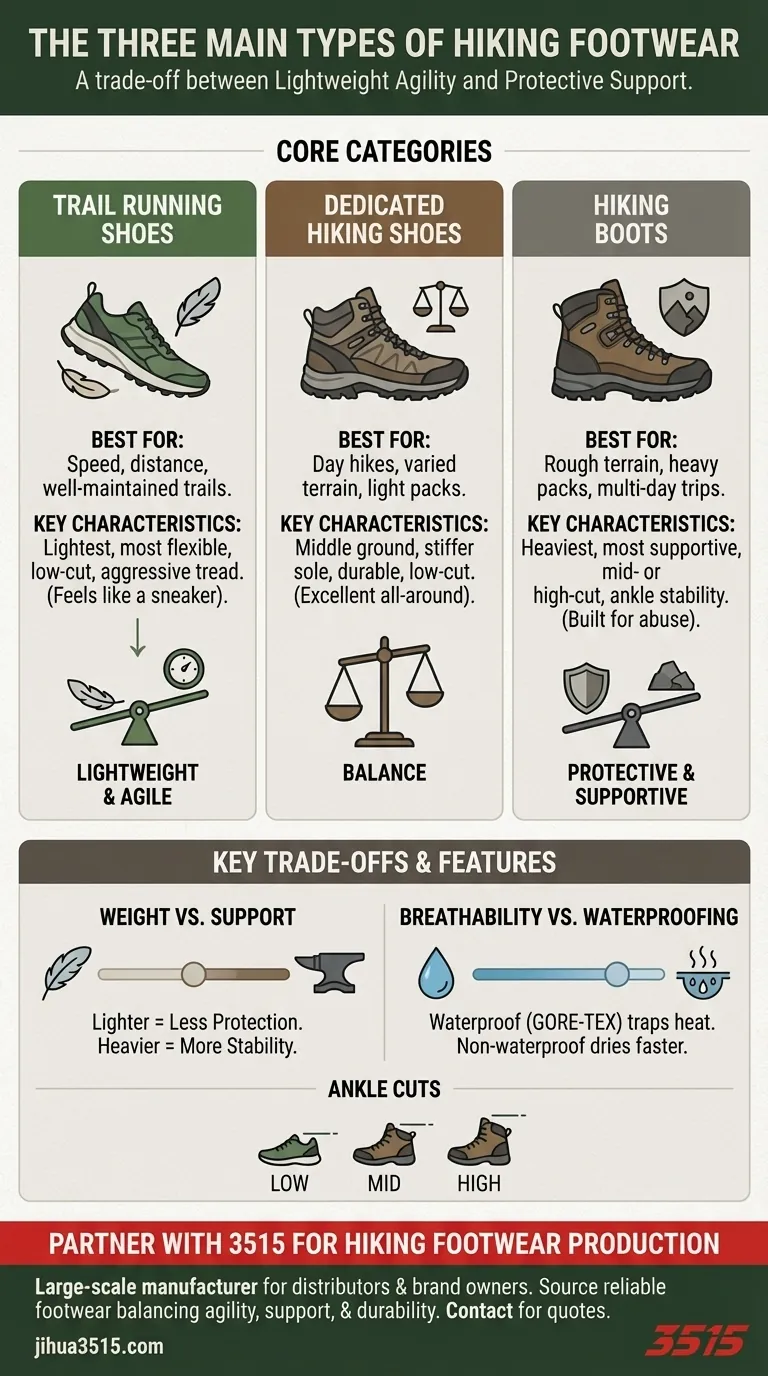
Visual Guide
Related Products
- Durable Rubber Sole Outdoor Shoes Wholesale & Custom Manufacturing
- Wholesale High-Traction Camo Boots - Custom Manufacturer for Brands
- Wholesale Durable Camouflage Canvas Shoes with High-Traction Cleated Rubber Sole
- Advanced KPU Athletic Safety Shoe with Steel Toe Cap Anti-Slip Rotary Lacing System
- Wholesale Durable Camo Canvas Shoes with High-Traction Rubber Soles
People Also Ask
- What is the function of the sole in outdoor shoes? Find the Perfect Grip and Support
- What role do outdoor shoes and sneakers play in navigating external terrains? Engineered Stability for Every Surface
- How is AI utilized in the design of outdoor and safety footwear? Harnessing Big Data for Market-Driven Shoe Innovation
- Why is durability important when selecting outdoor shoes? A Guide to Safety & Long-Term Value
- What are the key components of outdoor shoes that affect comfort and sturdiness? A Guide to Durable, High-Performance Footwear



















