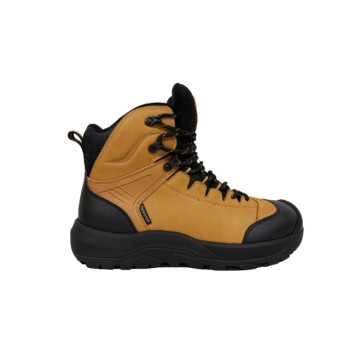
The primary technical advantage lies in the preservation of thermal balance through advanced material stratification. In high-altitude winter environments, tactical boots and safety shoes utilize thickened, multi-layer composite structures to significantly increase clothing insulation value (clo). This design prioritizes the blockage of cold conduction from the ground, which is critical when the wearer’s physical activity is too low to generate substantial metabolic heat.
By elevating the insulation value (clo) through composite materials, these boots act as a thermal shield. They address the critical deficit between the body's low heat production during static activities and the rapid heat loss demands of low Physiological Equivalent Temperatures.
The Mechanics of Thermal Construction
Multi-Layer Composite Structures
Standard footwear often relies on single-density materials that transmit temperature easily. In contrast, tactical boots designed for these extremes employ a multi-layer composite structure.
These layers work together to trap air and create dead space. This structural complexity is essential for isolating the foot from the external environment.
Maximizing the Clo Value
The technical measure of this isolation is the clothing insulation value (clo). Tactical safety shoes are manufactured with thickened materials specifically to increase this metric.
A higher clo value means the gear is more efficient at retaining whatever heat the body produces. In low-intensity scenarios, where metabolic heat generation is minimal, a high clo rating is the only barrier against hypothermia.
Combating Environmental Physics
Blocking Cold Conduction
In high-altitude winter settings, the ground acts as a massive heat sink. Heat naturally flows from warmer objects (feet) to colder ones (the frozen ground).
The high thermal resistance of these boots focuses heavily on the sole and footbed. By using thickened composite materials, the boots effectively block cold conduction, preventing the ground from draining heat directly from the soles of the feet.
Managing Physiological Equivalent Temperature
High altitude combines with low ambient temperatures to create a low Physiological Equivalent Temperature (PET). This is a measure of the thermal stress actually felt by the human body.
Because the body struggles to maintain thermal balance under low PET conditions, the footwear acts as an equalizer. It minimizes heat loss to the point where the body can maintain equilibrium despite the harsh external metrics.
Understanding the Trade-offs
Weight and Fatigue
To achieve high thermal resistance and increased clo values, manufacturers must use thickened materials and complex layering. This inevitably leads to increased footwear weight.
While this is acceptable for low-intensity or static activities, it can induce faster muscle fatigue if the user needs to transition to high-mobility tasks or long-distance marching.
Breathability Concerns
The same multi-layer structures that block cold conduction can also trap moisture. If the user's activity level spikes unexpectedly, sweat may accumulate inside the boot.
If this moisture is not managed, it can eventually cool and freeze, counteracting the insulation properties. This makes these boots strictly specialized for low-intensity or static phases of operation.
Making the Right Choice for Your Goal
Selecting the right footwear requires balancing thermal protection against mobility requirements.
- If your primary focus is static duty or observation: Prioritize boots with the highest possible clo value and thickest composite soles to eliminate conductive heat loss.
- If your primary focus is intermittent movement: Look for a balance between thermal resistance and weight to prevent fatigue while maintaining thermal balance.
The technical superiority of these boots is defined by their ability to mechanically substitute for the body's lack of metabolic heat generation in extreme cold.
Summary Table:
| Feature | Technical Advantage | Benefit for Low-Intensity Use |
|---|---|---|
| Material Structure | Multi-layer composite layers | Traps dead air to create a high-efficiency thermal shield |
| Insulation Metric | Increased Clo Value | Retains metabolic heat when physical activity is minimal |
| Sole Engineering | Thickened thermal resistance | Blocks direct cold conduction from frozen ground/heat sinks |
| Thermal Focus | PET (Physiological Equivalent Temperature) Management | Reduces thermal stress and helps maintain body equilibrium |
Partner with 3515 for High-Performance Cold Weather Solutions
As a large-scale manufacturer serving distributors and brand owners, 3515 offers comprehensive production capabilities for all footwear types, anchored by our flagship Safety Shoes series. Our technical expertise in high thermal resistance ensures that our footwear meets the rigorous demands of high-altitude and extreme winter environments.
Beyond specialized tactical gear, our extensive portfolio covers work and tactical boots, outdoor shoes, training shoes, and sneakers, as well as Dress & Formal shoes to meet diverse bulk requirements. Whether you are looking to source high-clo rated safety boots or durable outdoor footwear, we provide the scale and precision to support your brand.
Ready to elevate your product line with industry-leading thermal protection? Contact us today to discuss your bulk manufacturing needs!
References
- Yingzi Zhang, Xinxing Liu. Study on the outdoor thermal comfort of college students under different activity intensities in a high-altitude climate zone. DOI: 10.3389/fpubh.2024.1365470
This article is also based on technical information from 3515 Knowledge Base .
Related Products
- High-Traction Suede Tactical Boots Wholesale & Custom Manufacturing
- Wholesale Waterproof Tactical Boots Custom Suede & High-Traction Soles
- Wholesale Tactical Boots High-Traction & Reflective for Bulk & Brand Orders
- Durable Leather High-Ankle Tactical Boots for Wholesale & Custom Manufacturing
- Durable Leather Tactical Boots Wholesale & Custom Manufacturing for Brands
People Also Ask
- Why is sequential analysis utilized to evaluate tactical boots? Master Dynamic Boot Development and Ergonomic Performance
- How does the material of tactical boots affect their performance? Choose the Right Material for Your Mission
- How do tactical boots differ from regular boots? Performance, Durability & Design Explained
- How do military uniforms and tactical boots impact the prediction of thermal risk? Essential Safety Insights
- What are the benefits of integrating FES and sEMG into tactical boots? Safety, Reliability & Field-Ready Performance