The rider’s primary preferences for new horse boots are centered on three key criteria: superior protection, the ability to withstand wet conditions, and a reasonable price point. These needs are driven by the horse's tendency to injure itself and the owner's plan to increase conditioning on trails that include deep water crossings.
The core issue is transitioning from simple support wraps to genuine protective equipment. The rider requires a boot that can handle both impact and environmental challenges without failing, all while fitting within a practical budget.

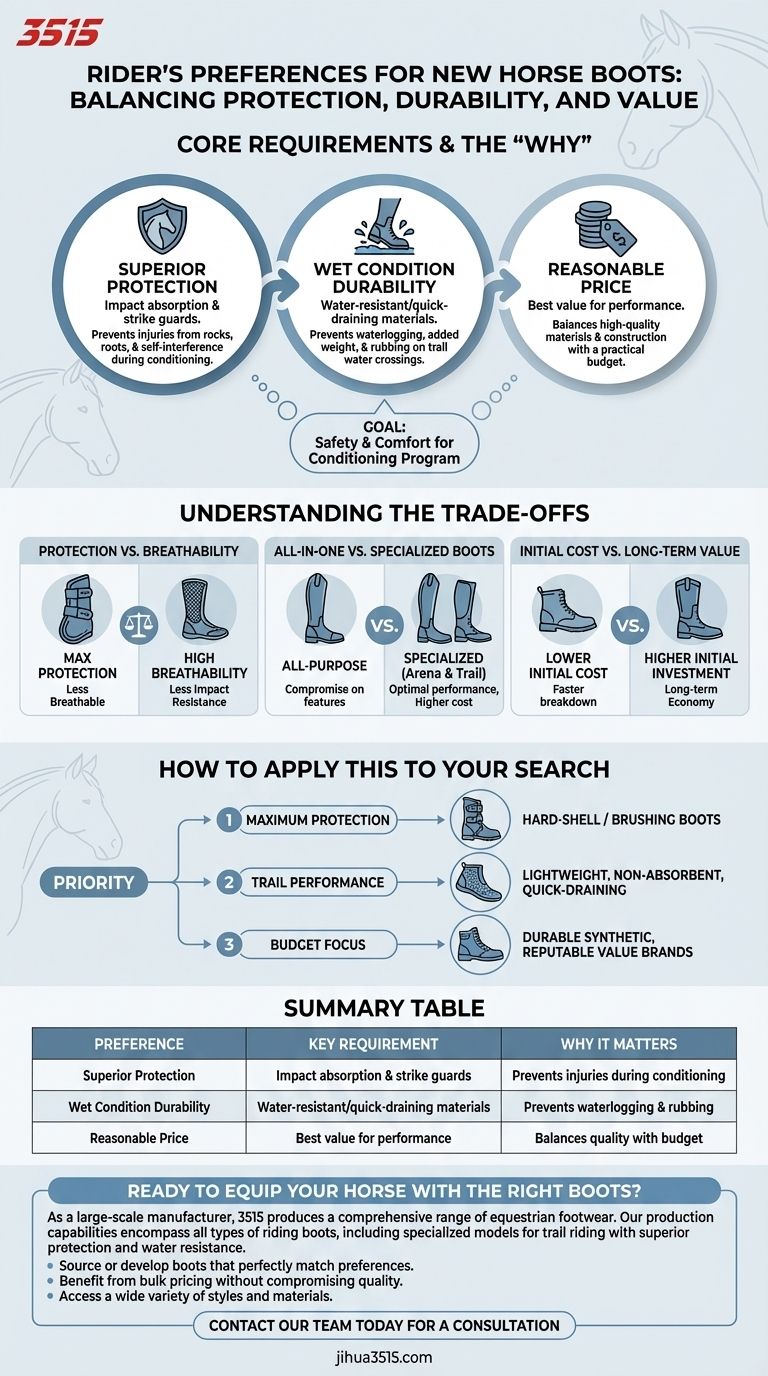
Deconstructing the Core Requirements
To select the right boot, we must analyze the "why" behind each of the rider's stated preferences. The horse's specific needs and riding environment dictate the necessary features.
The Need for Superior Protection
The rider explicitly notes that their current polo wraps do not offer enough protection for a horse that "has a tendency to bang itself up." This is the most critical requirement.
As the rider begins more intensive conditioning, including trot work on varied trail terrain, the risk of impact injuries from rocks, roots, or self-interference increases significantly. The new boots must provide a higher level of impact absorption and strike protection than simple wraps.
Durability in Wet Conditions
The plan to "hack out on trails with deep water crossings" places a significant demand on the boot's materials and construction.
Boots for this environment must not absorb and hold water, which would add weight and increase the risk of rubbing or skin irritation. The materials need to be water-resistant or quick-draining and must not degrade, stretch, or become brittle after repeated exposure to moisture.
The Importance of a Reasonable Price
Equestrian equipment varies widely in cost, and the rider's preference for a "reasonably priced" option is a practical constraint.
This requires finding a boot that meets the non-negotiable protection and water-durability standards without the premium cost of top-tier, specialized brands. It's about finding the best value and performance for the investment.
Understanding the Trade-offs
No single boot is perfect for every situation. The rider must balance competing factors to find the best solution.
Protection vs. Breathability
Boots offering the highest level of impact protection, such as those with a hard outer shell, are often less breathable. For a horse undergoing conditioning, heat and moisture buildup under the boot can be a concern, so this trade-off between airflow and impact resistance must be considered.
All-in-One vs. Specialized Boots
The rider is open to having separate boots for trail and arena work. A single, all-purpose set of boots must be a "jack-of-all-trades," potentially compromising on specific features.
Using two specialized sets—for example, more breathable boots for the arena and rugged, draining boots for the trail—can provide optimal performance in each environment but will increase the overall cost.
Initial Cost vs. Long-Term Value
A boot that seems reasonably priced at first may not be a good value if it breaks down quickly. Materials not designed for frequent water exposure can crack or have their stitching fail prematurely.
Sometimes, a slightly higher initial investment in a boot known for its durability and high-quality materials can be more economical in the long run than replacing a cheaper boot multiple times.
How to Apply This to Your Search
Your final choice should align directly with your most important priority for this horse.
- If your primary focus is maximum protection: Seek out boots with a hard-shell exterior and reinforced strike guards, often marketed as cross-country or brushing boots.
- If your primary focus is trail performance: Prioritize boots made from lightweight, non-absorbent materials with built-in drainage, ensuring they won't hold water after crossings.
- If your primary focus is budget: Focus on reputable brands known for durable synthetic materials that offer a good balance of protection and water resistance without a premium price tag.
Choosing the right boot is a critical investment in your horse's safety and comfort during its conditioning program.
Summary Table:
| Preference | Key Requirement | Why It Matters |
|---|---|---|
| Superior Protection | Impact absorption & strike guards | Prevents injuries from rocks, roots, and self-interference during conditioning. |
| Wet Condition Durability | Water-resistant/quick-draining materials | Prevents waterlogging, added weight, and rubbing on trails with water crossings. |
| Reasonable Price | Best value for performance | Balances high-quality materials and construction with a practical budget constraint. |
Ready to Equip Your Horse with the Right Boots?
As a large-scale manufacturer, 3515 produces a comprehensive range of equestrian footwear for distributors, brand owners, and bulk clients. Our production capabilities encompass all types of riding boots, including specialized models for trail riding with superior protection and water resistance.
We can help you:
- Source or develop boots that perfectly match these rider preferences.
- Benefit from bulk pricing without compromising on quality and durability.
- Access a wide variety of styles and materials to meet specific market demands.
Let's discuss your requirements and find the ideal boot solution for your customers.
Contact our team today for a consultation.
Visual Guide
Related Products
- Wholesale High-Traction Camo Boots - Custom Manufacturer for Brands
- Wholesale Lightweight Tactical Boots Custom Manufacturer for Desert & Combat Use
- High-Traction Suede Tactical Boots Wholesale & Custom Manufacturing
- Durable Leather Tactical Boots Wholesale & Custom Manufacturing for Brands
- Wholesale Perforated Comfort Dress Shoes | Custom Derby Shoe Manufacturer
People Also Ask
- What are the key features of the new line of camo boots? Built for Extreme Cold & Rugged Terrain
- Are camo boots necessary for hunting success? Prioritize Performance Over Pattern
- How does the Rank Score Test identify the primary causes of premature failure in tactical and work boots? Key Insights
- What is the technical logic behind using closed-eye testing for tactical boots? Unlocking Peak Footwear Stability
- What shoes to wear for a security job? Durable, Protective Footwear for Long Shifts