
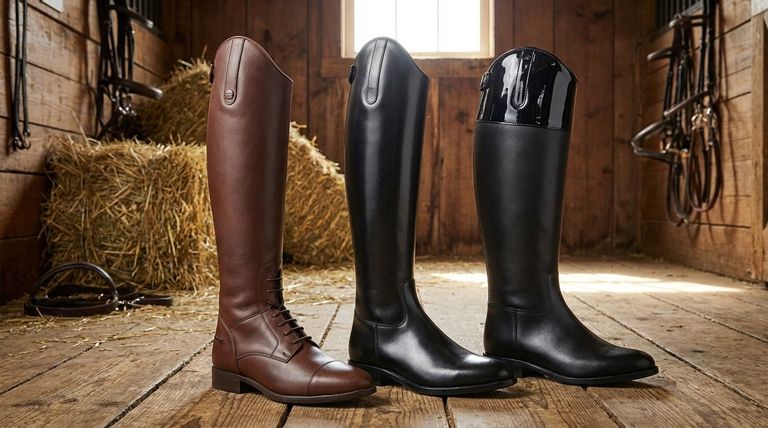
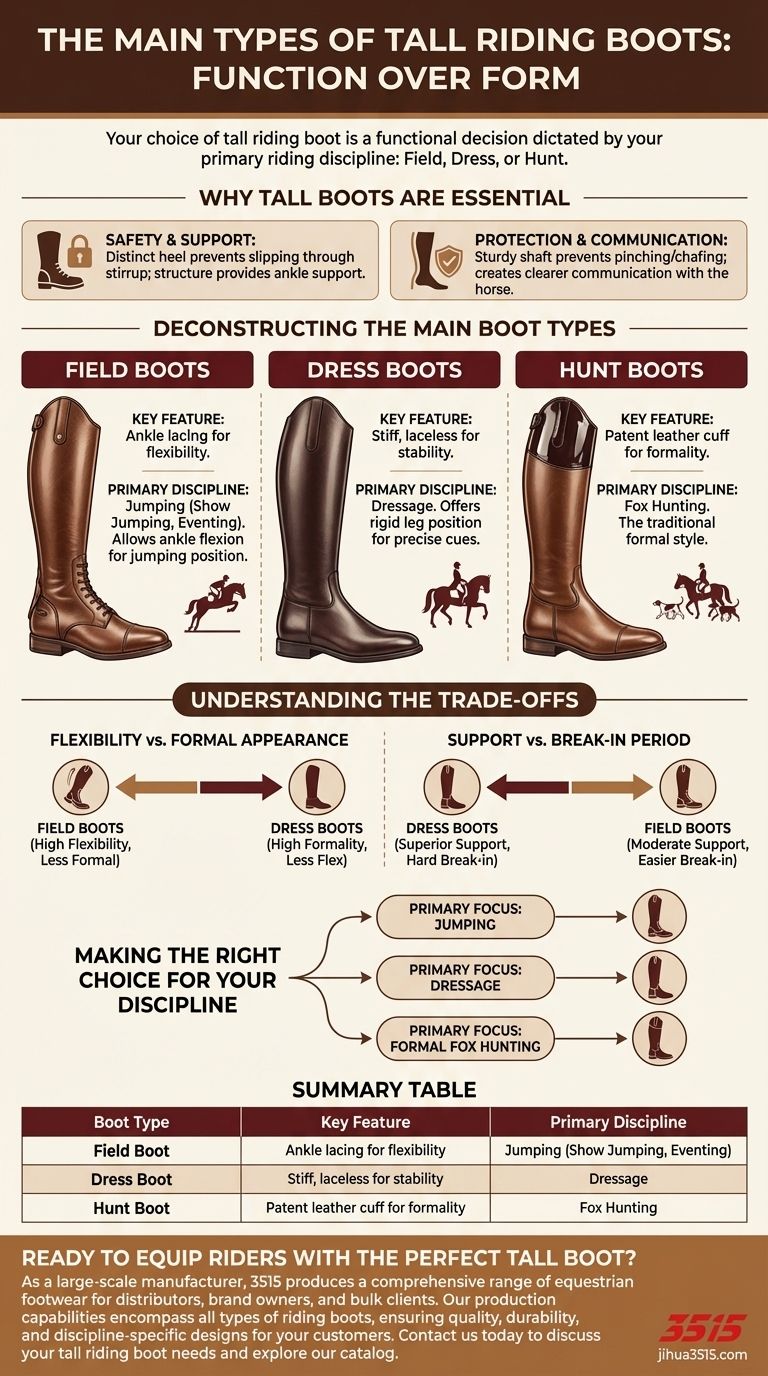
To put it simply, the three main types of English tall riding boots are field boots, dress boots, and hunt boots. Each is designed with a specific equestrian discipline in mind, differing primarily in ankle flexibility and formal appearance.
Your choice of a tall riding boot is not merely a stylistic preference; it's a functional decision dictated by your primary riding discipline. The core difference lies in whether your sport requires ankle flexibility for jumping or rigid support for precise leg cues.
Why Tall Boots Are Essential
Before dissecting the types, it's crucial to understand why tall boots are a cornerstone of riding equipment. Their design serves several key functions for any rider.
For Rider Safety and Support
A tall boot's most critical job is safety. The distinct heel prevents the rider's foot from slipping through the stirrup, a potentially dangerous situation. The boot's overall structure provides ankle support.
For Protection and Communication
The sturdy leather shaft protects the rider's leg from pinching and chafing against the saddle. This firm, smooth surface also creates a clearer line of communication, allowing for more subtle and effective leg aids to the horse.
Deconstructing the Main Boot Types
While all tall boots provide the core benefits above, their specific construction is tailored to different needs.
Field Boots: Designed for Flexibility
Field boots are immediately identifiable by the lacing at the ankle. This is their defining functional feature.
This lacing system provides the necessary flexibility for riders in jumping disciplines like show jumping, eventing, and hunt seat equitation. It allows the ankle to flex as the rider shortens their stirrups and shifts into a two-point or jumping position.
Dress Boots: Built for Formality and Stability
Dress boots are characterized by their clean, polished appearance without laces at the ankle.
This streamlined design offers a more formal look and provides a stiffer, more rigid leg position. This stability is highly valued in dressage, where riders use minute, precise leg cues to communicate with the horse from a deep seat with a longer stirrup. Dressage-specific boots are often the stiffest variant.
Hunt Boots: A Formal Distinction
Hunt boots are structurally similar to dress boots but feature a distinct contrasting cuff at the top, typically in black or brown patent leather.
As the name implies, these are traditionally worn for formal fox hunting. While less common in other disciplines, they represent the most traditional and formal style of tall boot.
Understanding the Trade-offs
Choosing a boot means balancing competing needs. There is no single boot that is perfect for every discipline.
Flexibility vs. Formal Appearance
The ankle lacing on field boots provides excellent flexibility but creates a less formal silhouette compared to the uninterrupted line of a dress boot. For this reason, they are standard for jumping but less common in the formal dressage arena.
Support vs. Break-In Period
The rigidity of a dress boot offers superior leg support and a pristine look, but this stiffness often comes with a longer, more challenging break-in period. Their lack of ankle flexion makes them unsuitable and uncomfortable for jumping.
Making the Right Choice for Your Discipline
Your decision should be guided entirely by your primary riding activity.
- If your primary focus is jumping (Hunters, Jumpers, Eventing): You need the ankle flexion of a field boot to be comfortable and effective in your jumping position.
- If your primary focus is dressage: The stability and clean lines of a dress boot will support a correct leg position and meet the sport's formal presentation standards.
- If your primary focus is formal fox hunting: A traditional hunt boot is the most appropriate and correct choice for formal attire.
Ultimately, selecting the correct boot is a fundamental step in equipping yourself for safety, comfort, and success in the saddle.
Summary Table:
| Boot Type | Key Feature | Primary Discipline |
|---|---|---|
| Field Boot | Ankle lacing for flexibility | Jumping (Show Jumping, Eventing) |
| Dress Boot | Stiff, laceless for stability | Dressage |
| Hunt Boot | Patent leather cuff for formality | Fox Hunting |
Ready to equip riders with the perfect tall boot?
As a large-scale manufacturer, 3515 produces a comprehensive range of equestrian footwear for distributors, brand owners, and bulk clients. Our production capabilities encompass all types of riding boots, ensuring quality, durability, and discipline-specific designs for your customers.
Contact us today to discuss your tall riding boot needs and explore our catalog.
Visual Guide
Related Products
- Durable High-Ankle Tactical Boots Wholesale Manufacturer for Custom & Bulk Orders
- Durable High-Ankle Tactical Boots for Wholesale & Custom Manufacturing
- Durable Leather High-Ankle Tactical Boots for Wholesale & Custom Manufacturing
- Wholesale High-Traction Camo Boots - Custom Manufacturer for Brands
- Wholesale Tactical Boots High-Traction & Reflective for Bulk & Brand Orders
People Also Ask
- What specialized protections do tactical boots offer? Maximize Endurance with High-Performance Footwear
- How do tactical boots protect against injuries? Discover the Integrated Safety System
- What are the ideal use cases for tactical boots? Empower Your Performance in Demanding Scenarios
- Can tactical boots be stylish for everyday wear? Yes, with the right styling and features.
- What are the primary benefits of wearing tactical boots for everyday use? Get All-Day Comfort & Durability


















