
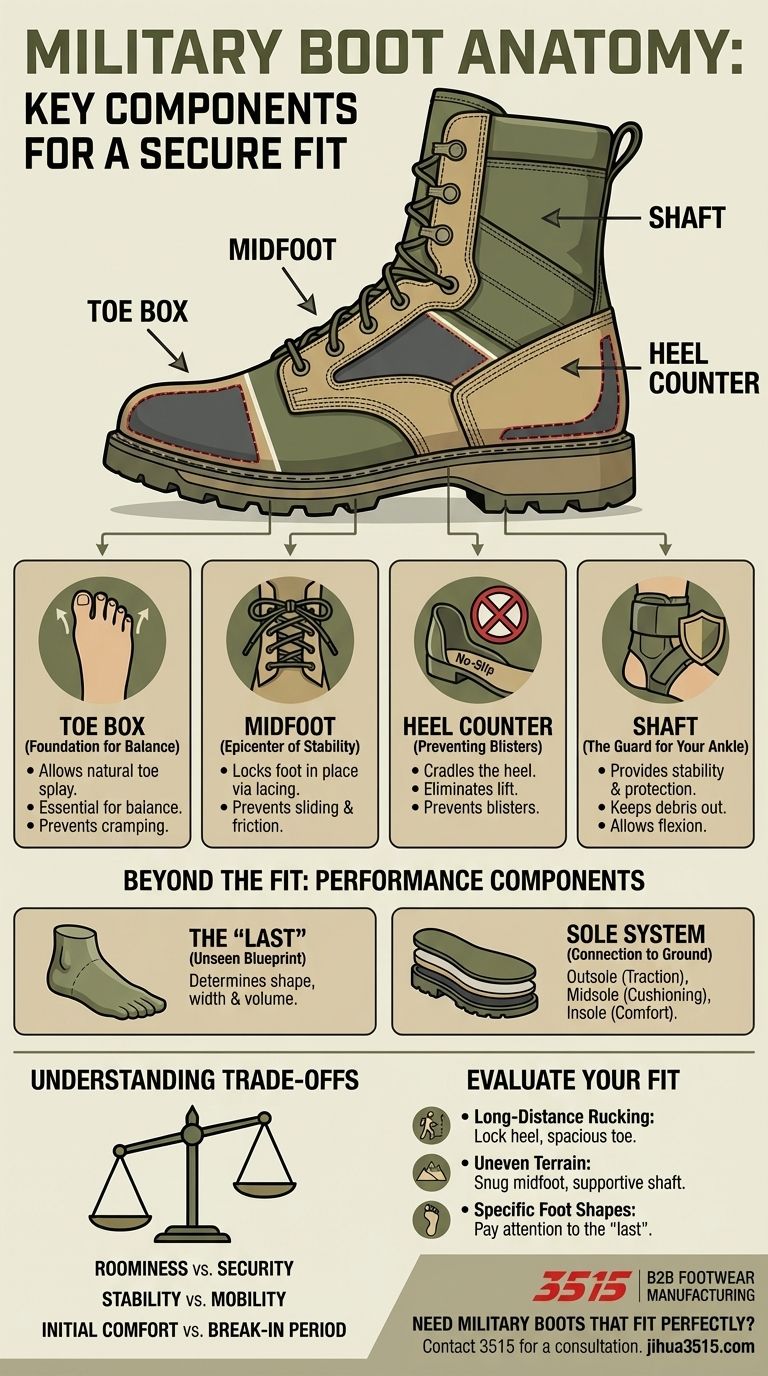
The key components of a military boot that most directly affect fit are the toe box, the midfoot, the heel counter, and the shaft. A proper fit is achieved not by one component alone, but by how these elements work together to secure your foot—preventing movement in the heel and midfoot while allowing your toes the freedom to splay naturally.
The goal of a perfect military boot fit is simple: lock the heel and midfoot in place to eliminate friction while providing ample room in the toe box for balance and to accommodate natural foot swelling.
The Anatomy of a Secure Fit: From Toe to Ankle
Understanding how each part of the boot interacts with your foot is the first step toward preventing discomfort, blisters, and potential injury. A boot is a system designed to hold your foot securely over a platform.
The Toe Box: Your Foundation for Balance
The toe box is the space at the very front of the boot that covers and protects your toes.
Its primary role in fitting is to allow your toes to spread out naturally, which is essential for balance and comfort, especially when carrying a load.
A correct fit means you can wiggle your toes freely without them feeling cramped or hitting the end of the boot. Too much space, however, can cause your foot to slide forward on declines.
The Midfoot: The Epicenter of Stability
The midfoot section is where the boot laces up over your instep. This area is critical for achieving a secure, locked-in feel.
A snug fit here prevents your entire foot from sliding around inside the boot, which is the primary cause of friction and blisters.
The lacing system allows you to customize the pressure, ensuring the boot feels like a firm handshake around your foot—secure, but not painfully tight.
The Heel Counter: Preventing Blisters and Injury
The heel counter is a rigid, cup-like structure built into the back of the boot that cradles your heel.
Its job is to prevent "heel lift" or slippage as you walk. A heel that moves up and down with every step is the fastest way to develop severe blisters.
When trying on a boot, there should be minimal to no movement in your heel. A small amount of lift might occur initially, but it should not be more than a quarter of an inch.
The Shaft: The Guard for Your Ankle
The shaft is the part of the boot that extends up from the ankle. While its main purpose is support and protection, its fit is still important.
It should be snug enough to provide stability and keep out debris, but not so tight that it restricts blood flow or necessary ankle flexion.
Beyond the Fit: Components Affecting Performance
While the components above dictate the immediate feel and fit, other parts are essential for performance and long-term comfort.
The "Last": The Unseen Blueprint of the Boot
The most overlooked component is the last—the three-dimensional foot model that a boot is constructed around.
The last determines the boot's overall shape, width, and volume. This is why a size 10 from one brand can feel drastically different from a size 10 in another; they are built on different lasts.
Understanding that boots are built on different lasts explains why some brands will simply never fit your foot shape, no matter what size you try.
The Sole System: Your Connection to the Ground
The sole is comprised of several layers. The outsole provides traction, the midsole provides cushioning and shock absorption, and the insole provides immediate underfoot comfort.
While not a direct "fit" component, a sole system that doesn't match your arch or activity type can lead to fatigue and pain, making the boot feel like a poor fit over time.
Understanding the Trade-offs
Choosing a boot always involves balancing competing characteristics. There is no single "best" boot, only the best boot for a specific purpose and foot.
Roominess vs. Security
A very roomy toe box is comfortable for long marches where feet swell. However, if the midfoot isn't locked down properly, that extra room can allow the foot to slide forward on steep descents, causing toes to slam into the front of the boot.
Stability vs. Mobility
A taller, stiffer shaft provides maximum ankle support, which is ideal for carrying heavy loads over broken ground. This added stability comes at the cost of reduced ankle mobility, which can feel restrictive in more dynamic situations.
Initial Comfort vs. Break-in Period
Boots with robust, stiff heel counters and thick leather uppers often require a break-in period. They may feel less comfortable out of the box but will mold to your foot and provide superior long-term support and durability.
How to Evaluate Your Boot Fit
Focus on the mission, not just the boot. Your activity dictates which fit characteristics you should prioritize.
- If your primary focus is long-distance rucking: Prioritize a locked-in heel and a spacious toe box to prevent friction blisters and accommodate foot swelling over many miles.
- If your primary focus is stability on uneven terrain: Focus on a snug midfoot fit and a supportive shaft that prevents ankle rolls.
- If you have specific foot shapes (e.g., wide feet, high arches): Pay close attention to the brand's reputation for its "last" and seek out models known to accommodate your foot type.
Ultimately, the right boot becomes an extension of your foot, enabling you to focus on the task at hand.
Summary Table:
| Component | Primary Role in Fit |
|---|---|
| Toe Box | Allows toes to splay naturally for balance; prevents cramping. |
| Midfoot | Locks the foot in place via lacing to prevent sliding and friction. |
| Heel Counter | Cradles the heel to eliminate lift and prevent blisters. |
| Shaft | Provides ankle stability without restricting movement or blood flow. |
Need Military Boots That Fit Perfectly From Day One?
As a large-scale manufacturer, 3515 produces a comprehensive range of tactical and military footwear for distributors, brand owners, and bulk clients. Our production capabilities encompass all types of boots, built on precision lasts designed for superior fit, durability, and performance.
We ensure your boots provide:
- Secure Heel Lock & Ample Toe Room to prevent blisters during long marches.
- Optimal Stability & Ankle Support for demanding terrain.
- Durable Construction that withstands the toughest conditions.
Let's discuss your specific requirements and get you a perfect-fitting solution.
Contact 3515 today for a consultation
Visual Guide
Related Products
- Durable Military Combat Boots with Water Drainage for Wholesale & OEM
- High-Traction Suede Tactical Boots Wholesale & Custom Manufacturing
- Durable High-Ankle Tactical Boots for Wholesale & Custom Manufacturing
- Durable Mid-Cut Tactical Boots for Wholesale & Private Label
- Wholesale Waterproof Tactical Boots Custom Suede & High-Traction Soles
People Also Ask
- Why must gait validation for military applications be conducted in combat boots? Ensure Data Accuracy for Soldiers
- What are the common types of combat boots? Find the Right Boot for Your Mission
- What factors should be considered when choosing military boots for hiking? Durability vs. Weight for Your Terrain
- What are the key considerations when choosing military boots? Prioritize Compliance, Environment & Fit
- How should the midfoot and heel fit in military boots? Achieve a Snug, Secure Fit for Blister Prevention

















