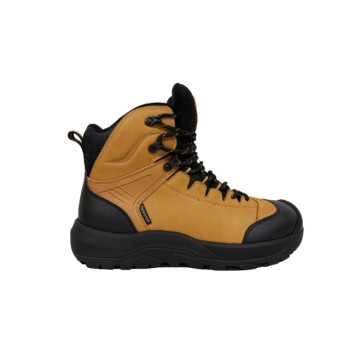
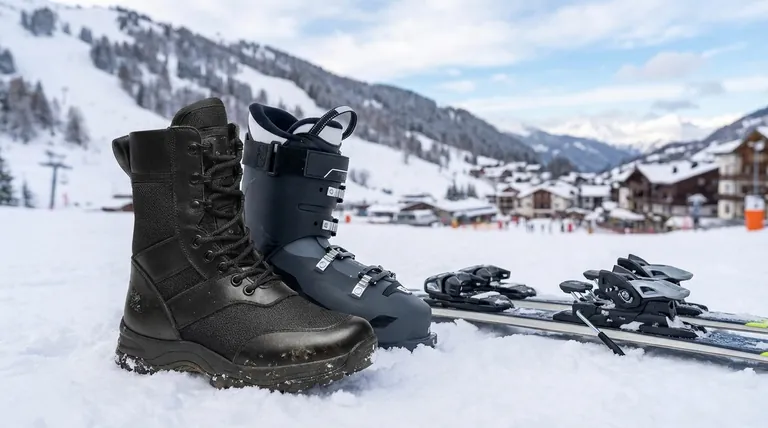
Critically, you should never use tactical boots for any form of skiing. While they are excellent for many cold-weather activities, they are fundamentally incompatible with the mechanics and safety requirements of ski equipment. Skiing requires a specialized, rigid boot that locks into a ski binding to control the ski and release safely during a fall; a tactical boot can do neither.
The core issue is a mismatch of function. Tactical boots are designed for walking with a flexible sole, while ski boots are a piece of rigid performance equipment designed to transfer force from your body to a ski's edge. Using the wrong tool for this job is not a matter of preference—it is a significant safety risk.
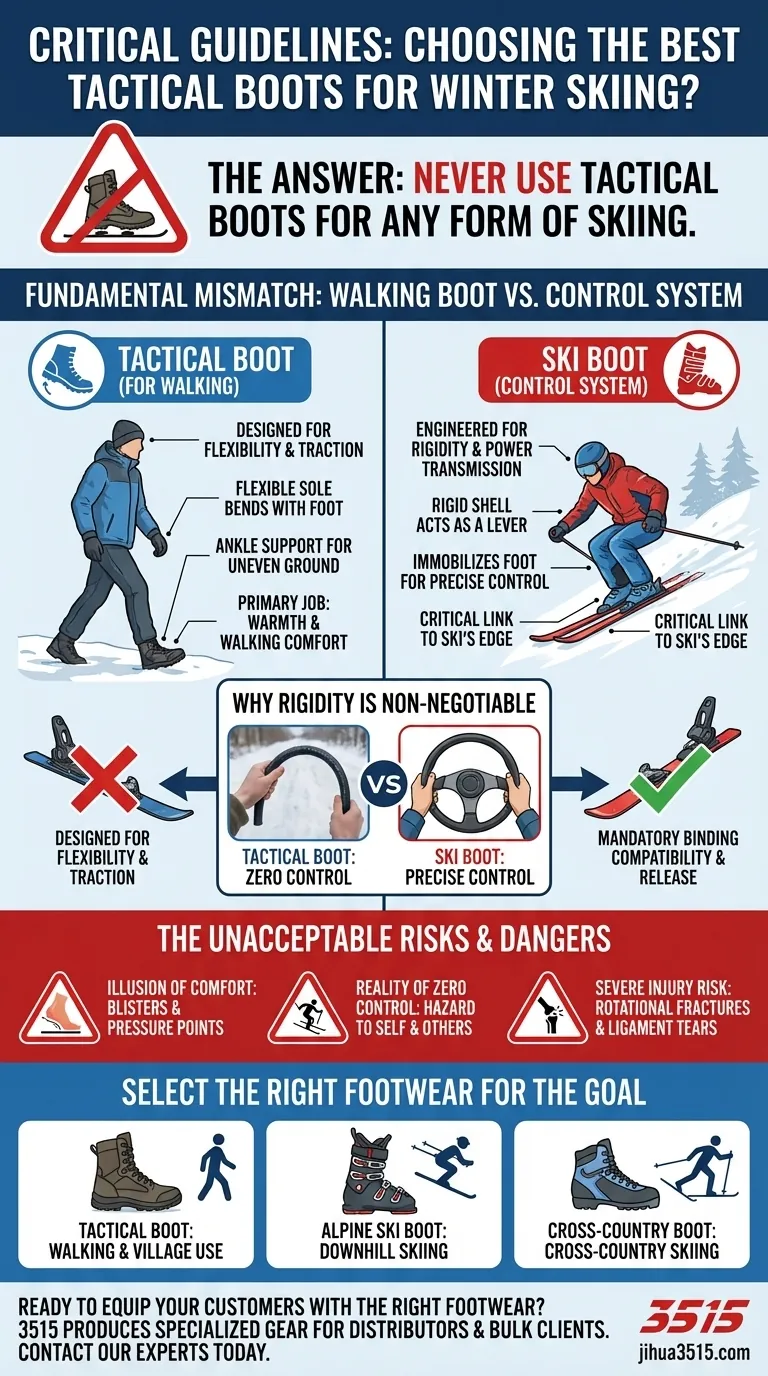
The Fundamental Mismatch: Walking Boot vs. Control System
The question of which tactical boot to use for skiing stems from a common misunderstanding of what a ski boot actually does. It's less a piece of footwear and more a critical link in a technical system.
The Purpose of a Tactical Boot
A tactical or high-quality winter boot is engineered for flexibility and traction while walking. Its sole is designed to bend with your foot, and it provides ankle support for stability on uneven, snowy, or icy ground. Its primary job is to keep you warm and secure while moving on your own two feet.
The Critical Function of a Ski Boot
A ski boot is engineered for rigidity and power transmission. Its main purpose is to hold your foot and ankle completely immobile, allowing you to transfer minuscule movements from your legs and feet directly into the edges of your skis. This is how you steer, control speed, and stop.
Why Rigidity is Non-Negotiable
Imagine trying to steer a car with a rubber hose instead of a steering wheel. That is the effect of using a flexible tactical boot on a ski. The rigid plastic shell of a ski boot acts as a lever, giving you the precision needed to engage the ski's metal edge into the snow. Without this rigidity, your skis will not respond to your commands.
Binding Compatibility: The Core Safety Feature
Modern ski bindings are engineered to release the boot during a fall to prevent severe leg injuries. This safety system depends on the standardized shape and hard plastic welts of a ski boot. A tactical boot has no such features and cannot properly lock into or release from a binding, creating a direct path to a rotational fracture of the lower leg.
The Unacceptable Trade-offs and Dangers
Opting for a tactical boot on skis introduces risks that far outweigh any perceived benefit in comfort or convenience.
The Illusion of Comfort
You might assume a tactical boot is more comfortable or warmer for a day on the slopes. While it is more comfortable for walking, this comfort disappears the moment you try to ski. The lack of a precise fit means your foot will slide around, creating blisters and painful pressure points as you fruitlessly try to control the skis.
The Reality of Zero Control
With a flexible boot, you will lack the ability to initiate turns, hold an edge on the snow, or stop with any reliability. This not only makes the activity impossible to enjoy but also turns you into a hazard to yourself and every other person on the mountain.
The Severe Injury Risk
This is the most critical point. Without a boot-binding system that releases, your ski becomes a long, unyielding lever attached to your foot. Any fall, even a small one, can apply immense twisting force to your shin and knee, leading to torn ligaments (like the ACL) and spiral fractures of the tibia.
How to Select the Right Footwear for Skiing
Instead of adapting the wrong tool, the solution is to select the correct, specialized equipment for the job.
Understand the Ski Boot System
A modern ski boot has two key parts: a hard outer shell for control and a soft inner liner for fit and warmth. The goal is to find a shell that matches your foot shape and a liner that provides a snug, comfortable fit.
Fit is Everything
Unlike winter boots where you might size up for thick socks, ski boots must be precisely fitted. A professional boot fitter will measure your foot's length and width to find the right size. A snug fit prevents your foot from moving, which is the key to both comfort and performance.
Focus on Flex, Not Insulation Ratings
The most important metric for a ski boot is its flex rating—a number that indicates how stiff the shell is. Beginners need a softer, more forgiving flex (e.g., 60-90), while experts require a much stiffer boot (e.g., 120-140) for high-speed power transmission. This is far more relevant than a generic insulation gram count.
Making the Right Choice for Your Goal
Selecting the correct footwear starts with identifying your actual activity.
- If your primary focus is downhill (alpine) or backcountry skiing: You must use a dedicated, rigid ski boot that is professionally fitted to your foot and compatible with your ski bindings.
- If your primary focus is cross-country skiing: You need a specific, much more flexible cross-country ski boot that clips into the appropriate cross-country binding system.
- If your primary focus is walking around a ski resort or village: A high-quality insulated tactical or winter boot is the perfect choice for warmth, comfort, and traction on snow and ice.
Using equipment designed specifically for your intended purpose is the most important step toward a safe and enjoyable time in the mountains.
Summary Table:
| Footwear Type | Primary Function | Sole Rigidity | Binding Compatibility | Suitable Activity |
|---|---|---|---|---|
| Tactical Boot | Walking & Ankle Support | Flexible | No | Hiking, Village Use |
| Alpine Ski Boot | Power Transmission & Control | Rigid | Yes (Mandatory) | Downhill Skiing |
| Cross-Country Ski Boot | Forward Flex & Kick | Flexible (Ankle) | Yes (Specific) | Cross-Country Skiing |
Ready to Equip Your Customers with the Right Footwear?
As a large-scale manufacturer, 3515 produces a comprehensive range of specialized footwear for distributors, brand owners, and bulk clients. Our production capabilities encompass all types of boots, from high-performance ski boots to durable tactical and winter footwear, ensuring your customers get the perfect gear for their specific activity.
Contact our experts today to discuss your product needs and how we can support your business with reliable, high-quality manufacturing.
Visual Guide
Related Products
- Premium Insulated Safety Boots and Shoes for Wholesale & Bulk Orders
- Factory Direct Wholesale Rain Boots Durable Waterproof & Fully Customizable
- Durable Waterproof Rain Boots | Custom Manufacturer for Wholesale & Brands
- Wholesale Waterproof Tactical Boots Custom Suede & High-Traction Soles
- High Performance Fire-Retardant Waterproof Safety Boots
People Also Ask
- What are the recommended insulation ratings for mild winter conditions? A Guide for Active & Stationary Workers
- How does insulation thickness correlate with temperature ranges? A Guide to Choosing the Right Warmth
- What insulation level is needed for severe cold and stationary work? 1200g or Higher is Essential
- What safety advantages do insulated boots offer beyond warmth? Dielectric Protection & Superior Grip
- How does fleece lining contribute to the warmth of insulated boots? Trapping Air for Superior Cold Protection