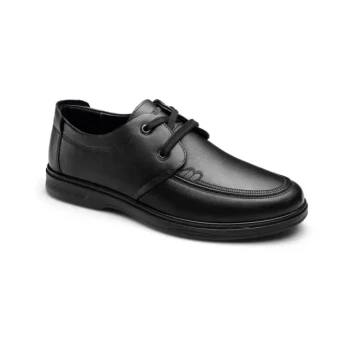
An industrial-grade 3D depth camera functions as the primary sensory input for an automated shoe polishing unit, bridging the gap between rigid mechanical programming and the variable nature of footwear. It performs a three-dimensional scan of the workspace to identify the shoe's model, size, and orientation (left vs. right) while simultaneously verifying its exact spatial position on the holder.
True automation requires adaptability. By integrating 3D vision, a polishing unit evolves from a blind machine into an intelligent system capable of recognizing distinct products and mechanically compensating for human or fixture loading errors.
The Role of Visual Identification
To achieve a consistent finish, the machine must first understand exactly what object is currently loaded into the workspace.
Scanning the Workspace
The process begins with the camera performing a complete three-dimensional scan of the polishing area. This creates a dense point cloud or depth map that represents the physical geometry of the object on the holder.
Determining Model and Attributes
The vision system analyzes the scan data to classify the shoe. It identifies the specific model type and determines the size of the footwear.
Orientation Logic
Crucially, the system distinguishes between the left and right foot. This ensures that the polishing arms apply the correct pressure and angle profiles appropriate for the specific curvature of that side.
Dynamic Spatial Calibration
In industrial environments, mechanical fixtures are rarely perfect. The 3D camera compensates for physical inconsistencies to protect the leather and the machinery.
Verifying Exact Position
Even with a standardized holder, a shoe may be loaded slightly off-center or at a minor angle. The depth camera verifies the actual spatial position of the shoe relative to the robot's coordinate system.
Detecting Offsets
The system compares the live scan against the expected "ideal" position. It calculates the delta—the precise distance and rotational difference between where the shoe should be and where it is.
Adaptive Trajectory Control
The ultimate value of the vision system lies in how it influences the machine's movement.
Modifying Pre-Stored Paths
The automated unit operates using pre-stored trajectories—specific movements programmed for a known shoe model. The camera does not invent new paths; it adapts existing ones.
Ensuring Target Alignment
When an offset is detected, the system mathematically recalibrates the pre-stored trajectory. This shifts the polishing path to align perfectly with the target leather areas, ensuring the tool follows the shoe's actual surface rather than a theoretical one.
Understanding the Trade-offs
While 3D vision enhances automation, it introduces specific dependencies that must be managed.
Dependency on Pre-Defined Libraries
The system's adaptability is limited to recalibrating pre-stored trajectories. If a shoe model has not been previously programmed into the database, the camera can see it but the machine cannot polish it effectively.
Sensitivity to Occlusion
The accuracy of the trajectory correction is entirely dependent on the quality of the scan. If the view of the shoe is obstructed or if the camera lens is dirty, the spatial verification may fail, potentially leading to improper contact with the shoe.
Making the Right Choice for Your Process
Successful implementation depends on aligning the camera's capabilities with your operational workflow.
- If your primary focus is mixed-batch processing: Ensure your software library is robustly populated with pre-stored trajectories for every model and size, as the camera relies on these baselines to perform recalibration.
- If your primary focus is minimizing loading errors: Prioritize the camera’s spatial verification features to automatically correct for inconsistencies in how operators place shoes on the holders.
By leveraging 3D depth sensing, you ensure that every polishing cycle is precise, forgiving of mechanical variance, and tailored to the specific geometry of the product.
Summary Table:
| Function | Description | Benefit |
|---|---|---|
| 3D Scanning | Generates a dense point cloud of the shoe geometry | Creates a precise digital map for the robot |
| Model Identification | Classifies size, model type, and left/right orientation | Selects the correct pre-stored polishing path |
| Spatial Calibration | Detects offsets between the shoe and the mechanical holder | Compensates for human or fixture loading errors |
| Trajectory Correction | Recalibrates pre-stored paths to match actual surface | Ensures consistent finish and prevents leather damage |
Elevate Your Footwear Production with 3515 Automation Expertise
As a large-scale manufacturer serving global distributors and brand owners, 3515 combines decades of footwear craftsmanship with cutting-edge production capabilities. Our extensive portfolio—ranging from our flagship Safety Shoes and Tactical Boots to high-end Dress & Formal shoes, outdoor gear, and sneakers—is built on precision and quality.
By integrating advanced technologies like 3D vision systems into our manufacturing workflows, we ensure that every product meets the highest standards of consistency and durability. Whether you need bulk manufacturing for work boots or specialized training footwear, our team is ready to deliver tailored solutions that meet your specific requirements.
Ready to scale your production with a reliable partner? Contact 3515 today to discuss your bulk manufacturing needs!
References
- Jorge Borrell Méndez, J. Ernesto Solanes. Cooperative human–robot polishing for the task of patina growing on high-quality leather shoes. DOI: 10.1007/s00170-022-10620-6
This article is also based on technical information from 3515 Knowledge Base .
Related Products
- Lightweight Breathable Sneakers with Wet-Traction Grip for Wholesale & Private Label
- Wholesale Lightweight Cushioned Athletic Sneakers for Custom Bulk Production
- Lightweight Breathable Training Shoes for Wholesale & Custom OEM Manufacturing
- Wholesale Durable Camouflage Canvas Shoes with High-Traction Cleated Rubber Sole
- Wholesale Durable & Breathable Training Shoes for Custom Brands
People Also Ask
- Why are breathable sneakers necessary for tropical commuting? Stay Cool and Dry in High Humidity
- What role do lightweight training shoes play in urban traffic? Boost Agility and Reaction for Safer City Navigation
- How do lightweight shoes provide support? The Science of Efficient Cushioning & Stability
- What are the style advantages of lightweight shoes? Sleek, Versatile & Modern Comfort
- How do lightweight shoes contribute to healthier feet? Reduce Fatigue & Prevent Foot Problems