
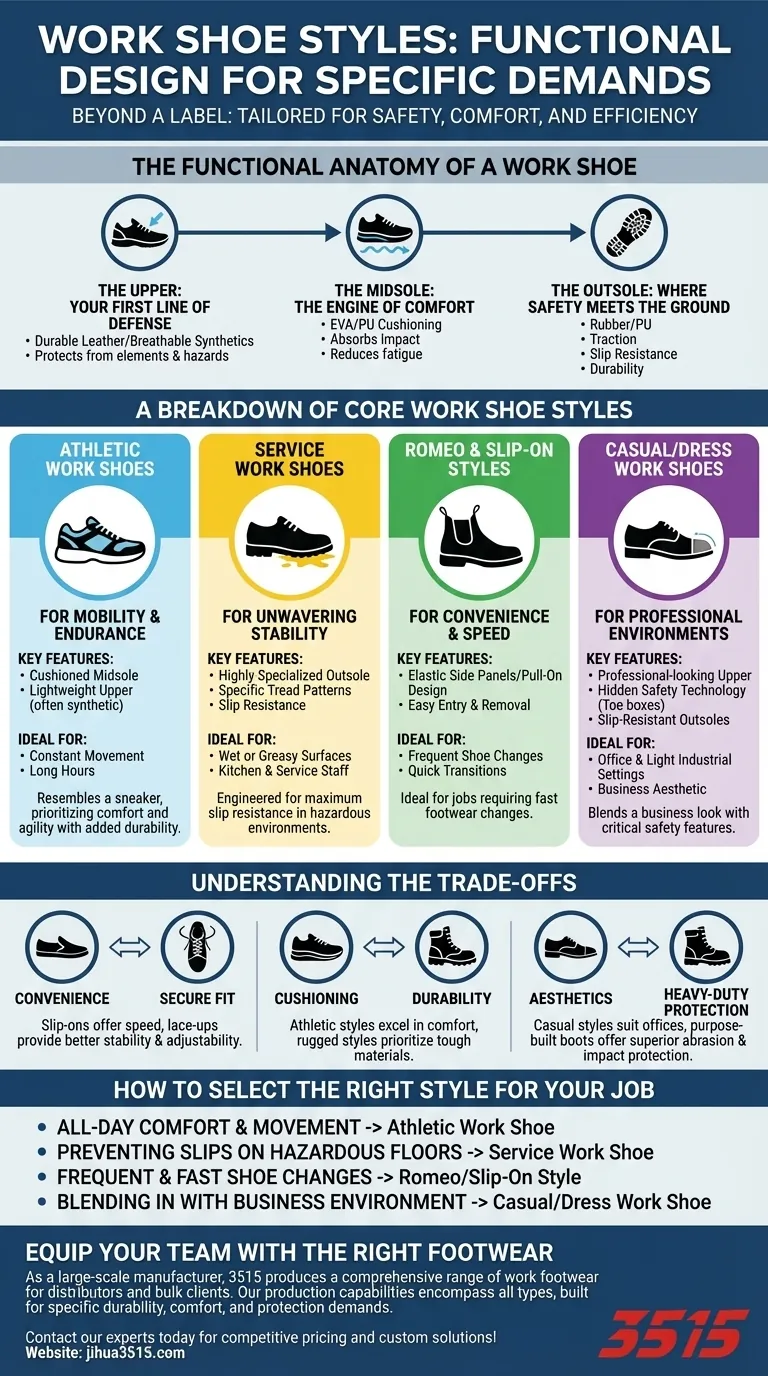
Beyond a simple label, work shoe styles are defined by their functional design, each tailored for a specific environment and set of tasks. The primary styles include lightweight Athletic Work Shoes for mobility, non-slip Service Work Shoes for hazardous floors, easy-on Romeo styles for convenience, and professional Casual/Dress Work Shoes that discreetly include safety features.
The most critical insight is that "style" in the context of work footwear is a direct reflection of its intended function. The right choice is not about appearance, but about aligning the shoe's construction with the specific demands of your job for safety, comfort, and efficiency.
The Functional Anatomy of a Work Shoe
To understand the different styles, you must first understand the three core components that dictate their performance. Each style emphasizes one of these areas to meet a specific need.
The Upper: Your First Line of Defense
The upper is the material that wraps around your foot. It's typically made from durable leather or breathable synthetics, designed to protect you from the elements and workplace hazards.
The Midsole: The Engine of Comfort
This is the hidden layer between your foot and the outsole, providing essential cushioning. Materials like EVA or polyurethane (PU) absorb impact, reducing fatigue during long hours on your feet.
The Outsole: Where Safety Meets the Ground
The outsole is the bottom of the shoe that makes contact with the ground. It is engineered from materials like rubber or PU for traction, slip resistance, and durability against abrasion.
A Breakdown of Core Work Shoe Styles
Each style is a unique combination of the three core components, optimized for a particular type of work.
Athletic Work Shoes: For Mobility and Endurance
These shoes prioritize a cushioned midsole and a lightweight, often synthetic upper. They are built for professionals who are constantly moving and need all-day comfort, resembling a sneaker but with added durability.
Service Work Shoes: For Unwavering Stability
The defining feature of a service shoe is its highly specialized outsole. It is engineered with specific tread patterns and rubber compounds to provide maximum slip resistance on wet or greasy surfaces, making it essential for kitchen and service staff.
Romeo & Slip-On Styles: For Convenience and Speed
This style is defined by its upper, which features elastic side panels or a pull-on design for easy entry and removal. They are ideal for jobs where you need to change footwear quickly or frequently.
Casual/Dress Work Shoes: For Professional Environments
These shoes blend a professional-looking upper with critical safety technology. They often incorporate hidden features like protective toe boxes and slip-resistant outsoles, allowing you to maintain a business aesthetic without compromising on safety.
Understanding the Trade-offs
No single shoe style is perfect for every situation. Choosing one means prioritizing certain features over others.
Convenience vs. Secure Fit
Slip-on styles like the Romeo offer unmatched convenience. However, a traditional lace-up design, common in athletic and dress styles, will always provide a more secure and adjustable fit for better foot stability.
Cushioning vs. Durability
Athletic styles excel in comfort due to their thick midsoles. This focus on cushioning can sometimes come at the expense of the rugged durability found in shoes with tougher leather uppers and more rigid outsoles.
Aesthetics vs. Heavy-Duty Protection
Casual/Dress Work Shoes are excellent for office or light industrial settings. However, their refined uppers will not offer the same level of protection against abrasion and impact as a purpose-built work boot.
How to Select the Right Style for Your Job
Your choice should be a direct response to the primary demands of your workday.
- If your primary focus is all-day comfort and constant movement: An Athletic Work Shoe offers the best combination of cushioning and flexibility.
- If your primary focus is preventing slips on hazardous floors: A Service Work Shoe with a certified non-slip outsole is the only correct choice.
- If your primary focus is frequent and fast shoe changes: A Romeo or other slip-on style will provide the efficiency you need.
- If your primary focus is blending in with a business environment: A Casual/Dress Work Shoe integrates safety into a professional package.
By understanding that a work shoe's style is determined by its function, you can confidently select the footwear that actively supports your safety and performance.
Summary Table:
| Style | Primary Focus | Key Features | Ideal For |
|---|---|---|---|
| Athletic Work Shoes | All-day comfort & mobility | Cushioned midsole, lightweight upper | Constant movement, long hours |
| Service Work Shoes | Slip resistance & stability | Specialized non-slip outsole | Wet/greasy floors (e.g., kitchens) |
| Romeo/Slip-On Styles | Convenience & speed | Elastic panels, easy on/off | Frequent shoe changes |
| Casual/Dress Work Shoes | Professional look with safety | Discreet safety toes, slip-resistant sole | Office & light industrial settings |
Need the right work shoe for your team?
As a large-scale manufacturer, 3515 produces a comprehensive range of work footwear for distributors, brand owners, and bulk clients. Our production capabilities encompass all types of safety shoes and boots, from athletic and service styles to professional dress shoes, all built to meet specific job demands for durability, comfort, and protection.
Let us help you equip your workforce with the perfect functional footwear. Contact our experts today for competitive pricing and custom solutions!
Visual Guide
Related Products
- Durable Leather Moc Toe Work Boots for Wholesale & Custom Manufacturing
- Durable Canvas Work Shoes with Rubber Lug Sole | Wholesale Manufacturer
- Durable Goodyear Welt Leather Work Boots for Wholesale & Private Label
- Durable Leather Work Boots for Wholesale & Custom Manufacturing
- Durable Leather Work Boots for Wholesale & Custom OEM Manufacturing
People Also Ask
- What are moc toe work boots designed for? Superior Comfort and Mobility for Tradespeople
- What are the key features to look for when purchasing moc toe boots? A Guide to Durability & Fit
- How did moc toe boots originate? A Legacy of Workwear Durability and Style
- What clothing items complement the Outdoorsman/Heritage Look with moc toe boots? Build a Timeless, Rugged Wardrobe
- What types of outfits can moc toe boots be worn with? Versatile Style Guide

















