In winter cycling, keeping your feet warm is a non-negotiable part of a successful ride. The most common and effective solutions involve a layered system, starting with merino wool socks and progressing to insulated overshoes (booties), or dedicated winter-specific cycling shoes for the coldest conditions. For extreme cold, chemical toe warmers can be added for active heating.
Your feet are often the first part of your body to get cold because cycling uses them less intensely than running, reducing internal heat generation. The solution isn't a single product, but a complete system designed to manage circulation, insulate against heat loss, and block external wind and moisture.
Why Your Feet Get Cold First
Understanding the core problem is the first step to solving it. Your feet are uniquely vulnerable to cold during cycling for two primary reasons.
The Circulation Problem
Your body's survival instinct is to protect your vital organs. When it senses cold, it reduces blood flow to your extremities—your hands and feet—to keep your core warm.
Because cycling involves less dynamic foot muscle engagement than walking or running, your feet generate very little of their own heat, making this circulation issue even more pronounced.
The External Attack
Your feet lose heat to the environment in several ways. Wind (convection) strips warmth away, contact with cold metal cleats and pedals pulls heat out (conduction), and dampness from sweat or precipitation (evaporation) rapidly chills the skin.
Building Your Foot-Warming System
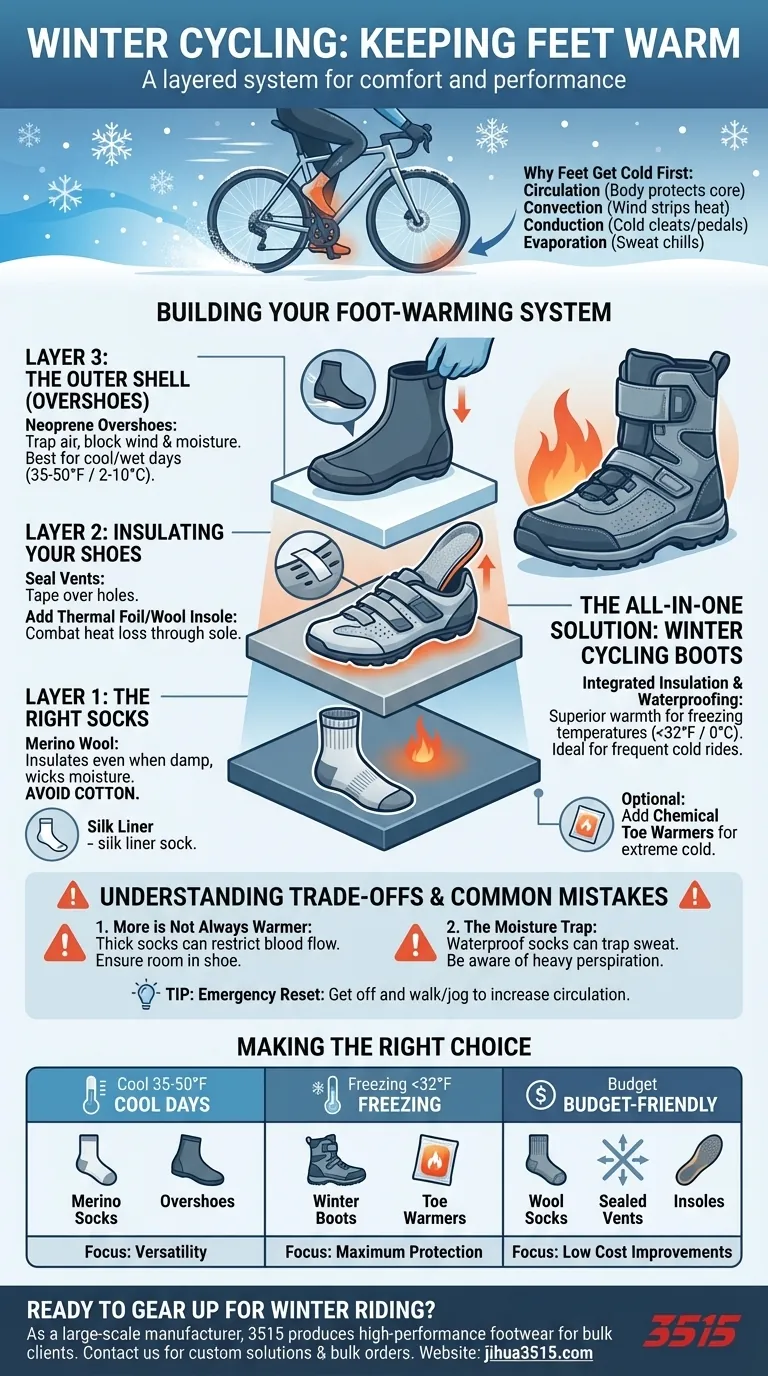
Think of your solution as a series of defensive layers. Each layer has a specific job in combating heat loss and protecting you from the elements.
Layer 1: The Right Socks
This is your foundation. The goal is insulation and moisture management.
Merino wool is the gold standard. It insulates even when damp and wicks moisture away from your skin. Avoid cotton at all costs, as it holds moisture and accelerates heat loss.
If your shoes have enough room, a thin silk or merino liner sock under a medium-weight wool sock can add significant warmth.
Layer 2: Insulating Your Shoes
Your standard cycling shoes are designed for ventilation, which is a liability in winter. You must seal them against the cold.
Start by placing tape over any ventilation holes on the top and bottom of the shoe. You can also add a bead of silicone to seal the cleat holes from underneath.
Replacing the standard footbed with an insulated insole made of wool or a thermal foil material is a highly effective way to fight heat loss through the sole of the shoe.
Layer 3: The Outer Shell (Overshoes)
Overshoes, or "booties," are one of the most effective pieces of winter cycling gear. They fit over your existing cycling shoes.
Neoprene overshoes are excellent, providing a thermal barrier that traps air and blocks wind completely. They are your primary defense against convective heat loss and are often water-resistant.
The All-in-One Solution: Winter Cycling Boots
For those who ride frequently in freezing temperatures, dedicated winter cycling boots are a worthwhile investment.
These boots combine insulation, a waterproof membrane, and a windproof outer shell into a single, integrated unit. They offer superior warmth and protection compared to a shoe-and-overshoe combination.
Understanding the Trade-offs and Common Mistakes
Simply adding more layers can sometimes make the problem worse. Awareness of these common pitfalls is critical for staying warm.
More is Not Always Warmer
The single biggest mistake is wearing socks that are too thick for your shoes.
This compresses your foot, restricting blood circulation and making your feet colder, not warmer. If you need thicker socks, you may need a slightly larger shoe for the winter season.
The Moisture Trap
Waterproof socks, like those from SealSkinz, can be useful in certain wet conditions.
However, be aware that they can also trap sweat. If your feet perspire heavily, that moisture has nowhere to go, which can eventually lead to cold, clammy feet on a long ride.
A Note on DIY Solutions
While some cyclists have tried placing aluminum foil in their shoes, it is generally ineffective. The material tends to shred easily and does not provide significant, lasting insulation.
Beyond the Feet: A Holistic Approach
Sometimes, the source of cold feet isn't just at your feet. Your body's entire system for regulating temperature plays a role.
The Emergency Reset
If your feet become painfully cold mid-ride, the best solution is to get off the bike.
Jogging or walking briskly for a few minutes forces your leg muscles to work harder, dramatically increasing blood flow and pushing warm blood back into your feet.
Your Core and Hips Matter
Your body's circulation is a closed loop. If your hips and upper legs get cold, the blood flowing down to your feet is already chilled.
Wearing insulated tights or thermal bibs helps keep your body's core temperature stable, ensuring warmer blood is available to circulate to your extremities.
Making the Right Choice for Your Ride
Your ideal setup depends on the conditions you ride in and your budget.
- If your primary focus is versatility for cool days (35-50°F / 2-10°C): Start with quality merino wool socks and a good pair of neoprene overshoes over your regular cycling shoes.
- If your primary focus is riding comfortably in freezing temperatures (below 32°F / 0°C): Invest in dedicated winter cycling boots and consider adding chemical toe warmers for the longest, coldest rides.
- If your primary focus is budget-friendly improvements: Focus on sealing your shoe vents, using wool socks, and adding insulated insoles to combat heat loss through the soles.
By combining the right gear into a thoughtful system, you can eliminate cold feet as the limiting factor in your winter cycling.
Summary Table:
| Solution | Best For | Key Benefit |
|---|---|---|
| Merino Wool Socks | All Conditions | Moisture-wicking, insulates when damp |
| Neoprene Overshoes | Windy/Wet Conditions (35-50°F / 2-10°C) | Blocks wind & water, traps heat |
| Winter Cycling Boots | Freezing Temperatures (<32°F / 0°C) | Integrated insulation & waterproofing |
| Insulated Insoles | Combatting Sole Heat Loss | Adds thermal barrier inside shoe |
| Chemical Toe Warmers | Extreme Cold/Long Rides | Provides active, targeted heat |
Ready to Gear Up for Winter Riding?
As a large-scale manufacturer, 3515 produces a comprehensive range of high-performance footwear for distributors, brand owners, and bulk clients. Whether you need reliable winter cycling boots, insulated overshoes, or other specialized footwear, our production capabilities ensure quality, durability, and thermal efficiency for all conditions.
Let’s discuss how we can support your winter cycling product needs. Contact us today to explore custom solutions and bulk ordering options.
Visual Guide
Related Products
- Premium Insulated Safety Boots and Shoes for Wholesale & Bulk Orders
- Factory Direct Wholesale Rain Boots Durable Waterproof & Fully Customizable
- Durable Waterproof Rain Boots | Custom Manufacturer for Wholesale & Brands
- Heavy-Duty Waterproof Nubuck Safety Boots Safety Shoes for Bulk Supply
- Durable Goodyear Welt Leather Work Boots for Wholesale & Private Label
People Also Ask
- What are the recommended insulation ratings for mild winter conditions? A Guide for Active & Stationary Workers
- How does insulation thickness correlate with temperature ranges? A Guide to Choosing the Right Warmth
- What insulation level is needed for severe cold and stationary work? 1200g or Higher is Essential
- What safety advantages do insulated boots offer beyond warmth? Dielectric Protection & Superior Grip
- How does fleece lining contribute to the warmth of insulated boots? Trapping Air for Superior Cold Protection