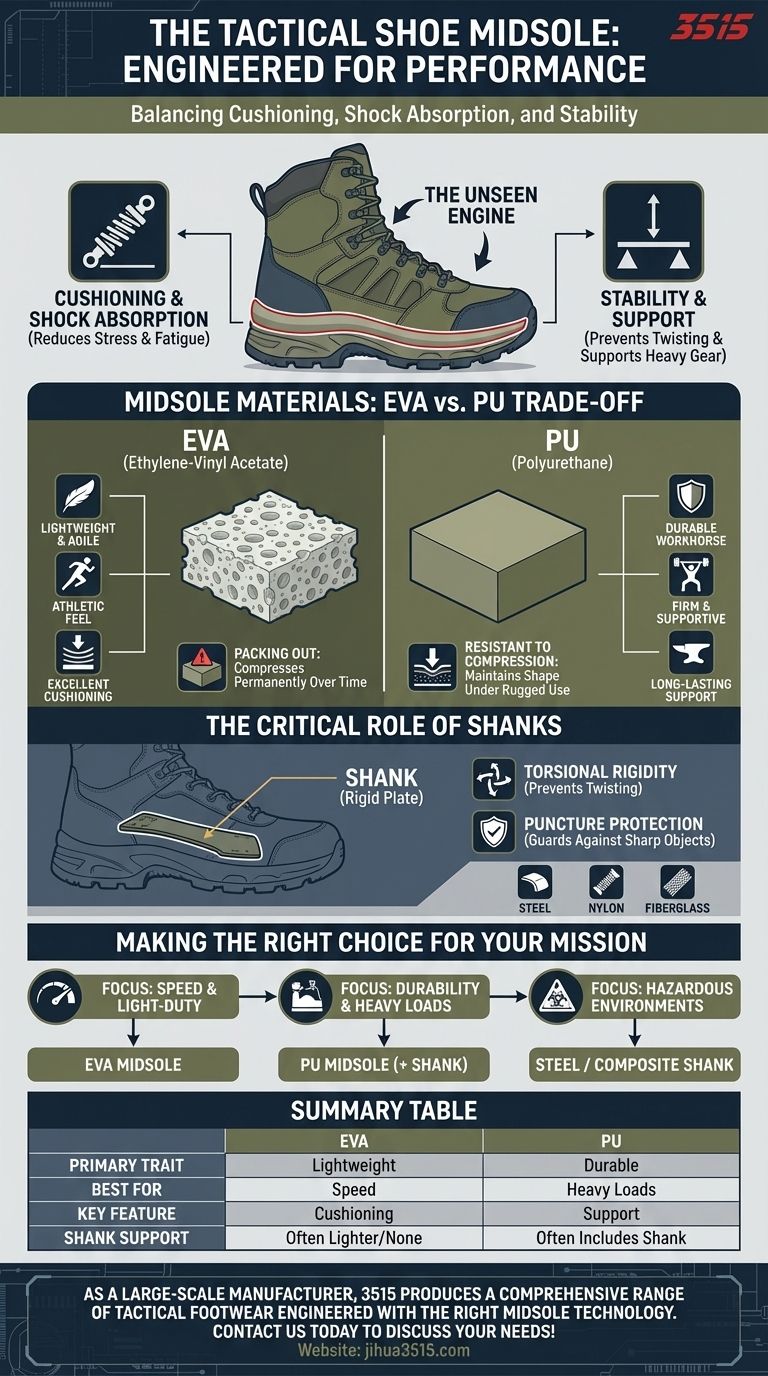
At its core, a tactical shoe midsole is engineered to provide a crucial balance of cushioning, shock absorption, and unwavering stability for demanding environments. Its primary characteristics are derived from specific materials like lightweight EVA or durable PU, often reinforced with a rigid shank to protect the foot and support heavy loads.
The choice of a tactical midsole is a fundamental trade-off between lightweight agility and long-term durability. Understanding how different materials serve these opposing needs is the key to selecting footwear that acts as a true performance tool for your specific mission.

The Midsole's Role: The Unseen Engine of Your Boot
While the outsole provides traction, the midsole is the functional core of the shoe's sole system. It dictates comfort, support, and how your foot handles impact over time.
Cushioning and Shock Absorption
The most fundamental job of the midsole is to absorb the impact of walking, running, or jumping on hard surfaces. This reduces stress on your feet, knees, and back, preventing fatigue during long periods of use.
Stability and Support
A well-designed tactical midsole provides a firm, stable platform. It prevents your foot from twisting or rolling on uneven terrain, which is especially critical when carrying heavy gear that alters your center of gravity.
Deconstructing Midsole Materials: EVA vs. PU
The material used in the midsole is the single most important factor determining its performance characteristics. The two most common options represent a classic trade-off.
EVA (Ethylene-Vinyl Acetate): The Lightweight Standard
EVA is a foam-like material known for being extremely lightweight and providing excellent initial cushioning. It gives tactical footwear a more athletic, sneaker-like feel, prioritizing flexibility and speed.
PU (Polyurethane): The Durable Workhorse
PU is a denser, heavier, and firmer polymer. While less cushy than EVA, it is significantly more durable and resistant to compression, meaning it will maintain its shape and support for much longer under rugged use.
The Critical Role of Shanks
Many high-quality tactical boots embed a supportive plate, known as a shank, within the midsole structure.
What is a Shank?
A shank is a load-bearing piece of rigid material, traditionally steel but now also composites like nylon or fiberglass. It sits between the outsole and insole, integrated with the midsole.
Torsional Rigidity
The primary function of a shank is to provide torsional rigidity. This prevents the boot from twisting, creating a much more stable platform for navigating rocky ground or climbing ladders, especially under load.
Puncture Protection
In more robust designs, particularly with steel shanks, this component offers critical protection from sharp objects like nails or glass penetrating the sole from below.
Understanding the Trade-offs
Choosing the right midsole means understanding its inherent compromises. No single design is perfect for every application.
Agility vs. Durability
This is the central conflict. An EVA midsole offers superior agility and less weight, making it ideal for fast-paced, light-duty work. A PU midsole provides superior durability and support for heavy loads but at the cost of added weight and less flexibility.
The "Packing Out" Problem
Lower-density materials, especially EVA, can suffer from compression set, or "packing out." Over time and with repeated impact, the material compresses permanently and loses its ability to absorb shock. PU is far more resistant to this.
The Cost Factor
Higher-performance materials cost more. Boots featuring durable PU midsoles and integrated shanks are typically more expensive than their lighter-duty EVA counterparts, reflecting their enhanced longevity and protective capabilities.
Making the Right Choice for Your Mission
Select your midsole based on the most likely demands of your environment and activity.
- If your primary focus is speed and light-duty use: Seek out an EVA midsole for its lightweight cushioning and athletic feel.
- If your primary focus is durability and heavy-load support: Prioritize a PU midsole, ideally with a built-in shank, for maximum stability and long-term performance.
- If your primary focus is protection in hazardous environments: A steel or composite shank is non-negotiable for guarding against punctures and providing rigidity.
By understanding the materials and structure of the midsole, you can confidently select footwear that performs as a reliable piece of equipment.
Summary Table:
| Characteristic | EVA Midsole | PU Midsole |
|---|---|---|
| Primary Trait | Lightweight & Agile | Durable & Firm |
| Best For | Speed, Light-Duty | Heavy Loads, Rugged Use |
| Key Feature | Excellent Cushioning | Long-Lasting Support |
| Shank Support | Often Lighter/None | Often Includes Shank |
As a large-scale manufacturer, 3515 produces a comprehensive range of tactical footwear for distributors, brand owners, and bulk clients. Our production capabilities encompass all types of tactical boots and shoes, engineered with the right midsole technology—be it lightweight EVA or durable PU with shanks—to meet your specific mission requirements. Ensure your footwear is a reliable piece of equipment. Contact us today to discuss your tactical footwear needs!
Visual Guide
Related Products
- Durable Mid-Cut Tactical Boots for Wholesale & Private Label
- Wholesale Durable Mid-Cut Tactical Boots for Custom & Private Label Brands
- Wholesale Waterproof Tactical Boots Custom Suede & High-Traction Soles
- Durable Leather High-Ankle Tactical Boots for Wholesale & Custom Manufacturing
- Durable High-Ankle Tactical Boots Wholesale Manufacturer for Custom & Bulk Orders
People Also Ask
- What are some key features of top-tier tactical boots for 2023? Find the Perfect Boot for Your Mission
- Can tactical boots be stylish for everyday wear? Yes, with the right styling and features.
- What are the weight and mobility differences between combat and tactical boots? Choose the Right Boot for Your Mission
- How should tactical boots be stored to maintain their condition? Protect Your Gear Investment
- What are the main construction similarities between tactical boots and tactical sneakers? Built for Performance & Durability