
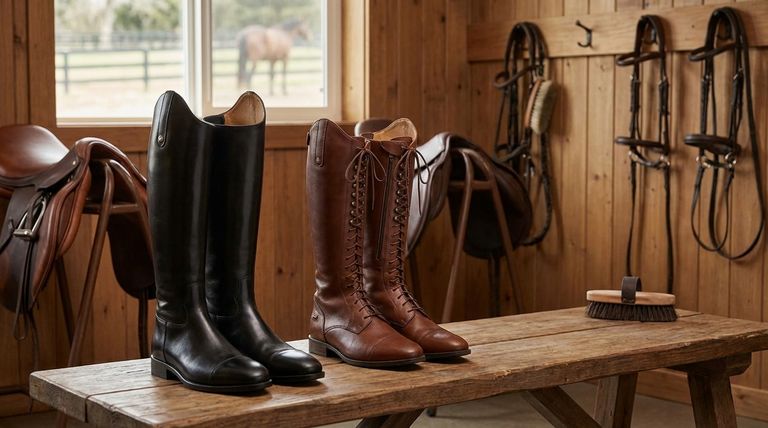
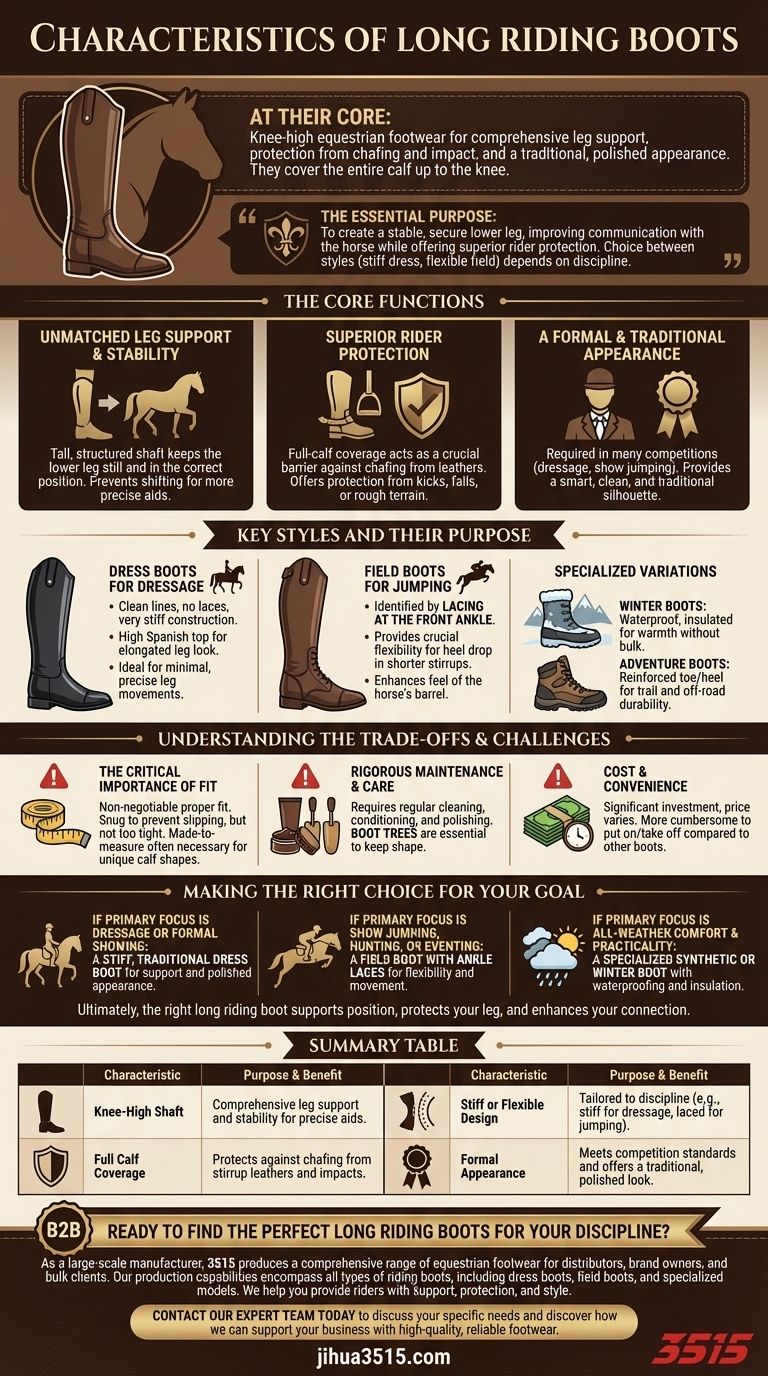
At their core, long riding boots are knee-high equestrian footwear designed to provide comprehensive leg support, protect the rider from chafing and impact, and create a traditional, polished appearance. They cover the entire calf up to the knee and are distinguished by their formal look and specialized designs tailored to different riding disciplines.
The essential purpose of a long riding boot is to create a stable, secure lower leg, which improves communication with the horse while offering the rider superior protection. The choice between styles—like the stiff dress boot or the flexible field boot—comes down to the specific demands of your riding discipline.
The Core Functions of Long Riding Boots
Long boots are more than just an aesthetic choice; they are a piece of functional equipment designed to enhance the rider's performance and safety.
Unmatched Leg Support and Stability
The tall, structured shaft of a long boot is its defining feature. It serves to keep the rider's lower leg still and in the correct position against the horse's side.
This stability prevents the leg from shifting, allowing for more precise and subtle aids.
Superior Rider Protection
The boot's full-calf coverage acts as a crucial barrier between the rider's leg and the saddle's stirrup leathers. This prevents the painful pinching and chafing that can occur with shorter boots.
They also offer a degree of protection from kicks, falls, or navigating rough terrain.
A Formal and Traditional Appearance
In many equestrian competitions, particularly dressage and show jumping, long boots are a required element of the rider's attire.
They provide a smart, clean, and traditional silhouette that is highly valued in the show ring.
Key Styles and Their Purpose
While all long boots share common traits, specific designs have evolved to meet the needs of different equestrian sports.
Dress Boots for Dressage
Dress boots are characterized by their clean lines, lack of laces, and a very stiff construction. They often have a high "Spanish top" on the outside of the knee for an elongated leg look.
This rigidity is ideal for dressage, a discipline that relies on minimal, precise leg movements.
Field Boots for Jumping
Field boots are easily identified by the lacing at the front ankle. This feature provides crucial flexibility, allowing the rider's heel to drop down comfortably in the shorter stirrup length used for jumping and cross-country.
Made of softer leather, they enhance the rider's ability to feel the horse's barrel.
Specialized Variations
Modern long boots also come in specialized forms. Winter boots are designed with waterproof materials and thin insulation for warmth without bulk.
Adventure boots are built for trail and off-road riding, featuring reinforced toe and heel areas for extra durability and safety.
Understanding the Trade-offs and Challenges
While highly effective, long boots come with practical considerations that every rider must weigh.
The Critical Importance of Fit
A proper fit is non-negotiable. The boot must be snug through the calf to prevent slipping down but not so tight that it cuts off circulation.
Finding a well-fitting boot off the rack can be challenging for riders with particularly short, long, or wide calves, sometimes making expensive made-to-measure options necessary.
Rigorous Maintenance and Care
To maintain their appearance and longevity, leather long boots require regular care. This includes cleaning off mud and sweat, conditioning the leather, and polishing.
Using boot trees is essential to help them keep their shape and prevent the ankle from collapsing.
Cost and Convenience
Long riding boots represent a significant investment, with prices varying widely based on material and custom fitting.
They can also be more cumbersome and time-consuming to put on and take off compared to paddock boots and half-chaps.
Making the Right Choice for Your Goal
Selecting the right boot depends entirely on your primary riding activity and priorities.
- If your primary focus is dressage or formal showing: A stiff, traditional dress boot is essential for providing the correct support and a polished, classic appearance.
- If your primary focus is show jumping, hunting, or eventing: A field boot with ankle laces is the superior choice for the necessary ankle flexibility and movement.
- If your primary focus is all-weather comfort and practicality: A specialized synthetic or winter boot offers features like waterproofing and insulation that may be more important than a traditional look.
Ultimately, the right long riding boot is a critical tool that supports your position, protects your leg, and enhances your connection with the horse.
Summary Table:
| Characteristic | Purpose & Benefit |
|---|---|
| Knee-High Shaft | Provides comprehensive leg support and stability for precise aids. |
| Full Calf Coverage | Protects against chafing from stirrup leathers and impacts. |
| Stiff or Flexible Design | Tailored to discipline (e.g., stiff for dressage, laced for jumping). |
| Formal Appearance | Meets competition standards and offers a traditional, polished look. |
Ready to find the perfect long riding boots for your discipline?
As a large-scale manufacturer, 3515 produces a comprehensive range of equestrian footwear for distributors, brand owners, and bulk clients. Our production capabilities encompass all types of riding boots, including dress boots, field boots, and specialized winter or adventure models. We can help you provide riders with the ideal combination of support, protection, and style.
Contact our expert team today to discuss your specific needs and discover how we can support your business with high-quality, reliable footwear.
Visual Guide
Related Products
- Durable High-Ankle Tactical Boots Wholesale Manufacturer for Custom & Bulk Orders
- Durable High-Ankle Tactical Boots for Wholesale & Custom Manufacturing
- Wholesale High-Traction Camo Boots - Custom Manufacturer for Brands
- Wholesale Tactical Boots High-Traction & Reflective for Bulk & Brand Orders
- Durable Leather High-Ankle Tactical Boots for Wholesale & Custom Manufacturing
People Also Ask
- What specialized protections do tactical boots offer? Maximize Endurance with High-Performance Footwear
- How do tactical boots protect against injuries? Discover the Integrated Safety System
- What are the ideal use cases for tactical boots? Empower Your Performance in Demanding Scenarios
- Can tactical boots be stylish for everyday wear? Yes, with the right styling and features.
- What are the primary benefits of wearing tactical boots for everyday use? Get All-Day Comfort & Durability


















