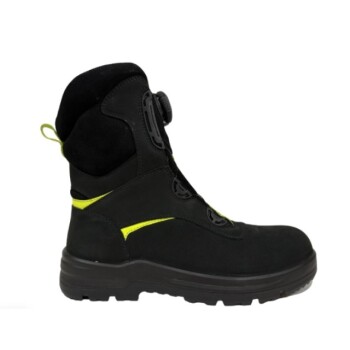
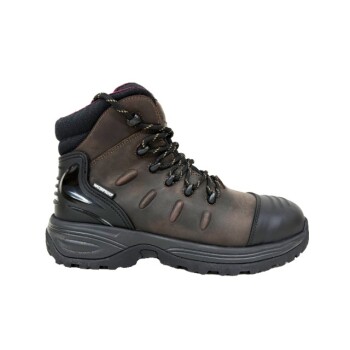
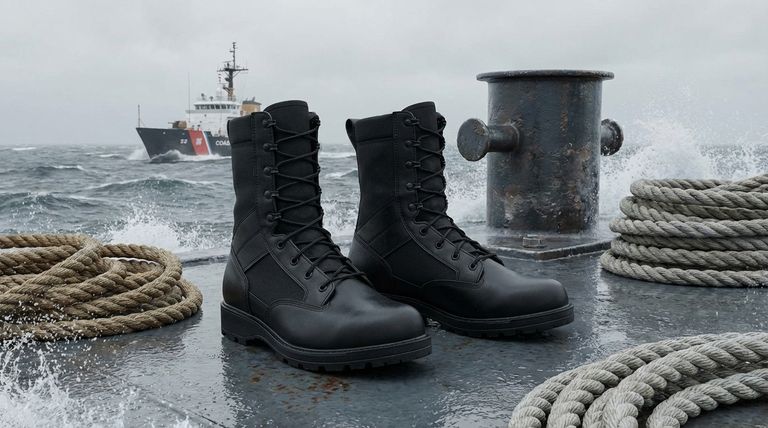
At their core, Coast Guard boots are standardized black footwear, standing 8 to 10 inches tall, and most often feature a composite safety toe. They are engineered to comply with specific military regulations (M1020.6J) while providing the durability and comfort required for demanding maritime missions, such as search and rescue operations.
The design of a Coast Guard boot is a deliberate compromise, prioritizing long-duration comfort, agility, and compliance over the extreme protective features found in more specialized tactical or industrial footwear.
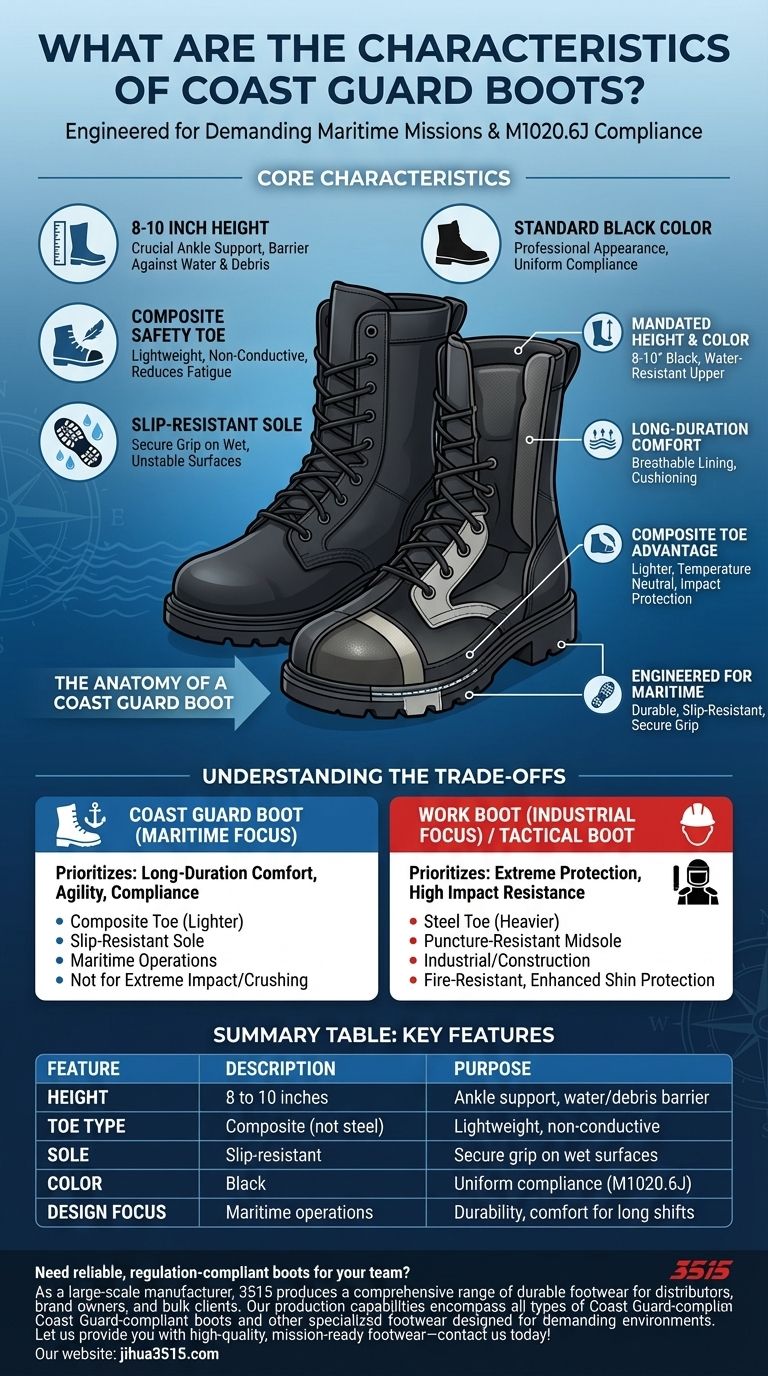
The Anatomy of a Coast Guard Boot
Every feature of a Coast Guard-compliant boot is driven by the unique demands of service on and near the water. The design choices reflect a balance between protection, uniform standards, and the physical endurance required of personnel.
Mandated Height and Color
The required 8 to 10-inch height is not arbitrary. It provides crucial ankle support and a barrier against water, debris, and other minor hazards encountered on a vessel's deck or during shore-based activities. The uniform black color ensures a professional and standardized appearance across the service.
The Composite Toe Advantage
While steel toes offer maximum impact resistance, Coast Guard boots typically specify a composite toe. This is a critical distinction. Composite materials are significantly lighter, reducing fatigue over long 12-hour shifts. They also do not conduct heat or cold, a vital comfort factor in diverse maritime climates.
Engineered for Maritime Environments
These boots are built for durability in harsh, wet conditions. Key features often include water-resistant leather uppers and, most importantly, slip-resistant outsoles designed to provide a secure grip on wet and often unstable surfaces. The goal is to keep the wearer stable, dry, and comfortable through any mission.
Adherence to Uniform Regulations
The governing standard, M1020.6J, ensures that every boot worn meets a minimum threshold for safety, durability, and professional appearance. This regulation guarantees that all personnel are equipped with footwear appropriate for their demanding roles, removing guesswork for the service member.
Understanding the Trade-offs
No single boot can do everything perfectly. The characteristics that make a Coast Guard boot ideal for its mission are the result of specific trade-offs when compared to other types of protective footwear.
Comfort and Agility vs. Extreme Protection
The emphasis on a lightweight composite toe and overall comfort means these boots are not designed for heavy industrial or construction environments where the risk of severe crushing injuries is high. A steel-toed work boot offers superior impact protection but at the cost of added weight and fatigue.
Maritime Operations vs. High-Intensity Tactical Response
A Coast Guard boot should not be confused with a "public order" or riot boot. While protective, it lacks the specialized features for civil unrest, such as fire-resistant uppers or a reinforced midsole to protect against sharp objects from below. The design is focused on the sea, not the street.
Making the Right Choice for Your Goal
Understanding these distinctions is key to selecting the appropriate footwear for any demanding task. The mission dictates the gear.
- If your primary focus is maritime duty or long-shift patrol: A Coast Guard-style boot offers the best balance of lightweight protection, comfort, and slip resistance.
- If your primary focus is maximum impact resistance in an industrial setting: A dedicated work boot with a steel toe and puncture-resistant sole is non-negotiable.
- If your primary focus is high-threat tactical situations: Specialized public order boots with features like fire resistance and enhanced shin protection are required.
Ultimately, choosing the right boot is about clearly defining the challenges of your environment.
Summary Table:
| Feature | Description | Purpose |
|---|---|---|
| Height | 8 to 10 inches | Ankle support, water/debris barrier |
| Toe Type | Composite (not steel) | Lightweight, non-conductive |
| Sole | Slip-resistant | Secure grip on wet surfaces |
| Color | Black | Uniform compliance (M1020.6J) |
| Design Focus | Maritime operations | Durability, comfort for long shifts |
Need reliable, regulation-compliant boots for your team? As a large-scale manufacturer, 3515 produces a comprehensive range of durable footwear for distributors, brand owners, and bulk clients. Our production capabilities encompass all types of Coast Guard-compliant boots and other specialized footwear designed for demanding environments. Let us provide you with high-quality, mission-ready footwear—contact us today to discuss your needs!
Visual Guide
Related Products
- Durable Military Combat Boots with Water Drainage for Wholesale & OEM
- High-Traction Suede Tactical Boots Wholesale & Custom Manufacturing
- Wholesale Durable Mid-Cut Tactical Boots for Custom & Private Label Brands
- Durable Mid-Cut Tactical Boots for Wholesale & Private Label
- Wholesale Waterproof Tactical Boots Custom Suede & High-Traction Soles
People Also Ask
- Why must gait validation for military applications be conducted in combat boots? Ensure Data Accuracy for Soldiers
- What are the common types of combat boots? Find the Right Boot for Your Mission
- What factors should be considered when choosing military boots for hiking? Durability vs. Weight for Your Terrain
- What are the key considerations when choosing military boots? Prioritize Compliance, Environment & Fit
- How should the midfoot and heel fit in military boots? Achieve a Snug, Secure Fit for Blister Prevention