
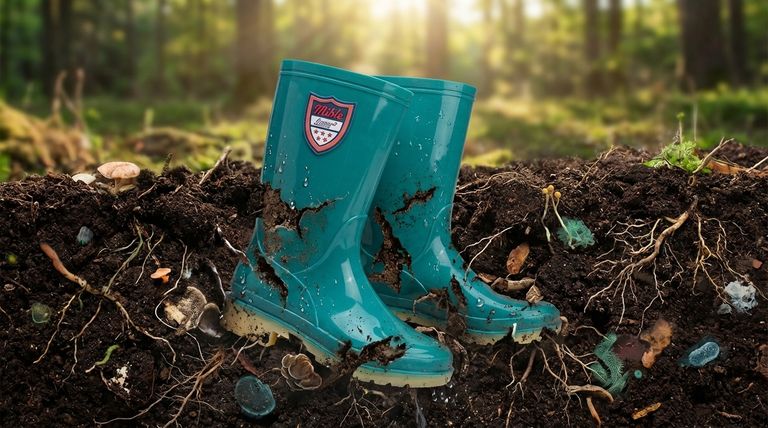
The defining characteristic of biodegradable PVC Wellington boots is their formulation with special additives that cause the plastic to break down when consistently exposed to environmental elements like microbes, moisture, and sunlight. This design aims to shorten the material's lifespan in a landfill, reducing long-term plastic waste accumulation compared to traditional PVC.
While designed to decompose and reduce permanent landfill waste, the term "biodegradable" for PVC requires careful consideration. The effectiveness and environmental safety of the breakdown process depend heavily on specific conditions and raise important questions about potential microplastic residues.
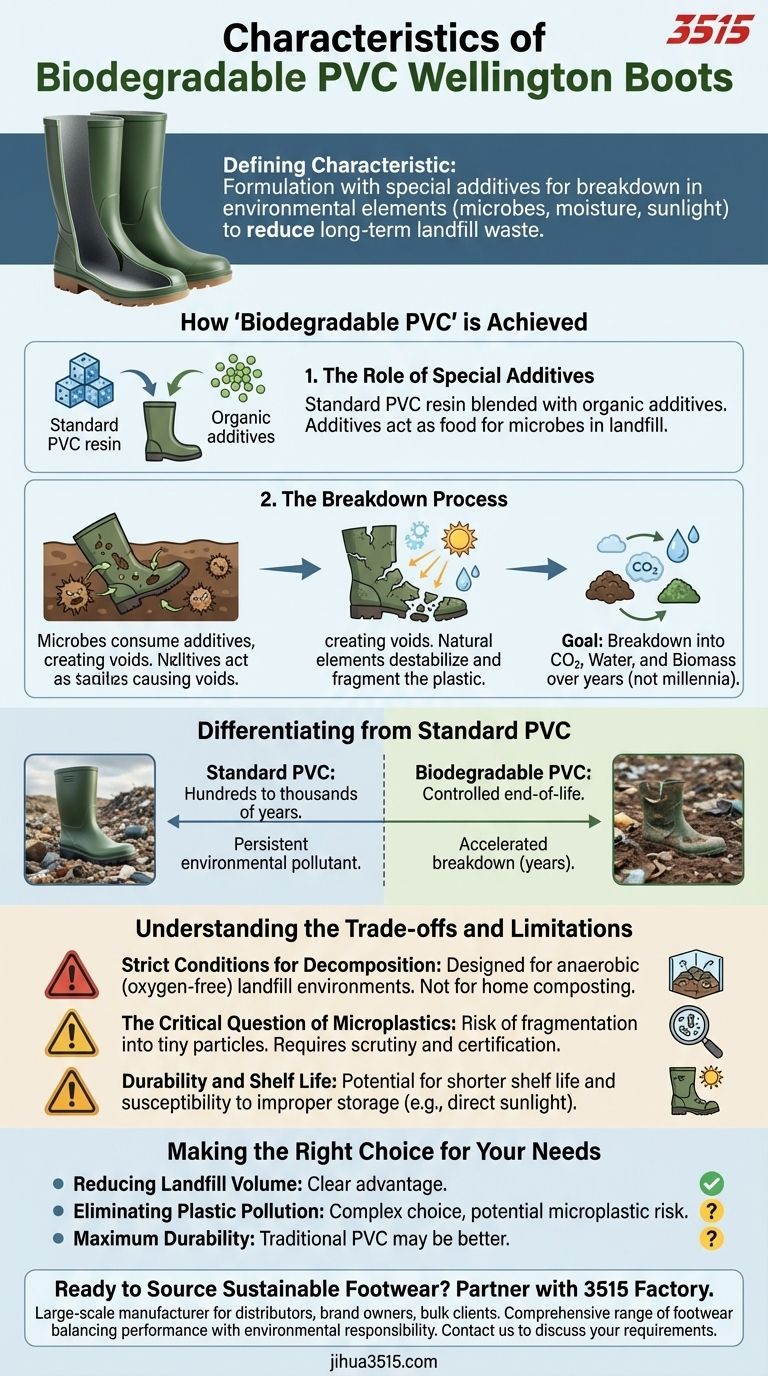
How "Biodegradable PVC" is Achieved
Polyvinyl Chloride (PVC) is not inherently biodegradable. Its famous durability is what makes it a persistent environmental pollutant. To create a biodegradable version, manufacturers must fundamentally alter its chemical stability.
The Role of Special Additives
The key to this technology is blending standard PVC resin with specific organic additives. These additives act as a food source for microbes commonly found in soil and landfill environments.
Once the boots are discarded and buried, these microbes consume the additives. This process creates microscopic voids and breaks down the molecular bonds of the surrounding PVC polymer.
The Breakdown Process
This microbial action effectively destabilizes the entire plastic structure from within. It allows natural elements like UV radiation and moisture to further fragment the material at a much faster rate than untreated PVC.
The goal is for the boot to eventually break down into simpler components like carbon dioxide, water, and biomass, rather than persisting for centuries as a whole object.
Differentiating from Standard PVC
A standard PVC Wellington boot can last for hundreds or even thousands of years in the environment without significant decomposition. Biodegradable PVC is engineered for a controlled and accelerated end-of-life, intended to happen over a period of years, not millennia.
Understanding the Trade-offs and Limitations
The claim of biodegradability is not without its complexities and potential downsides. An objective evaluation requires looking at the entire lifecycle and the specific conditions needed for decomposition.
Strict Conditions for Decomposition
These boots will not simply disappear if left in a field. The biodegradation process is designed to activate most efficiently in an anaerobic (oxygen-free) landfill environment where microbial activity is high.
In a dry or less biologically active setting, the breakdown process will be significantly slower, if it happens at all. They are not designed for home composting.
The Critical Question of Microplastics
A major concern with many "biodegradable" plastics is whether they break down completely or simply fragment into microplastics. These tiny particles can persist in the environment and enter the food chain.
It is crucial to scrutinize manufacturer claims and seek third-party certifications to understand if the end-product is benign biomass or a collection of microscopic plastic fragments.
Durability and Shelf Life
Introducing additives that promote decomposition inherently creates a trade-off with durability. While perfectly functional during their intended use, these boots may have a shorter shelf life and be more susceptible to degradation from improper storage (e.g., prolonged exposure to direct sunlight) than their conventional counterparts.
Making the Right Choice for Your Needs
Evaluating whether biodegradable PVC boots are the right choice depends entirely on your primary sustainability goal and your ability to verify the product's claims.
- If your primary focus is reducing long-term landfill volume: These boots offer a clear advantage over traditional PVC, as they are designed to break down and occupy less space over time.
- If your primary focus is eliminating all potential plastic pollution: The risk of microplastic creation makes this a more complex choice that requires deep trust in the specific manufacturer's technology.
- If your primary focus is maximum durability and longevity: A traditional PVC or natural rubber boot will likely offer a longer service life, reducing the need for frequent replacement.
Ultimately, an informed decision rests on understanding that "biodegradable" is a specific end-of-life solution, not a universal environmental panacea.
Summary Table:
| Characteristic | Description | Key Consideration |
|---|---|---|
| Core Technology | PVC resin blended with organic additives that microbes consume. | Alters the chemical stability of standard PVC to enable breakdown. |
| Breakdown Process | Microbes create voids, allowing natural elements to fragment the material. | Designed for anaerobic landfill conditions; not for home composting. |
| Primary Advantage | Reduces long-term landfill volume by breaking down over years. | A clear advantage over traditional PVC, which persists for centuries. |
| Major Limitation | Potential risk of creating microplastics if breakdown is incomplete. | Effectiveness and safety depend on specific manufacturer technology. |
| Durability Trade-off | Functional for intended use but may have a shorter shelf life. | More susceptible to degradation from improper storage than conventional boots. |
Ready to Source Sustainable Footwear? Partner with 3515 Factory.
As a large-scale manufacturer, 3515 produces a comprehensive range of footwear for distributors, brand owners, and bulk clients. Our production capabilities encompass all types of shoes and boots, including developing solutions that balance performance with environmental responsibility.
Let us help you navigate the complexities of sustainable materials and deliver high-quality products that meet your customers' needs. Contact our team today to discuss your specific requirements and explore our manufacturing solutions.
Visual Guide
Related Products
- Durable Waterproof Rain Boots | Custom Manufacturer for Wholesale & Brands
- Premium Wholesale Waterproof Safety Boots High Performance Protection for Industrial Markets
- High Performance Fire-Retardant Waterproof Safety Boots
- Durable Moc-Toe Wedge Work Boots | Wholesale Manufacturing for Brands
- Durable Military Combat Boots with Water Drainage for Wholesale & OEM
People Also Ask
- What are the main materials for waterproof rain boots? Choose the Right Material for Durability & Comfort
- What is the overall recommendation for choosing rain boot materials? A Guide to Rubber vs. PVC
- How does boot height affect waterproofing? Choose the Right Height for Ultimate Protection
- Why are rain boots more flexible and comfortable than snow boots? The Key Differences Explained
- What are the best types of shoes for different gardening conditions? Find Your Perfect Match.









