At its core, natural rubber contributes to shock absorption in footwear through its exceptional elasticity. This inherent property allows the material to deform under impact, temporarily storing and then dissipating the energy that would otherwise travel into your feet and joints, while simultaneously distributing pressure evenly across the sole.
The fundamental challenge in footwear is managing the repetitive, high-impact forces of movement. Natural rubber solves this not by being rigid, but by being resilient—its molecular structure is uniquely designed to absorb impact, protect the body, and return to its original shape.
The Mechanics of Shock Absorption
To understand why natural rubber is so effective, we need to look at its physical properties. Its performance is not a single feature but the result of how it behaves under the stress of each step.
The Critical Role of Elasticity
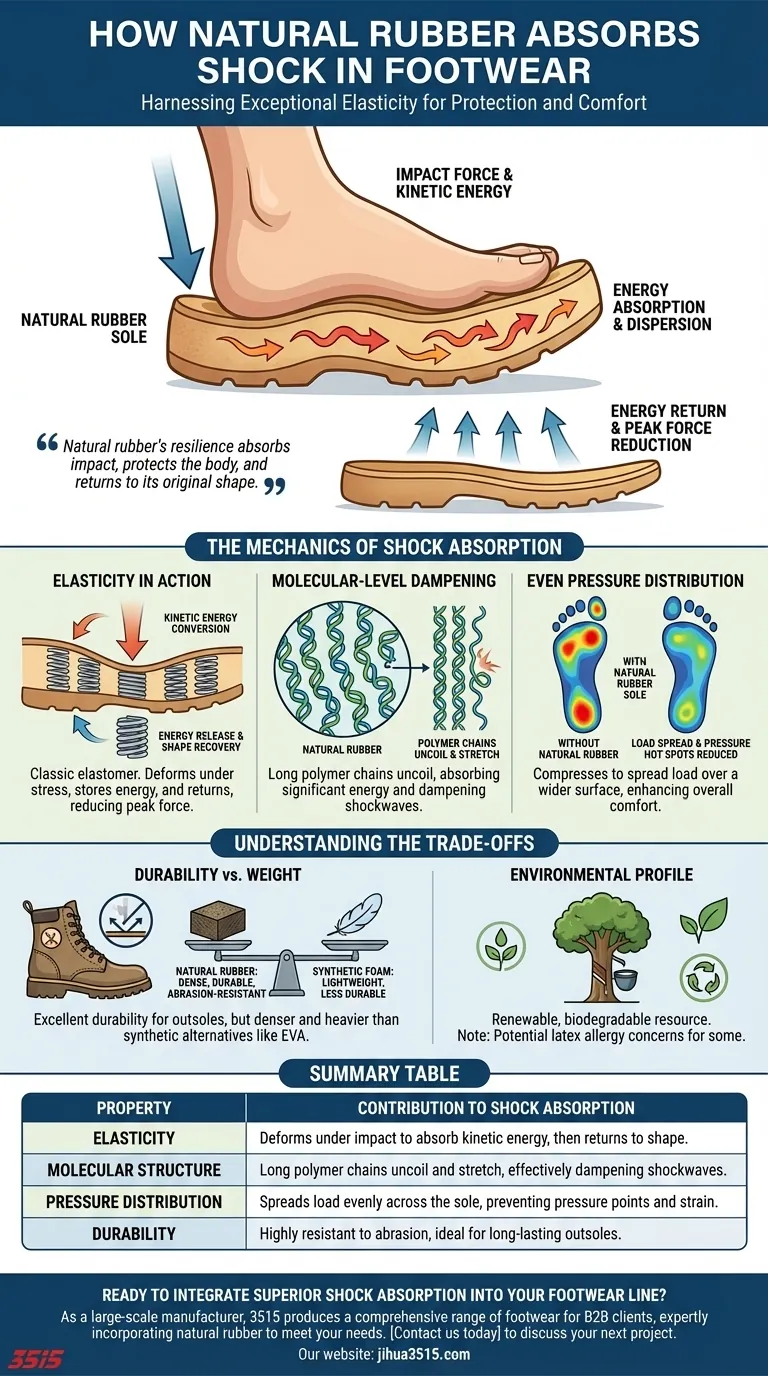
Elasticity is the ability of a material to deform under stress and then return to its original state once the stress is removed. Natural rubber is a classic elastomer.
When your foot strikes the ground, the rubber sole compresses. This deformation absorbs the kinetic energy of the impact, converting it into potential energy stored within the material's structure.
As you lift your foot, the sole expands back to its original shape, releasing that stored energy. This cycle reduces the peak force transmitted to your skeletal system.
Impact Absorption at a Molecular Level
Natural rubber is composed of long, coiled polymer chains. When an impact occurs, these chains are forced to uncoil and stretch, a process that absorbs a significant amount of energy.
This molecular-level stretching action effectively dampens the shockwave from the ground strike, preventing a jarring sensation.
The Advantage of Even Pressure Distribution
Shock isn't just about the total force; it's also about how that force is concentrated. A key benefit of natural rubber is its ability to distribute pressure evenly.
As the sole compresses, it spreads the load over a wider surface area. This prevents pressure "hot spots" under key areas like the heel or the ball of the foot, which reduces strain and enhances overall comfort.
Understanding the Trade-offs
While highly effective, choosing any material involves balancing its strengths against its limitations. Objectivity requires acknowledging where natural rubber stands in a broader context.
Durability vs. Weight
Natural rubber's resilience makes it extremely durable and resistant to abrasion, which is ideal for outsoles.
However, it is generally denser and heavier than synthetic alternatives like EVA (ethylene-vinyl acetate) foam. This makes it less common as a primary midsole material in lightweight performance running shoes.
Aesthetic and Material Variations
The sourcing and processing of natural rubber can lead to subtle variations in color and texture. This gives each sole a unique character, which can be a desirable feature for lifestyle or heritage footwear.
For products requiring absolute material uniformity, these natural inconsistencies can present a manufacturing challenge.
Environmental Profile
Natural rubber is a renewable, biodegradable resource, making it a strong choice for sustainable product design.
It is important to note, however, that a small percentage of the population has a latex allergy, which can be a consideration for certain product applications where the material might contact skin.
Making the Right Choice for Your Application
Selecting the right material depends entirely on the intended use and performance goals of the footwear.
- If your primary focus is maximum impact protection and durability: Natural rubber is an excellent choice for the outsoles of work boots, hiking shoes, or everyday footwear where longevity is paramount.
- If your primary focus is lightweight performance: Consider a hybrid design that uses lighter synthetic foams for the main midsole cushioning, with targeted natural rubber pods in high-wear, high-impact zones for traction and durability.
- If your primary focus is sustainability and unique aesthetics: Natural rubber's eco-friendly credentials and organic finish make it a compelling choice for crafting distinct, environmentally conscious footwear.
Ultimately, natural rubber provides a powerful combination of protection, durability, and sustainability grounded in its fundamental elastic properties.
Summary Table:
| Property | Contribution to Shock Absorption |
|---|---|
| Elasticity | Deforms under impact to absorb kinetic energy, then returns to shape. |
| Molecular Structure | Long polymer chains uncoil and stretch, effectively dampening shockwaves. |
| Pressure Distribution | Spreads load evenly across the sole, preventing pressure points and strain. |
| Durability | Highly resistant to abrasion, ideal for long-lasting outsoles. |
Ready to integrate superior shock absorption into your footwear line?
As a large-scale manufacturer, 3515 produces a comprehensive range of footwear for distributors, brand owners, and bulk clients. Our production capabilities encompass all types of shoes and boots, and we can expertly incorporate natural rubber to meet your specific needs for durability, comfort, and sustainability.
Contact us today to discuss how we can bring your next project to life.
Visual Guide
Related Products
- Durable Rubber Sole Outdoor Shoes Wholesale & Custom Manufacturing
- Wholesale Durable Camo Canvas Shoes with High-Traction Rubber Soles
- Durable Leather Work Boots for Wholesale & Custom Manufacturing
- Durable Leather Work Boots for Wholesale & Custom OEM Manufacturing
- Wholesale Leather Work Boots with Customizable Wedge Sole for Brands
People Also Ask
- What is the function of the sole in outdoor shoes? Find the Perfect Grip and Support
- What role do outdoor shoes and sneakers play in navigating external terrains? Engineered Stability for Every Surface
- How is AI utilized in the design of outdoor and safety footwear? Harnessing Big Data for Market-Driven Shoe Innovation
- Why is durability important when selecting outdoor shoes? A Guide to Safety & Long-Term Value
- What are the key components of outdoor shoes that affect comfort and sturdiness? A Guide to Durable, High-Performance Footwear