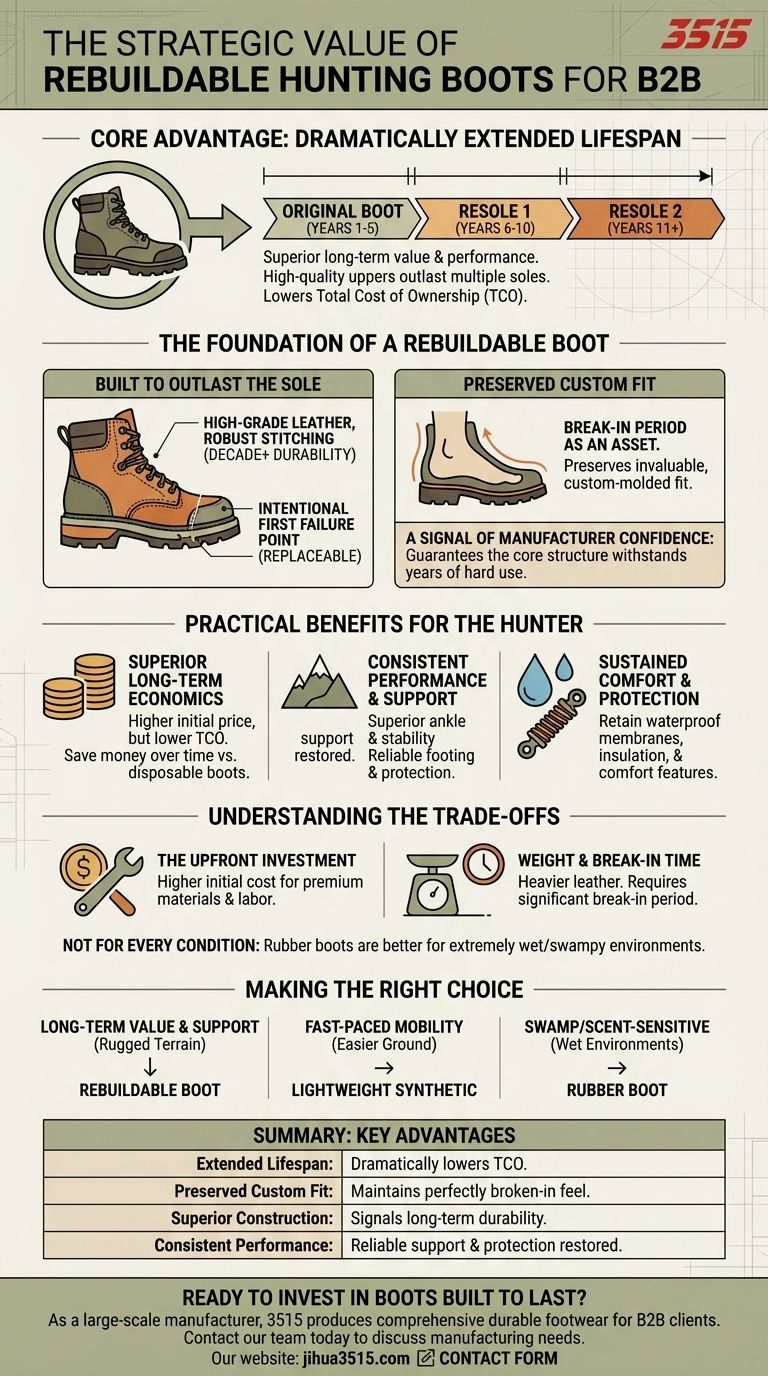
The primary advantage of rebuildable hunting boots is their dramatically extended lifespan, which delivers superior long-term value and performance. Unlike disposable footwear, these boots are constructed with high-quality uppers designed to outlast multiple soles, allowing you to maintain a perfectly broken-in fit for many years, ultimately lowering your total cost of ownership.
Rebuildable boots shift your perspective from buying a disposable product to investing in a long-term tool. The ability to replace a worn-out sole is a clear signal that the rest of the boot is built to a much higher standard of quality and durability.
The Foundation of a Rebuildable Boot
A boot isn't rebuildable just because you can glue a new sole on it. The term signifies a specific philosophy of construction focused on longevity, where the sole is intentionally designed to be the first major point of failure after extensive use.
Built to Outlast the Sole
The core concept is that the boot's upper—typically made of high-grade leather with robust stitching—is durable enough to last for a decade or more. This is why manufacturers can confidently offer resoling or rebuilding services; they know the foundational structure will remain sound.
The Break-In Period as an Asset
High-quality leather boots require a significant break-in period. This process molds the boot perfectly to the unique shape of your foot, creating a custom fit that is impossible to replicate. Rebuilding preserves this invaluable fit, whereas replacing the boot forces you to start the entire process over.
A Signal of Manufacturer Confidence
When a company offers a rebuild program, it is making a powerful statement about the quality of its materials and craftsmanship. They are guaranteeing that the boot's core structure can withstand years of hard use and is worthy of the investment to repair it.
The Practical Benefits for the Hunter
Beyond the concept, rebuildable boots offer tangible advantages in the field, affecting your budget, comfort, and even your safety.
Superior Long-Term Economics
While the initial purchase price is higher, the total cost of ownership is often much lower. Instead of buying a new $200-$300 pair of boots every two or three seasons, you can pay a fraction of that cost to resole a premium pair every five or six years, saving money over the long run.
Consistent Performance and Support
Boots built to this standard typically feature superior ankle support, reinforced components, and a more stable platform. This durable construction provides reliable footing and protection on treacherous terrain, hunt after hunt. You are not just replacing a sole; you are restoring a trusted piece of equipment to peak performance.
Sustained Comfort and Protection
Features like premium waterproof membranes, effective insulation, and shock-absorbing insoles are part of the initial high-quality package. Because the uppers remain intact, you retain the comfort and protection you have come to rely on, simply with a fresh, grippy outsole underneath.
Understanding the Trade-offs
Rebuildable boots are a specialized tool, not a universal solution. Being objective about their limitations is crucial for making an informed decision.
The Upfront Investment
There is no avoiding the higher initial cost. You are paying for premium materials and the labor-intensive construction required to make a boot durable enough to be rebuilt.
Weight and Break-In Time
Traditionally, the most durable and rebuildable boots are made from leather, which is heavier than modern synthetic materials. They also demand a significant break-in period, which can be uncomfortable at first.
Not for Every Condition
For extremely wet, marshy, or swampy environments, a 100% watertight rubber boot is often a better choice. Leather boots, even with waterproof membranes, can eventually become saturated in these conditions, and they are not scent-free.
Making the Right Choice for Your Hunt
Your decision should be based on your specific needs, hunting style, and long-term goals.
- If your primary focus is long-term value and support on rugged terrain: A quality rebuildable boot is the undisputed best investment you can make.
- If your primary focus is fast-paced mobility on easier ground: A modern, lightweight synthetic boot may serve you better, but accept that it will have a much shorter lifespan.
- If your primary focus is hunting in swamps, marshes, or scent-sensitive areas: A dedicated, non-rebuildable rubber boot is the correct tool for the job.
Choosing a rebuildable boot is an investment in a reliable piece of equipment that will become uniquely yours over years of demanding use.
Summary Table:
| Key Advantage | Benefit for the Hunter |
|---|---|
| Extended Lifespan | Dramatically lowers the total cost of ownership vs. disposable boots. |
| Preserved Custom Fit | Maintains the perfectly broken-in feel of the upper for years. |
| Superior Construction | High-quality materials and craftsmanship signal long-term durability. |
| Consistent Performance | Reliable ankle support and protection are restored with each resole. |
Ready to Invest in Boots Built to Last?
As a large-scale manufacturer, 3515 produces a comprehensive range of durable footwear for distributors, brand owners, and bulk clients. Our production capabilities encompass all types of hunting boots designed for long-term performance. Let us help you equip your customers with reliable, high-quality footwear.
Contact our team today to discuss your manufacturing needs.
Visual Guide
Related Products
- Durable Military Combat Boots with Water Drainage for Wholesale & OEM
- Durable High-Ankle Tactical Boots for Wholesale & Custom Manufacturing
- Durable Leather Tactical Boots Wholesale & Custom Manufacturing for Brands
- Wholesale Lightweight Tactical Boots Custom Manufacturer for Desert & Combat Use
- Durable High-Ankle Tactical Boots Wholesale Manufacturer for Custom & Bulk Orders
People Also Ask
- Why must gait validation for military applications be conducted in combat boots? Ensure Data Accuracy for Soldiers
- What are the common types of combat boots? Find the Right Boot for Your Mission
- What factors should be considered when choosing military boots for hiking? Durability vs. Weight for Your Terrain
- What are the key considerations when choosing military boots? Prioritize Compliance, Environment & Fit
- How should the midfoot and heel fit in military boots? Achieve a Snug, Secure Fit for Blister Prevention