When comparing custom-made and store-bought work boots, the primary advantages of a custom boot are a perfect anatomical fit, superior durability from higher-quality materials, and enhanced long-term performance. While the upfront cost is often higher, this investment can translate into greater comfort, safety, and a lower total cost of ownership over the boot's extended lifespan.
The core difference isn't just about comfort; it's a fundamental shift from a mass-produced product to a personalized tool. A custom boot is engineered for your specific foot and work environment, while a store-bought boot is a generalized solution that requires compromise.
The Foundation: Why Fit is Non-Negotiable
The most significant advantage of a custom work boot is achieving a truly anatomical fit. This goes far beyond simply choosing the right size from a box.
The Problem with Mass Production
Store-bought boots are built on a "last," a mechanical form shaped like a generic foot. This forces your unique foot—with its specific arch, width, and volume—to conform to a standardized shape.
This mismatch is the root cause of most common foot problems, including blisters, calluses, and general discomfort.
The Custom-Fit Solution
Custom boots are built around a mold or precise measurement of your actual feet. This ensures the boot perfectly mirrors every contour of your foot.
This precision eliminates negative space, preventing your foot from slipping. It also removes pressure points, which are the primary cause of pain and the dreaded "break-in" period.
Eliminating the Break-In Period
The infamous break-in period for store-bought boots is essentially a process of your foot and the leather fighting each other until one gives.
Because custom boots are made to fit you from the start, this painful process is entirely unnecessary. The boot feels like an extension of your foot from the very first wear.
Performance and Longevity: An Investment in Durability
Beyond fit, custom boots are typically constructed with a focus on durability and performance that surpasses mass-produced alternatives.
Superior Material Quality
Custom bootmakers often use higher-grade leathers and construction materials. These materials are selected for their resilience and ability to withstand harsh work conditions, not to meet a mass-market price point.
This results in a boot that is more resistant to abrasion, water, and general wear and tear.
Craftsmanship and Construction
The construction methods used in custom bootmaking, such as hand-welting, often create a more robust and repairable product.
This level of craftsmanship ensures the boot can endure years of heavy use and can often be resoled multiple times, significantly extending its service life compared to a disposable, cemented-sole boot.
Understanding the Trade-offs
Choosing a custom boot is a significant decision that involves weighing clear benefits against practical considerations.
The Upfront Cost
The most obvious drawback is the initial investment. Custom boots are more expensive than most off-the-shelf options due to the skilled labor and premium materials involved.
However, because they often last two to three times longer, the total cost of ownership over several years can be lower.
The Time Commitment
You cannot walk into a store and leave with custom boots. The process involves detailed measurements, consultation, and a production period that can take several weeks or months.
This requires planning and is not a solution for someone who needs a new pair of boots immediately.
Making the Right Choice for Your Work
The decision between custom and store-bought boots depends entirely on your priorities, work environment, and budget.
- If your primary focus is immediate availability and a lower initial cost: A quality store-bought boot is the most practical choice for general use.
- If your primary focus is all-day comfort, safety, and long-term value: A custom-made boot is an investment that addresses the root causes of foot fatigue and premature boot failure.
Ultimately, choosing a custom boot is a commitment to treating your footwear as a critical piece of professional equipment rather than a disposable commodity.
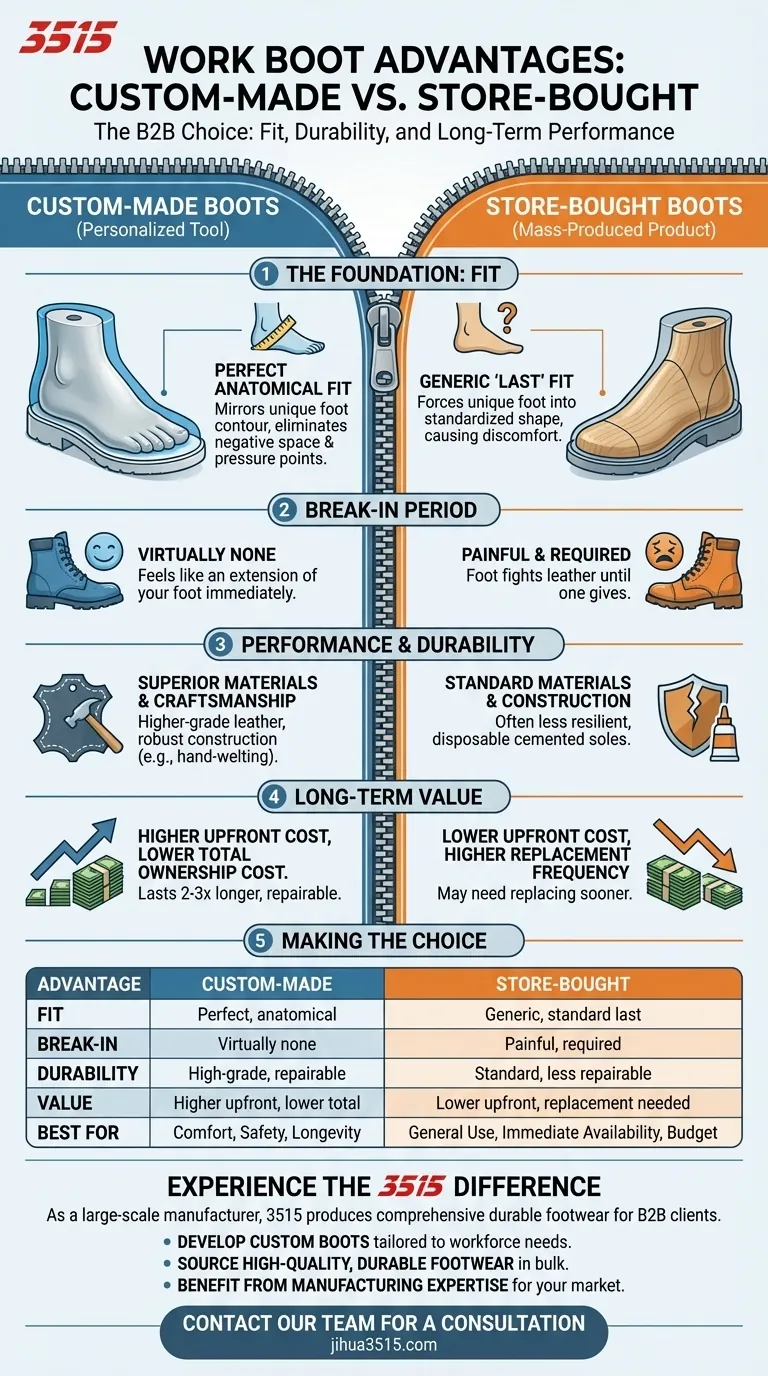
Summary Table:
| Advantage | Custom-Made Boots | Store-Bought Boots |
|---|---|---|
| Fit | Perfect anatomical fit from a mold of your foot | Generic fit based on a standard last |
| Break-in Period | Virtually none | Often painful and required |
| Durability & Materials | Higher-grade materials, repairable construction | Standard materials, often less repairable |
| Long-Term Value | Higher upfront cost, lower total cost of ownership | Lower upfront cost, may need replacing sooner |
| Best For | Professionals prioritizing comfort, safety, and longevity | General use, immediate availability, and budget |
Ready to Experience the 3515 Difference in Your Footwear?
As a large-scale manufacturer, 3515 produces a comprehensive range of durable footwear for distributors, brand owners, and bulk clients. Our production capabilities encompass all types of safety and work boots.
We can help you:
- Develop custom boots tailored to your specific workforce and safety requirements.
- Source high-quality, durable footwear in bulk for your brand or distribution network.
- Benefit from our manufacturing expertise to get the right product for your market.
Let's discuss how we can bring superior comfort, safety, and value to your customers or workforce.
Contact our team today for a consultation
Visual Guide
Related Products
- Durable Leather Moc Toe Work Boots for Wholesale & Custom Manufacturing
- Wholesale Durable 6-Inch Work Boots | Custom & Private Label Manufacturer
- Durable Leather Work Boots for Wholesale & Custom Manufacturing
- Durable Leather Work Boots for Wholesale & Custom OEM Manufacturing
- Durable Leather Work Boots Wholesale Manufacturer & Custom Factory
People Also Ask
- What are moc toe work boots designed for? Superior Comfort and Mobility for Tradespeople
- What are the key features to look for when purchasing moc toe boots? A Guide to Durability & Fit
- How did moc toe boots originate? A Legacy of Workwear Durability and Style
- What clothing items complement the Outdoorsman/Heritage Look with moc toe boots? Build a Timeless, Rugged Wardrobe
- What types of outfits can moc toe boots be worn with? Versatile Style Guide