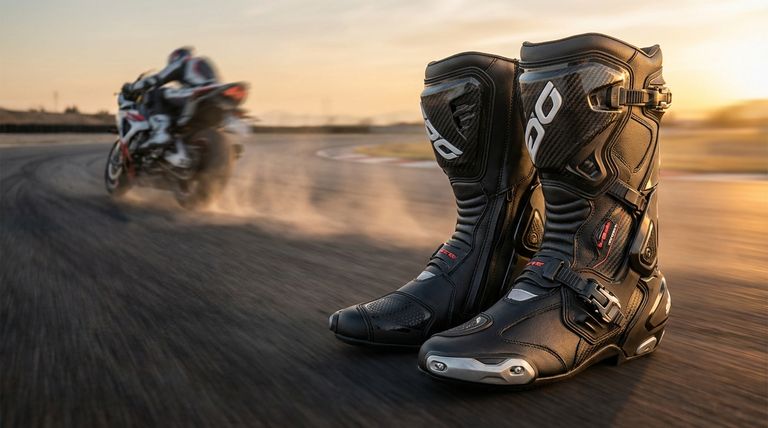
At their core, sport motorcycle boots are specialized safety equipment designed to provide maximum protection during high-speed and aggressive riding. They are defined by their rigid construction, extensive armor, and features that prioritize impact and abrasion resistance above all else, often extending over the ankle and up the shin.
While many boots offer basic protection, sport boots are engineered specifically to mitigate the unique forces involved in a high-speed crash, such as severe impacts, slides, and unnatural twisting of the ankle.
The Core Philosophy: Protection at Speed
The design of a sport boot is driven by a single, uncompromising goal: to keep the rider's foot and ankle intact during a worst-case scenario. This singular focus informs every material and feature.
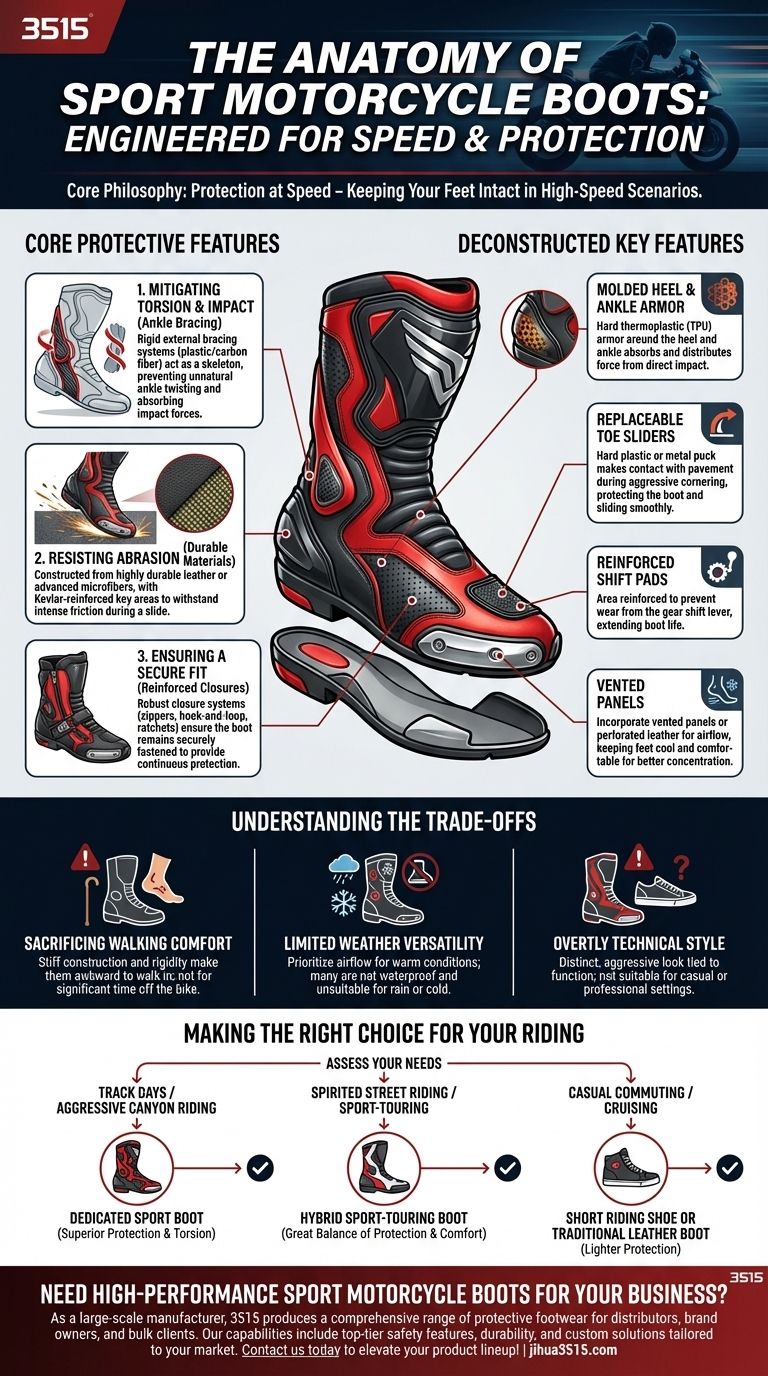
Mitigating Torsion and Impact
A primary danger in a motorcycle crash is the violent twisting of the ankle, known as torsion. Sport boots feature external bracing systems, often made of stiff plastic or carbon fiber, that wrap around the heel and ankle.
This rigid structure acts like an external skeleton, allowing for necessary forward and backward movement for shifting and braking while preventing the ankle from bending or rotating in unnatural, injury-causing directions.
Resisting Abrasion
During a slide, gear must withstand intense friction against the pavement. Sport boots are constructed from highly durable materials like genuine leather or advanced microfibers.
Key areas are often reinforced with materials like Kevlar or have double layers of leather to ensure the boot does not wear through and expose the rider's foot.
Ensuring a Secure Fit
A boot is useless if it comes off during an accident. Sport boots use robust and redundant closure systems—often a combination of zippers, hook-and-loop (Velcro) straps, and ratchet systems.
This ensures the boot remains securely fastened to the rider's foot, providing continuous protection throughout the duration of a crash.
Deconstructing Key Features
While designs vary, most high-quality sport boots share a set of common, purpose-built features that distinguish them from other riding footwear.
Molded Heel and Ankle Armor
Hard, molded thermoplastic (TPU) or similar plastics are placed around the heel and ankle. This armor is designed to absorb and distribute the force from a direct impact.
Replaceable Toe Sliders
On the outer edge of the toe box, you will find a small, replaceable puck of hard plastic or metal. This is the toe slider.
It is designed to make contact with the pavement during aggressive cornering, allowing the boot to slide without catching and preventing damage to the boot itself.
Reinforced Shift Pads
The area on top of the toe box that makes contact with the gear shift lever is reinforced. This prevents the shifter from wearing a hole in the boot over time.
Vented Panels
High-performance riding is physically demanding and generates heat. Many sport boots incorporate vented panels or perforated leather to allow airflow, keeping the rider's feet cool and comfortable, which aids in concentration.
Understanding the Trade-offs
The specialized nature of sport boots means they excel in one area by making deliberate compromises in others. Understanding these trade-offs is key to making the right choice.
Sacrificing Walking Comfort
The same rigidity that protects your ankle makes sport boots stiff and often awkward to walk in. They are not designed for spending significant time off the bike.
Limited Weather Versatility
Many sport boots prioritize airflow for warm, dry conditions. While some waterproof models exist, the majority are not designed to protect against rain or cold weather.
Overtly Technical Style
Sport boots have a distinct, aggressive look that is directly tied to their function. They do not blend in and are not suitable for wearing in a casual or professional setting off the motorcycle.
Making the Right Choice for Your Riding
Selecting the right boot means honestly assessing your needs and the type of riding you do most often.
- If your primary focus is track days or aggressive canyon riding: A dedicated sport boot is non-negotiable for its superior torsional and impact protection.
- If your primary focus is spirited street riding or sport-touring: A hybrid sport-touring boot offers a great balance, retaining key protective features while adding more comfort and weather resistance.
- If your primary focus is casual commuting or cruising: A full sport boot is likely unnecessary; a shorter, reinforced riding shoe or a more traditional leather boot may better suit your needs.
Ultimately, choosing your gear is about matching the level of protection to the level of risk you anticipate.
Summary Table:
| Feature | Purpose | Key Benefit |
|---|---|---|
| Ankle Bracing | Prevents torsion injuries | Rigid support for crash protection |
| Abrasion-Resistant Materials | Withstands slides | Durable leather or Kevlar construction |
| Reinforced Closure Systems | Ensures secure fit | Zippers, straps, and ratchets for safety |
| Toe Sliders & Shift Pads | Protects during cornering and shifting | Extends boot life and rider safety |
| Vented Panels | Enhances airflow | Keeps feet cool for focused riding |
Need high-performance sport motorcycle boots for your business?
As a large-scale manufacturer, 3515 produces a comprehensive range of protective footwear for distributors, brand owners, and bulk clients. Our production capabilities include all types of sport boots, ensuring top-tier safety features, durability, and custom solutions tailored to your market.
Contact us today to discuss your requirements and elevate your product lineup with reliable, performance-driven gear!
Visual Guide
Related Products
- Wholesale Tactical Boots High-Traction & Reflective for Bulk & Brand Orders
- Durable Spiked Camouflage Boots Wholesale & Factory Production
- Durable Goodyear Welt Leather Work Boots for Wholesale & Private Label
- Wholesale Waterproof Tactical Boots Custom Suede & High-Traction Soles
- Wholesale Lightweight Tactical Boots with Dial Closure OEM & Bulk Orders
People Also Ask
- How do tactical boots protect against injuries? Discover the Integrated Safety System
- What are the key features to look for in the best tactical boots? A Guide to Peak Performance
- What is the necessity of high-performance tactical boots in exoskeletons? Enhancing Load Efficiency and Safety
- What makes the traction of tactical boots superior? Unlock the Science of Unbeatable Grip
- Why are tactical work boots ideal for law enforcement? Boost Performance & Safety