
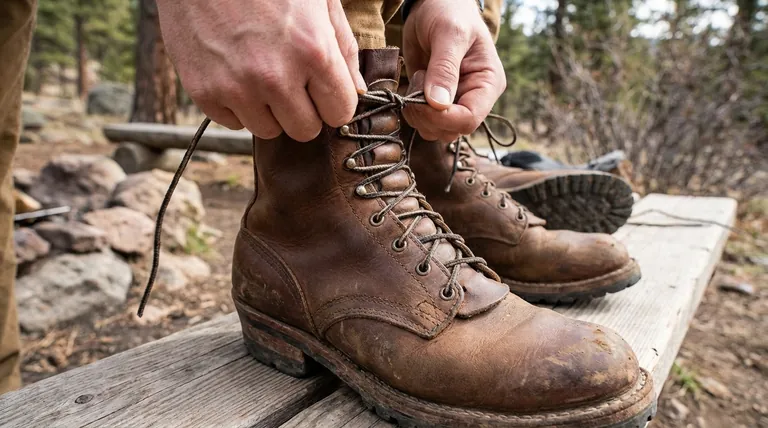
In short, speed hooks are specialized hardware that replaces the top few eyelets on a pair of boots. Their design features an open-faced hook instead of a closed loop or hole. This fundamental difference in design allows you to quickly wrap the lace around the hook to tighten the boot, rather than meticulously threading it through an eyelet, dramatically speeding up the process of putting on and taking off your footwear.
The core function of a speed hook is to trade the absolute, enclosed security of a traditional eyelet for a significant gain in convenience and speed. Understanding this trade-off is the key to deciding if they are the right feature for your specific needs.
The Mechanics of Boot Lacing Systems
To understand the value of speed hooks, it's essential to first appreciate the function of the hardware they replace. A boot's lacing system is engineered to secure your foot and ankle by distributing pressure evenly.
Traditional Eyelets: The Standard for Security
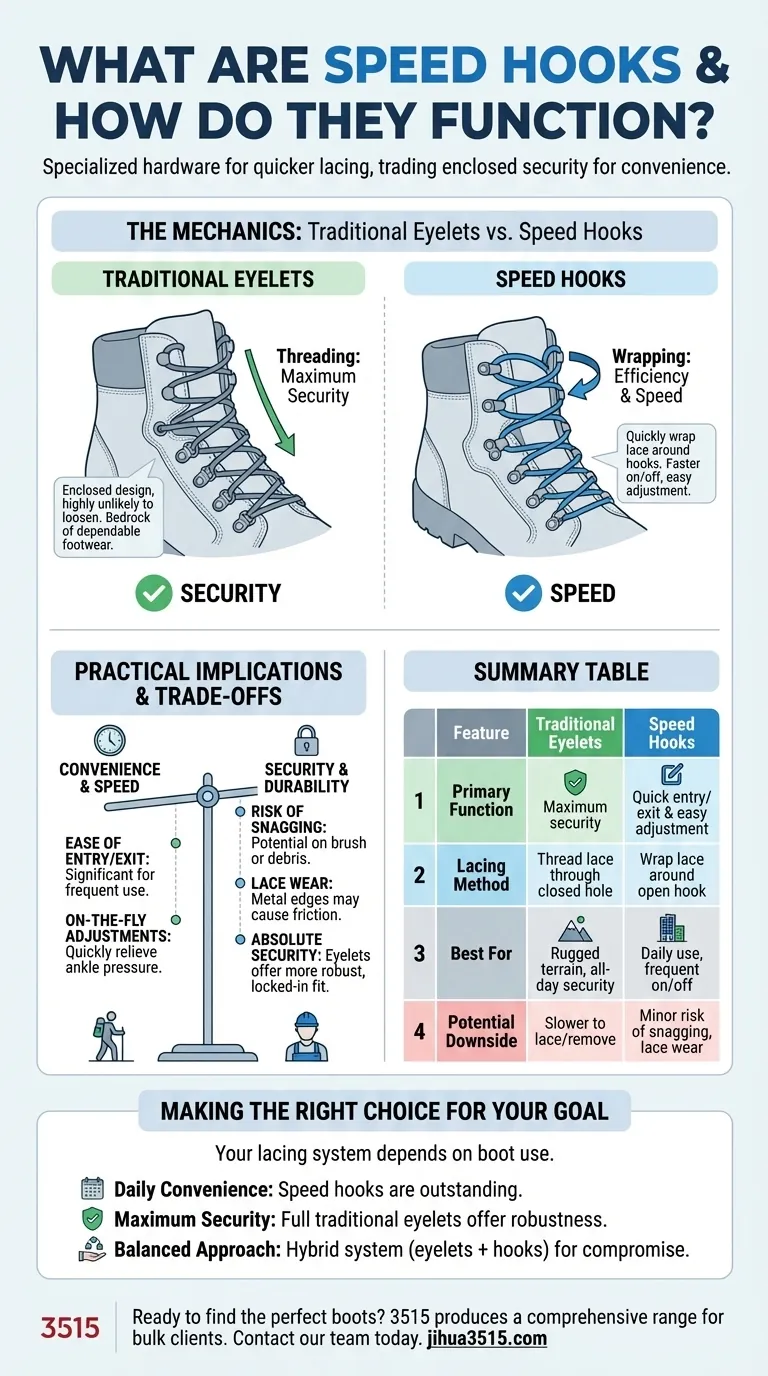
Traditional eyelets are reinforced holes, often with metal grommets, in the boot's upper. You secure the boot by threading the lace through each eyelet in sequence.
This method provides maximum security. The lace is fully captured, making it highly unlikely to come undone or loosen unintentionally. This design is the bedrock of dependable footwear for a reason.
Speed Hooks: The Design for Efficiency
Speed hooks are typically found on the top two or three positions of a high-cut boot's lacing system. Instead of threading, you simply pull the laces taut and wrap them around these open metal hooks.
To remove the boots, you just unwrap the laces from the hooks. This allows the top of the boot to open wide, making entry and exit far easier and faster than unthreading multiple eyelets.
The Practical Implications: When Do They Matter?
The choice between speed hooks and eyelets is not about one being universally better, but about which is better for a specific task.
The Core Benefit: Ease of Entry and Exit
The most obvious advantage is speed. For anyone who puts on and takes off their boots multiple times a day—such as a tradesperson moving between indoor and outdoor sites—this convenience is a significant quality-of-life improvement.
The Impact on Fit Adjustment
Speed hooks also allow for faster on-the-fly adjustments. You can quickly unhook the top laces to relieve pressure around the ankle during a break, then re-secure them just as quickly without having to unlace the entire boot.
Understanding the Trade-offs
While convenient, speed hooks are not without their potential downsides. Recognizing these trade-offs is crucial for making an informed choice.
The Risk of Snagging
Because they are open-faced, speed hooks have a small but real potential to snag on brush, debris, or even the pant leg of your other foot. For serious off-trail hikers or mountaineers, this can be a notable concern.
Potential for Increased Lace Wear
The metal edges of some speed hooks can cause more friction and wear on your laces over time compared to the smooth, rolled surface of a high-quality eyelet. This is a minor point but a factor in long-term durability.
A Question of Absolute Security
For activities requiring a locked-in, bomb-proof fit for hours on end, some users prefer the total security of an eyelet. As the reference material notes, a hiker who puts their boots on in the morning and doesn't take them off until night may not gain much from the speed hook's convenience and might prefer the peace of mind an eyelet provides.
Making the Right Choice for Your Goal
Your ideal lacing system depends entirely on how you intend to use your boots.
- If your primary focus is daily convenience: Speed hooks are an outstanding feature that streamlines the process of wearing and removing your boots.
- If your primary focus is maximum security for rugged terrain: A full system of traditional eyelets offers a more robust, snag-free, and securely enclosed setup.
- If you need a balanced approach: The most common configuration—eyelets on the lower foot and speed hooks at the ankle—offers an excellent compromise between security and convenience.
Ultimately, your lacing hardware is a critical interface between you and your footwear, so choosing the right system is essential for performance and comfort.
Summary Table:
| Feature | Traditional Eyelets | Speed Hooks |
|---|---|---|
| Primary Function | Maximum security | Quick entry/exit & easy adjustment |
| Lacing Method | Thread lace through closed hole | Wrap lace around open hook |
| Best For | Rugged terrain, all-day security | Daily use, frequent on/off, on-the-fly adjustments |
| Potential Downside | Slower to lace/remove | Minor risk of snagging, potential for lace wear |
Ready to find the perfect boots for your needs?
As a large-scale manufacturer, 3515 produces a comprehensive range of footwear for distributors, brand owners, and bulk clients. Our production capabilities encompass all types of shoes and boots, including models with speed hooks, traditional eyelets, or a hybrid design for optimal performance and convenience.
Let us help you equip your customers with the right gear. Contact our team today to discuss your footwear requirements.
Visual Guide
Related Products
- High-Traction Suede Tactical Boots Wholesale & Custom Manufacturing
- Durable Leather Work Boots Wholesale Manufacturer & Custom Factory
- Durable Leather Work Boots for Wholesale & Custom OEM Manufacturing
- Durable Leather Work Boots for Wholesale & Custom Manufacturing
- Durable Leather Tactical Boots Wholesale & Custom Manufacturing for Brands
People Also Ask
- Why is sequential analysis utilized to evaluate tactical boots? Master Dynamic Boot Development and Ergonomic Performance
- How does the material of tactical boots affect their performance? Choose the Right Material for Your Mission
- How do tactical boots differ from regular boots? Performance, Durability & Design Explained
- How do military uniforms and tactical boots impact the prediction of thermal risk? Essential Safety Insights
- What are the benefits of integrating FES and sEMG into tactical boots? Safety, Reliability & Field-Ready Performance


















