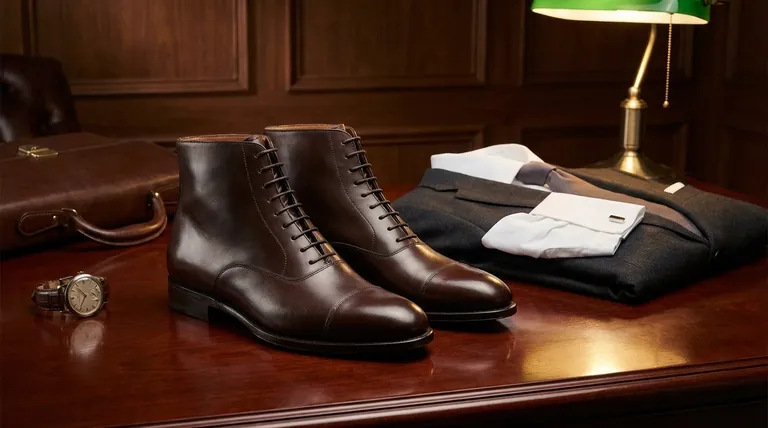
At its core, an Oxford boot is simply a high-ankle version of the classic Oxford dress shoe. Its defining characteristic is the closed lacing system, where the eyelet facings are stitched underneath the front part of the boot, creating a clean, sleek, and formal appearance.
The single most important feature of an Oxford boot is its closed lacing. This design choice elevates it from a simple piece of footwear to a statement of formal or smart-casual style, distinguishing it from more rugged or utilitarian boot types.
The Defining Feature: Understanding Closed Lacing
The "Oxford" designation isn't about the height or the material; it's entirely about how the laces are integrated into the boot's upper. This detail dictates its entire character.
What Closed Lacing Means
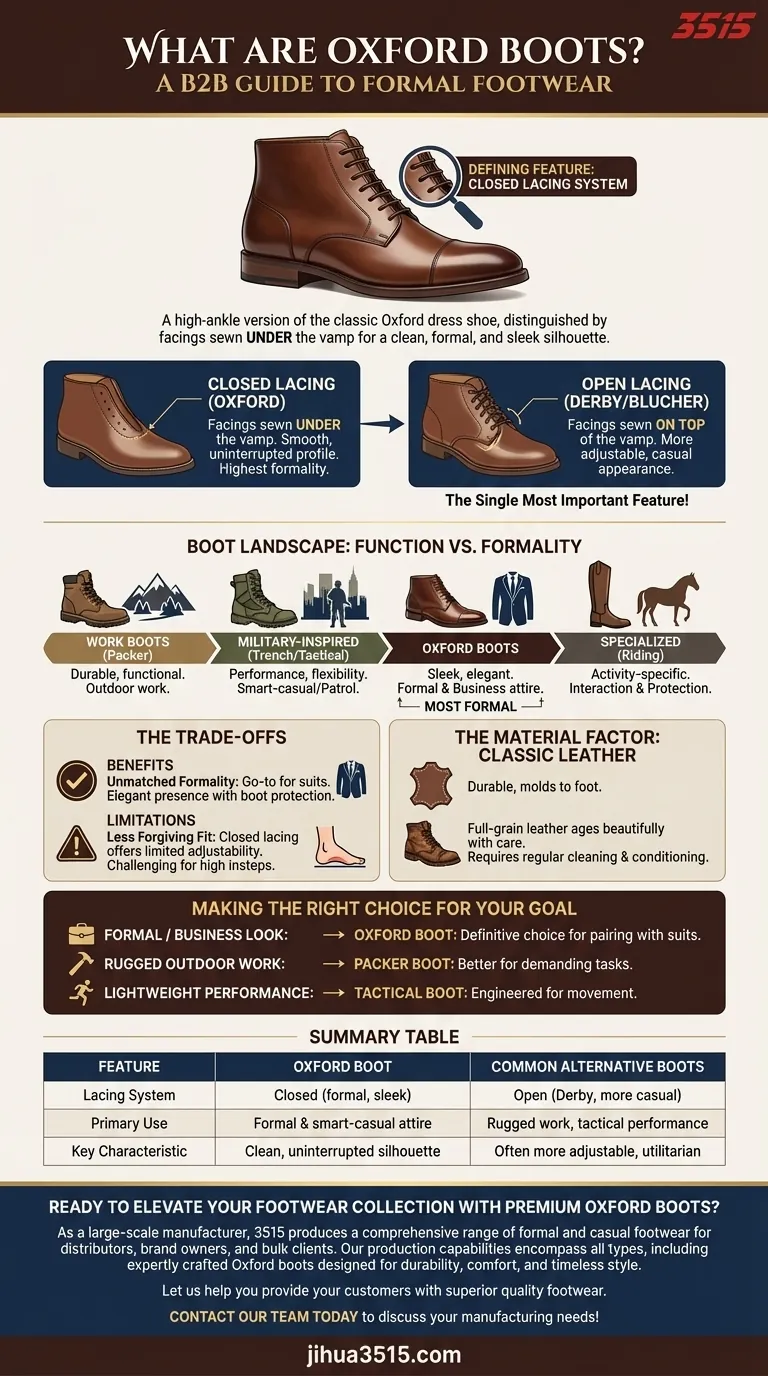
In an Oxford, the pieces of leather that hold the eyelets (the facings) are sewn under the vamp—the part of the boot that covers the top of your foot.
This construction pulls the boot together neatly, leaving no visible gaps at the bottom of the lacing section. The result is a smooth, uninterrupted silhouette.
The Visual Impact
This closed system creates a formal, tidy look. It stands in direct contrast to boots with an "open" lacing system (like Derby or Blucher boots), where the eyelet facings are sewn on top of the vamp, appearing more like flaps.
Formality and Fit
Because of its sleek design, the Oxford boot is considered the most formal type of dress boot. This clean aesthetic pairs exceptionally well with suits and tailored trousers.
Placing the Oxford in the Boot Landscape
To truly understand the Oxford, it helps to see where it fits among other popular boot styles, which are often defined by their function rather than their lacing system.
Compared to Work Boots (Packer Boots)
Packer boots are built for durability and outdoor work. They feature a higher cut for ankle support, rugged construction, and sturdy laces, prioritizing function over formal aesthetics.
Compared to Military-Inspired Boots (Trench & Tactical)
Trench boots share a classic, low-profile inspiration but often have a slightly taller heel and more generous lacing. They bridge the gap between casual and smart-casual wear.
Tactical boots, on the other hand, are engineered for performance. They are lightweight, flexible, and designed for a wide range of motion, making them ideal for law enforcement or patrol use, not formal occasions.
Compared to Specialized Boots (Riding Boots)
Long riding boots or high-performance racing boots are highly specialized. Their design is driven entirely by the demands of their activity, focusing on protection, support, and interaction with a vehicle or animal.
Understanding the Trade-offs
Choosing an Oxford boot comes with distinct benefits and considerations tied directly to its design.
The Benefit: Unmatched Formality
The primary advantage of the Oxford boot is its sleek, formal appearance. It is the go-to choice when you need the protection and presence of a boot but the elegance of a dress shoe.
The Limitation: A Less Forgiving Fit
The closed lacing system offers less adjustability than an open-laced design. This can sometimes make it a challenging fit for individuals with a particularly high instep.
The Material Factor: Classic Leather
Most Oxford boots are crafted from leather, prized for its durability and ability to mold to the wearer's foot. Full-grain leather, in particular, ages beautifully but requires regular cleaning and conditioning to maintain its longevity.
Making the Right Choice for Your Goal
Selecting the right boot depends entirely on its intended purpose.
- If your primary focus is a formal or business-appropriate look: The Oxford boot is the definitive choice for pairing with suits or smart-casual attire.
- If your primary focus is rugged outdoor work and durability: A Packer boot is far better suited for demanding physical tasks.
- If your primary focus is lightweight performance and flexibility: A tactical boot is engineered for movement and utility, not style.
Ultimately, choosing the Oxford boot means prioritizing its clean, classic aesthetic for a more polished and formal context.
Summary Table:
| Feature | Oxford Boot | Common Alternative Boots |
|---|---|---|
| Lacing System | Closed (formal, sleek) | Open (Derby, more casual) |
| Primary Use | Formal & smart-casual attire | Rugged work, tactical performance |
| Key Characteristic | Clean, uninterrupted silhouette | Often more adjustable, utilitarian |
| Best For | Pairing with suits, tailored trousers | Outdoor work, high-mobility activities |
Ready to Elevate Your Footwear Collection with Premium Oxford Boots?
As a large-scale manufacturer, 3515 produces a comprehensive range of formal and casual footwear for distributors, brand owners, and bulk clients. Our production capabilities encompass all types of shoes and boots, including expertly crafted Oxford boots designed for durability, comfort, and timeless style.
Let us help you provide your customers with superior quality footwear. Contact our team today to discuss your manufacturing needs!
Visual Guide
Related Products
- Wholesale Patent Oxford Dress Shoes | Custom & Bulk Manufacturing
- Wholesale Leather Derby Shoes Manufacturer | Customizable Business & Dress Footwear
- Classic Leather Derby Dress Shoes Wholesale & Custom Manufacturing
- Wholesale Breathable Perforated Leather Derby Dress Shoes for Custom Brands
- Custom Manufactured Air Cushion Leather Business Shoes for Wholesale
People Also Ask
- What are the key characteristics of Oxford dress shoes? A Guide to Timeless Formal Footwear
- How do Oxfords and Derbies differ in terms of lacing and formality? A Guide to Choosing the Right Shoe
- What is the origin of the Oxford shoe? From 1800s University Boots to Modern Elegance
- How do Oxford Shoes differ from other casual shoes? The Ultimate Guide to Lacing & Formality
- What makes Oxford shoes suitable for business casual settings? Master the Art of Professional Style