
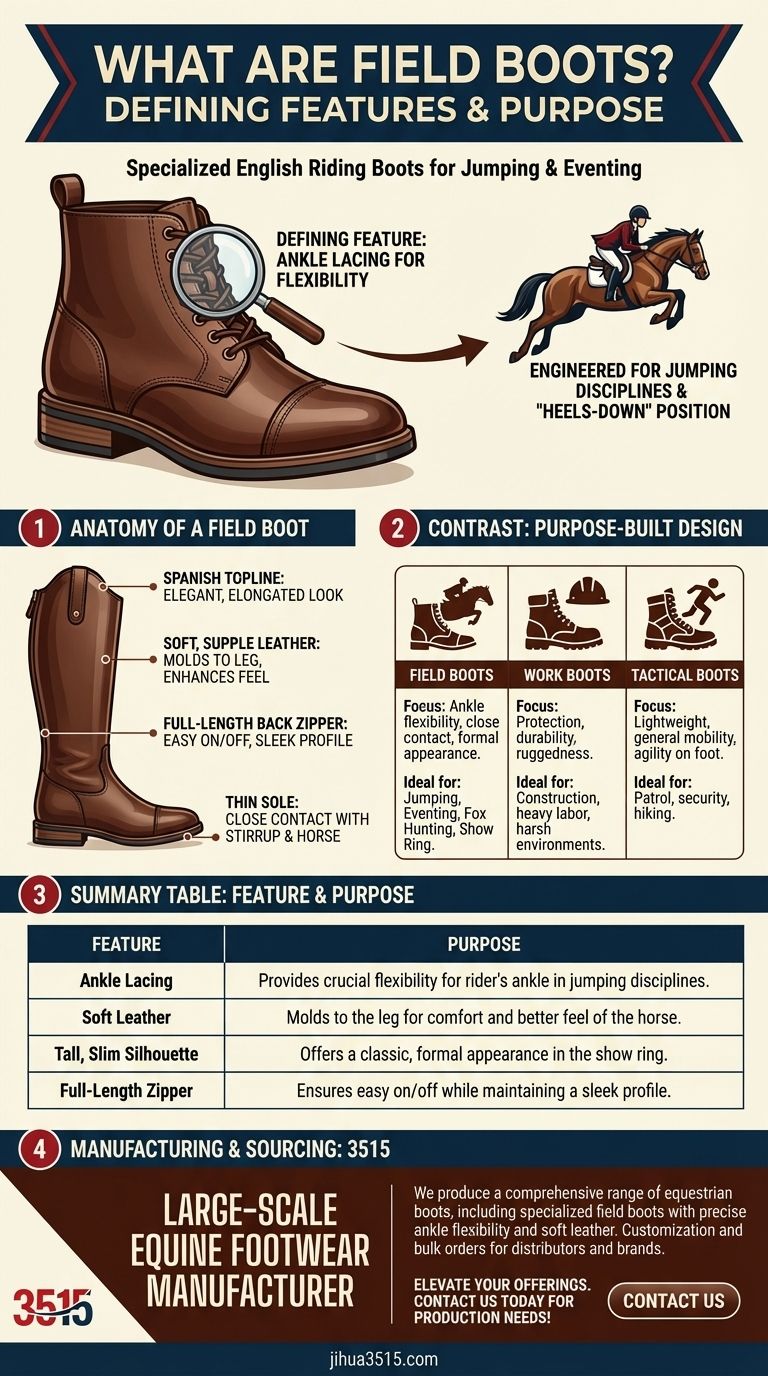
At its core, a field boot is a specific type of English riding boot designed for equestrian sports. It is a knee-high boot made of soft, supple leather, but its single most defining characteristic is a lace-up closure over the instep at the front of the ankle. This lacing system is not just for show; it is engineered to provide crucial flexibility for the rider.
The key takeaway is that field boots are specialized equipment for jumping disciplines. Their design prioritizes ankle flexion and a close feel of the horse over the rugged durability or protective features found in other types of high-cut boots.

The Anatomy of a Field Boot
Understanding the purpose of a field boot begins with its specific design elements. Each feature serves a distinct function related to performance in the saddle.
The Defining Feature: Ankle Lacing
The lace-up system at the instep is what separates a field boot from other English riding boots, like a dress boot.
This lacing allows the boot to flex easily at the ankle. This is critical for riders, particularly in jumping, as it helps them maintain a secure and correct "heels-down" position in the stirrups.
The laces also ensure a snug, customized fit around the ankle, preventing the boot from feeling restrictive.
Material and Construction
Field boots are crafted from soft, supple leather. This material choice is intentional.
The softer leather creases and molds to the rider's leg and ankle, enhancing comfort and movement. It also allows the rider to have a more sensitive feel of the horse's side, which is vital for communicating cues.
Most modern field boots include a full-length zipper up the back, making them much easier to put on and take off while maintaining a sleek profile.
The Classic Profile
Field boots feature a tall, slim silhouette that extends nearly to the rider's knee.
Many are designed with a Spanish topline, where the outside of the boot is cut slightly higher than the inside, creating an elegant, elongated look for the rider's leg.
Function Dictates Form: The Purpose of the Field Boot
The specific anatomy of the field boot is a direct result of the demands of certain equestrian activities.
Engineered for Jumping and Eventing
The primary use for field boots is in disciplines that involve jumping, such as show jumping, eventing, and fox hunting.
The ankle flexibility they provide is essential for a rider to absorb the shock of landing and maintain balance over a fence.
A Sleek, Traditional Appearance
Beyond pure function, field boots present a classic and formal appearance required in the show ring. Their snug fit and elegant profile are a traditional part of equestrian attire.
They are also used by some mounted police units for this combination of professional appearance and functional comfort in the saddle.
Understanding the Trade-offs: Field Boots vs. Other Boots
To truly understand what a field boot is, it is helpful to contrast it with other types of boots that may look superficially similar.
Contrast with Work Boots
Work boots are built for protection and durability in harsh environments. They often feature steel toes, reinforced soles, and thick, moisture-resistant leather.
A field boot prioritizes flexibility and feel over this level of rugged protection. Its thin sole and soft leather would not be suitable for a construction site.
Contrast with Tactical Boots
Tactical boots are designed to be lightweight and flexible for a wide range of motion on foot, such as patrolling, climbing, or hiking.
While both are flexible, a tactical boot's flexibility is for general mobility. A field boot's flexibility is specifically engineered for the unique biomechanics of riding a horse over jumps.
Making the Right Choice for Your Needs
Choosing the correct boot means matching its intended design to your specific activity.
- If your primary focus is equestrian jumping or eventing: The field boot is purpose-built to provide the essential ankle flexibility and close contact you require.
- If your primary focus is demanding physical labor: A dedicated work boot offers the critical safety features and rugged durability that field boots lack.
- If your primary focus is patrol, security, or hiking: A tactical boot delivers the lightweight, all-purpose flexibility needed for covering ground on foot.
Ultimately, selecting the right boot is about choosing the specialized tool designed to master its specific task.
Summary Table:
| Feature | Purpose |
|---|---|
| Ankle Lacing | Provides crucial flexibility for rider's ankle in jumping disciplines |
| Soft Leather | Molds to the leg for comfort and better feel of the horse |
| Tall, Slim Silhouette | Offers a classic, formal appearance in the show ring |
| Full-Length Zipper | Ensures easy on/off while maintaining a sleek profile |
Need high-quality field boots for your equestrian business?
As a large-scale manufacturer, 3515 produces a comprehensive range of footwear for distributors, brand owners, and bulk clients. Our production capabilities encompass all types of equestrian boots, including specialized field boots designed with the precise ankle flexibility and soft leather construction that riders demand.
We can help you source or customize field boots that meet the highest standards of performance and appearance. Contact us today to discuss your production needs and elevate your equestrian footwear offerings!
Visual Guide
Related Products
- Durable Military Combat Boots with Water Drainage for Wholesale & OEM
- Wholesale Lightweight Tactical Boots Custom Manufacturer for Desert & Combat Use
- High-Traction Suede Tactical Boots Wholesale & Custom Manufacturing
- Durable Leather Tactical Boots Wholesale & Custom Manufacturing for Brands
- Durable Leather Work Boots for Wholesale & Custom Manufacturing
People Also Ask
- Why must gait validation for military applications be conducted in combat boots? Ensure Data Accuracy for Soldiers
- What are the common types of combat boots? Find the Right Boot for Your Mission
- What factors should be considered when choosing military boots for hiking? Durability vs. Weight for Your Terrain
- What are the key considerations when choosing military boots? Prioritize Compliance, Environment & Fit
- How should the midfoot and heel fit in military boots? Achieve a Snug, Secure Fit for Blister Prevention


















