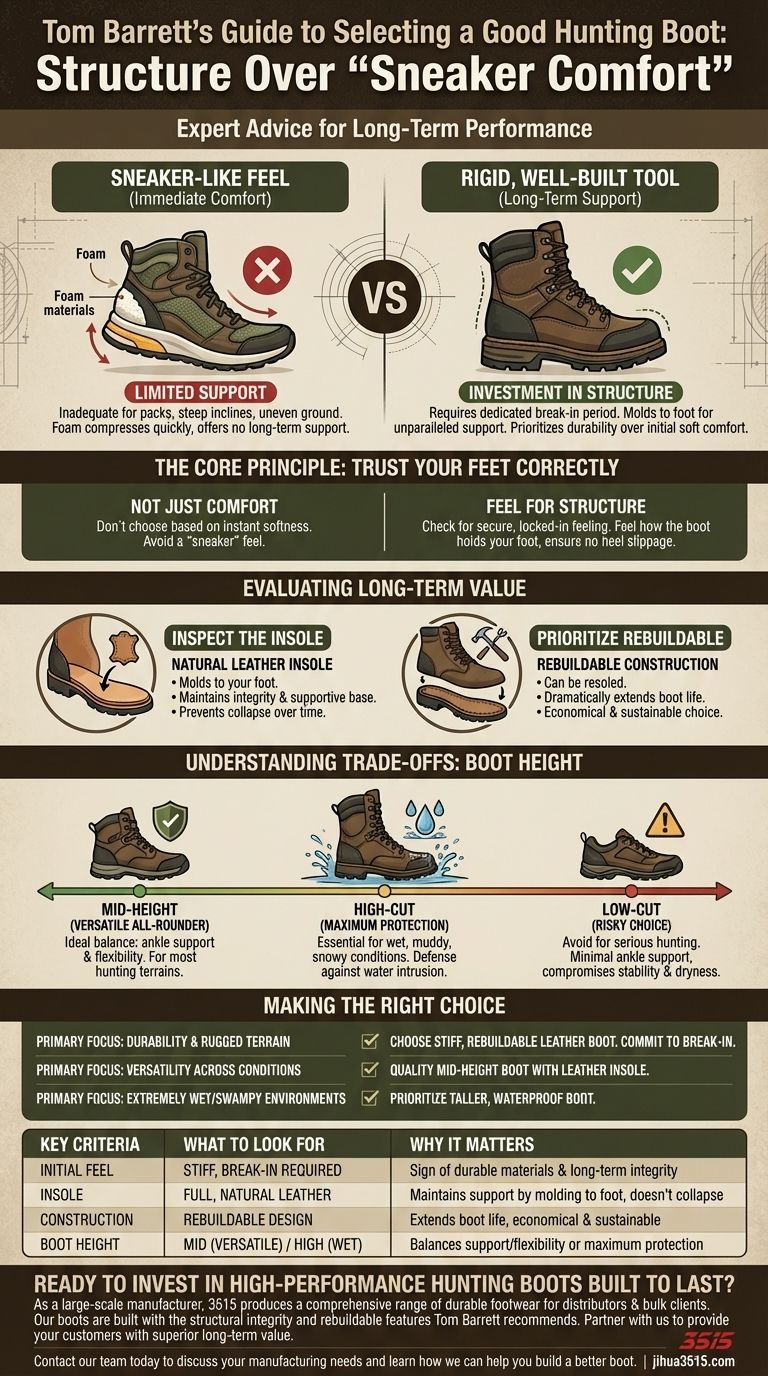
According to hunting expert Tom Barrett, the most critical advice for selecting a good hunting boot is to prioritize long-term structural integrity over immediate, out-of-the-box comfort. He suggests that if a boot feels like a sneaker, it will ultimately offer the same limited support. A truly high-performance boot is an investment that will feel stiff at first and require a dedicated break-in period.
The core decision when choosing a hunting boot is between the instant gratification of a flexible, sneaker-like feel and the long-term support of a rigid, well-built tool. Barrett's philosophy is clear: a hunting boot is technical equipment, and its value lies in its durability and structure, not its initial comfort.
The Core Principle: Structure Over "Sneaker Comfort"
The most common mistake is choosing a boot that feels perfect the moment you put it on. True performance boots are built with robust materials that need time to conform to your foot.
Why Immediate Comfort Can Be a Red Flag
Barrett warns that a boot with sneaker-like flexibility will provide sneaker-level support. This is inadequate for carrying a pack, navigating steep inclines, or maintaining stability on uneven ground.
That initial soft comfort often comes from foam and soft synthetics that compress and break down quickly, leaving you with a boot that offers little to no support when you need it most.
The Importance of a Break-In Period
A quality boot that requires breaking in is a sign of superior construction. It indicates the presence of durable materials like a full leather insole and a stiff midsole.
This break-in process allows these robust components to mold precisely to the shape of your foot, creating a custom fit that provides unparalleled support for years. It's a short-term inconvenience for long-term performance.
How to "Trust Your Feet" Correctly
When Barrett says to "trust your feet," he doesn't mean you should simply choose the most comfortable option. He means you should feel for structure and support.
Check for heel slippage, ensure your toes aren't cramped, and feel how the boot holds your foot in place. You are looking for a secure, locked-in feeling, not a soft, cushioned one.
Evaluating a Boot's Long-Term Value
A hunting boot is a long-term investment. Looking beyond the initial fit to the boot's core construction is essential for determining its true value.
Inspect the Insole
The insole is the foundation of the boot's support system. Barrett strongly recommends boots with natural leather insoles.
Unlike foam or synthetic insoles that collapse over time, a leather insole maintains its integrity and continues to provide a supportive base that has molded to your foot.
Prioritize Rebuildable Construction
The best boots are designed to be repaired, not replaced. Look for rebuildable boots, which can be resoled by a cobbler.
This feature dramatically extends the life of your boots. Once the upper is perfectly broken in, you can simply replace the worn-out sole, making it a far more economical and sustainable choice over the long run.
Understanding the Trade-offs: Boot Height
While Barrett focuses on construction, the height of the boot is a practical consideration that impacts its performance in different environments.
Mid-Height Boots: The Versatile All-Rounder
For most hunting scenarios, a mid-height boot provides the ideal balance between ankle support and flexibility. It is sufficient for most terrains without being overly restrictive.
High Boots: Maximum Environmental Protection
In very wet, muddy, or snowy conditions, a taller boot is essential. The extra height is your best defense against water getting in over the top, keeping your feet dry and comfortable.
Low-Cut Boots: A Risky Choice
Low-cut boots should generally be avoided for serious hunting. They offer minimal ankle support and are easily swamped in wet grass or stream crossings, compromising both stability and dryness.
Making the Right Choice for Your Hunt
Your final decision should be guided by the boot's construction and your specific hunting environment.
- If your primary focus is durability and support for rugged, off-trail terrain: Choose a stiff, rebuildable leather boot and commit to the break-in period.
- If your primary focus is versatility across varied conditions: A quality mid-height boot with a leather insole offers the best all-around performance.
- If your primary focus is navigating extremely wet or swampy environments: Prioritize a taller, waterproof boot to ensure your feet stay dry and protected from the elements.
Ultimately, selecting a boot based on its structural integrity, not its initial feel, will provide superior performance and comfort for years of use in the field.
Summary Table:
| Key Selection Criteria | What to Look For | Why It Matters |
|---|---|---|
| Initial Feel | Stiff, requires a break-in period | Sign of durable materials and long-term structural integrity |
| Insole | Full, natural leather insole | Maintains support by molding to your foot, unlike foam that collapses |
| Construction | Rebuildable design (can be resoled) | Extends boot life, making it a more economical and sustainable investment |
| Boot Height | Mid-height for versatility; High-cut for wet environments | Balances ankle support with flexibility or provides maximum protection |
Ready to Invest in High-Performance Hunting Boots Built to Last?
As a large-scale manufacturer, 3515 produces a comprehensive range of durable footwear for distributors, brand owners, and bulk clients. Our production capabilities encompass all types of hunting boots and work boots, built with the structural integrity and rebuildable features Tom Barrett recommends.
Partner with us to provide your customers with boots that deliver superior long-term value.
Contact our team today to discuss your manufacturing needs and learn how we can help you build a better boot.
Visual Guide
Related Products
- Wholesale Lightweight Tactical Boots Custom Manufacturer for Desert & Combat Use
- Durable Leather Tactical Boots Wholesale & Custom Manufacturing for Brands
- High-Traction Suede Tactical Boots Wholesale & Custom Manufacturing
- Wholesale Waterproof Tactical Boots Custom Suede & High-Traction Soles
- Durable Spiked Camouflage Boots Wholesale & Factory Production
People Also Ask
- What are the common types of combat boots? Find the Right Boot for Your Mission
- What specialized protections do tactical boots offer? Maximize Endurance with High-Performance Footwear
- How is the compatibility of polymer materials demonstrated in smart footwear? Enhancing Tactical & Training Performance
- How does additive manufacturing equipment reduce environmental risks? Sustainable Tactics for Modern Footwear Production
- What are the main construction similarities between tactical boots and tactical sneakers? Built for Performance & Durability