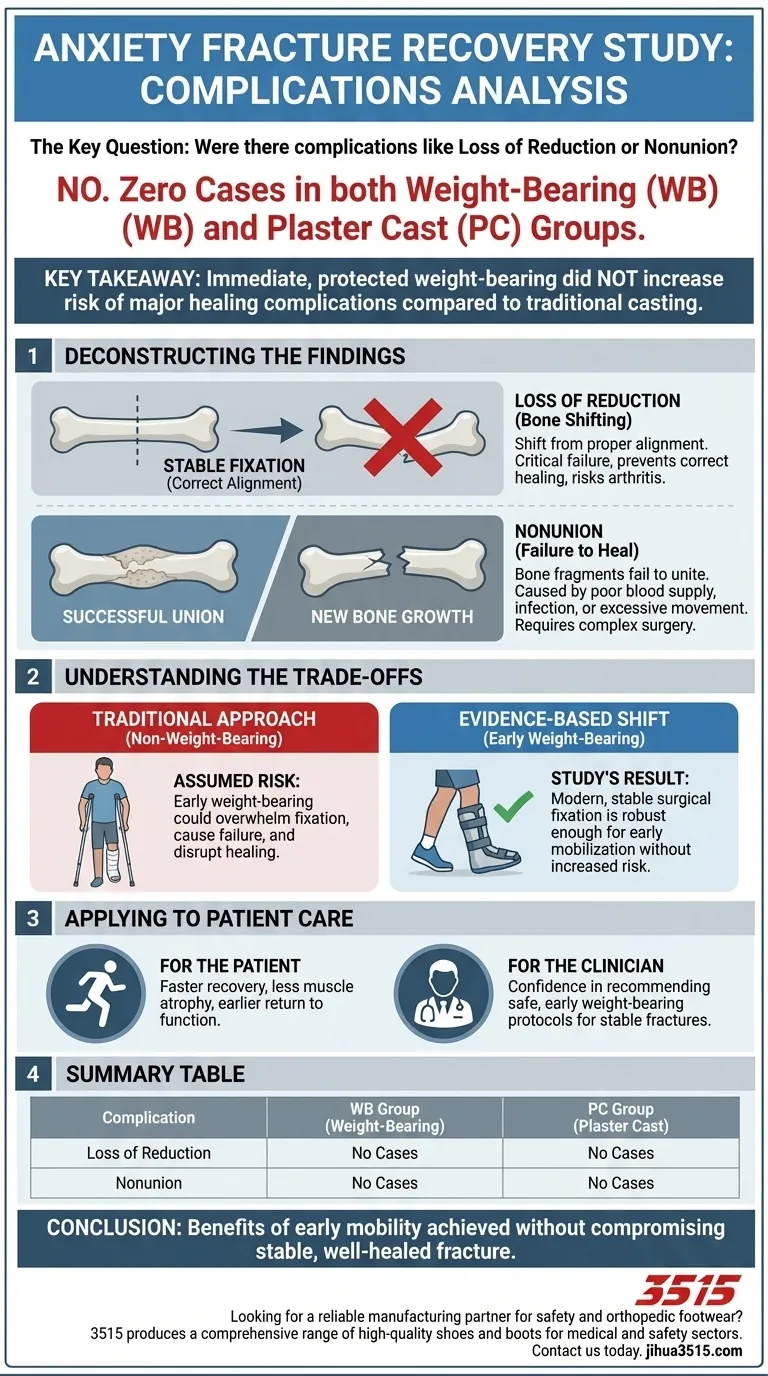
In short, no. The study found that no patients, regardless of whether they were in the weight-bearing (WB) or plaster cast (PC) group, experienced a loss of reduction or a nonunion of the fracture after surgery.
The key takeaway from this finding is that immediate, protected weight-bearing after surgical fixation of these specific ankle fractures did not increase the risk of the most common and serious healing complications compared to traditional, non-weight-bearing casting.
Deconstructing the Findings: What This Means for Healing
When a surgeon repairs a fractured bone, the primary goal is to ensure it heals in the correct position. The absence of complications like loss of reduction and nonunion is a critical measure of success.
The Problem of "Loss of Reduction"
Loss of reduction means the fractured bone fragments have shifted or moved out of the proper alignment that was set during surgery.
This is a significant failure because proper alignment is essential for the bone to heal correctly, restore function, and prevent long-term issues like arthritis or chronic pain.
The study's finding that no patients experienced this suggests the surgical fixation used was stable enough to withstand the forces of both early weight-bearing and traditional casting.
The Challenge of "Nonunion"
Nonunion is the medical term for a fracture that fails to heal completely. The bone fragments do not "unite" or bridge together with new bone tissue as they should.
This can occur for various reasons, including poor blood supply to the area, infection, or excessive movement between the bone fragments, which disrupts the delicate healing process.
A nonunion often requires additional, sometimes complex, surgery to correct. The fact that no patients in either group developed a nonunion indicates that both treatment protocols provided an environment conducive to successful bone healing.
Understanding the Trade-offs: Why This Result Matters
The traditional approach after ankle fracture surgery involves a prolonged period of non-weight-bearing. The primary concern has always been that putting weight on the repaired ankle too soon could compromise the surgical repair.
The Assumed Risk of Early Weight-Bearing
The fear is that the mechanical stress of walking could overwhelm the screws and plates used for fixation. This could cause the hardware to fail, the bone fragments to shift (loss of reduction), or disrupt the healing process entirely (leading to nonunion).
What the Evidence Suggests
This study's results directly challenge that long-held assumption. It demonstrates that with modern, stable surgical fixation techniques, the risk of these major complications was not realized, even when patients began bearing weight much earlier than is traditional.
This implies that the stability achieved in surgery was robust enough to handle the demands of early, protected mobilization.
Applying This to Patient Care
The absence of these specific complications is a powerful data point that supports a shift in postoperative care protocols.
- For the patient: The finding suggests that an earlier return to weight-bearing may be possible without increasing the risk of the fracture failing to heal, potentially leading to faster recovery and less muscle atrophy.
- For the clinician: This evidence provides confidence that for suitable patients with stable fracture fixation, recommending an early weight-bearing protocol is a safe and viable option.
This study indicates that the benefits of early mobility can be achieved without compromising the fundamental goal of a stable, well-healed fracture.
Summary Table:
| Complication | WB Group | PC Group |
|---|---|---|
| Loss of Reduction | No Cases | No Cases |
| Nonunion | No Cases | No Cases |
| Key Takeaway | Immediate, protected weight-bearing did not increase the risk of these major complications compared to traditional non-weight-bearing casting. |
Looking for a reliable manufacturing partner for safety and orthopedic footwear?
As a large-scale manufacturer, 3515 produces a comprehensive range of high-quality footwear designed for durability, support, and optimal recovery. Our production capabilities encompass all types of shoes and boots, making us the ideal partner for distributors, brand owners, and bulk clients in the medical and safety sectors.
Let's discuss how we can support your product line with reliable, well-constructed footwear. Contact our team today to explore partnership opportunities.
Visual Guide