
On the contrary, the idea that cowboy boots are inherently uncomfortable is one of the most persistent myths in footwear. A properly constructed and correctly fitted cowboy boot is designed for long-term support and can be exceptionally comfortable for all-day wear.
The widespread reputation for discomfort stems not from the boot's design, but from three common and avoidable errors: improper fit, misunderstanding the break-in period, and choosing the wrong boot for your foot shape.
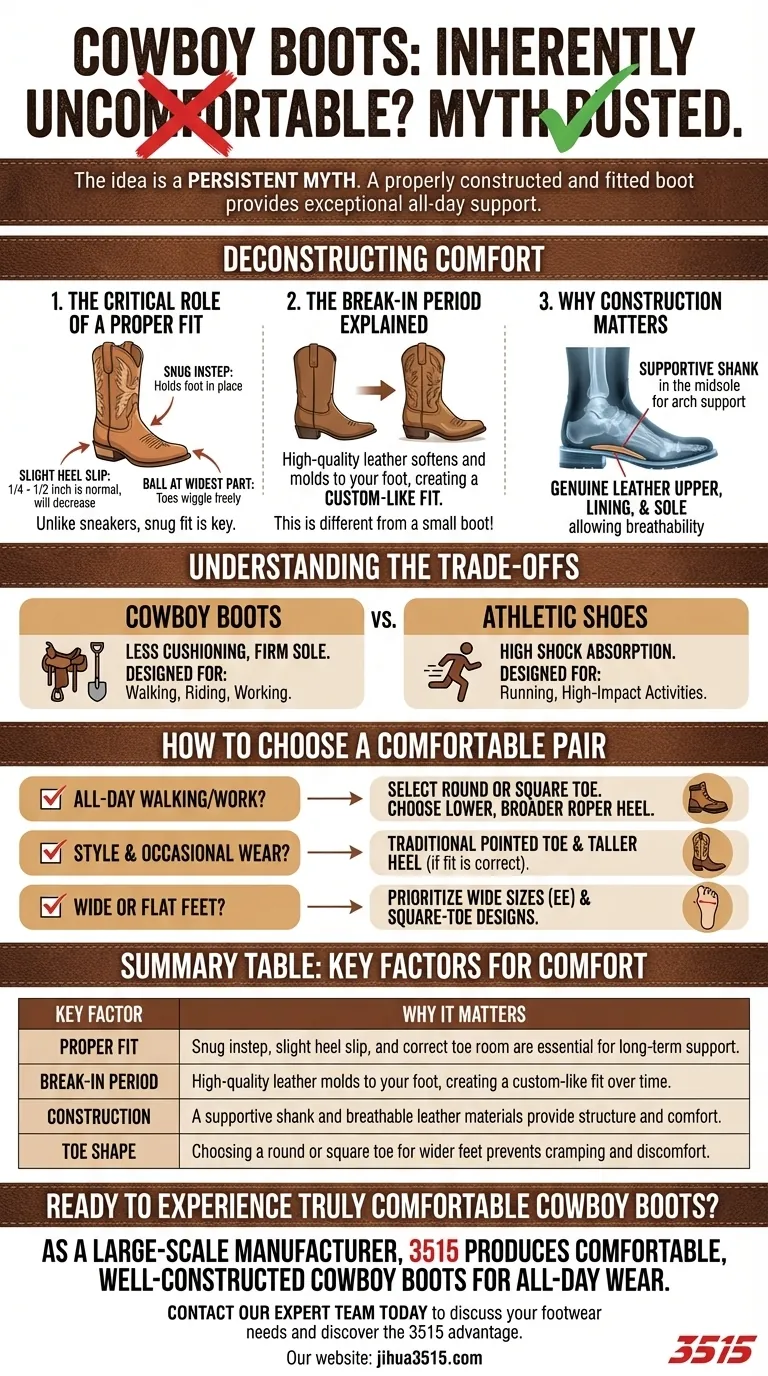
Deconstructing Cowboy Boot Comfort
The comfort of a cowboy boot is not an accident; it's the result of a design refined over a century. Understanding its core components is the key to finding a pair that feels custom-made for your feet.
The Critical Role of a Proper Fit
This is the single most important factor. Unlike a sneaker, a cowboy boot must fit snugly through the instep (the top of your foot) to hold your foot in place.
Your heel should lift slightly when you walk—about a quarter to a half-inch. This "heel slip" is normal and will decrease as the leather sole breaks in and flexes with your step.
The ball of your foot should sit at the widest part of the boot, and your toes should have enough room to wiggle freely without being cramped.
The Break-In Period Explained
High-quality boots, especially those made from thick leather, require a break-in period. This is not a sign of a bad boot; it's a sign of durable materials.
During this time, the stiff leather and sole will soften and mold precisely to the shape of your foot, creating a custom-like fit. This is different from a boot that is fundamentally too small, which will cause pain and pressure from the start.
Why Construction and Materials Matter
A well-made boot has a strong, supportive shank (a piece of steel or fiberglass) embedded in the midsole, which provides crucial arch support.
The use of genuine leather for the upper, lining, and sole allows the boot to breathe and conform to your foot, preventing the sweat and friction common with synthetic materials.
Understanding the Trade-offs
While exceptionally comfortable for their intended purpose, cowboy boots are specialized footwear. It's crucial to align your expectations with their design.
Cushioning and Shock Absorption
Cowboy boots are not athletic shoes. They traditionally feature a stacked leather heel and a firm leather sole, offering less cushioning and shock absorption than a modern running shoe.
They are designed for walking, riding, and working, but not for high-impact activities like running or long treks on hard pavement.
The Impact of Toe Shape
Much of the discomfort myth comes from people with wider feet trying to force them into a narrow, pointed-toe boot.
Bootmakers offer various toe shapes for a reason. If you have a wider foot, choosing a square or round toe box will provide significantly more comfort than a traditional pointed design.
The Purpose of the Heel
The angled "Cuban" heel is designed to prevent a rider's foot from slipping through a stirrup. It also positions the body in a way that provides excellent arch support for many people.
However, if you are unaccustomed to any kind of heel, it may feel strange at first. For general walking, a lower, broader "roper" or "walking" heel is often a more comfortable choice.
How to Choose a Comfortable Pair
Selecting the right boot is about matching its design to your foot and your intended use.
- If your primary focus is all-day walking or work: Look for a boot with a round or square toe box and a lower, broader "roper" heel for maximum stability and comfort.
- If your primary focus is style and occasional wear: A more traditional pointed toe and taller heel can be perfectly comfortable, provided the boot fits your instep and width correctly.
- If you have wide or flat feet: Prioritize brands that offer specific wide sizes (often marked as EE) and choose a square-toe design to avoid cramping.
Armed with this understanding, you can confidently find a pair of cowboy boots that delivers both iconic style and lasting comfort.
Summary Table:
| Key Factor | Why It Matters for Comfort |
|---|---|
| Proper Fit | Snug instep, slight heel slip, and correct toe room are essential for long-term support. |
| Break-In Period | High-quality leather molds to your foot, creating a custom-like fit over time. |
| Construction | A supportive shank and breathable leather materials provide structure and comfort. |
| Toe Shape | Choosing a round or square toe for wider feet prevents cramping and discomfort. |
Ready to experience truly comfortable cowboy boots?
As a large-scale manufacturer, 3515 produces a comprehensive range of footwear for distributors, brand owners, and bulk clients. Our production capabilities encompass all types of comfortable, well-constructed cowboy boots designed for all-day wear. Let us help you find or create the perfect pair for your customers.
Contact our expert team today to discuss your footwear needs and discover the 3515 advantage.
Visual Guide
Related Products
- High-Traction Suede Tactical Boots Wholesale & Custom Manufacturing
- Wholesale High-Traction Camo Boots - Custom Manufacturer for Brands
- Wholesale Lightweight Tactical Boots Custom Manufacturer for Desert & Combat Use
- Durable Leather Tactical Boots Wholesale & Custom Manufacturing for Brands
- Wholesale Durable Mid-Cut Tactical Boots for Custom & Private Label Brands
People Also Ask
- Why is sequential analysis utilized to evaluate tactical boots? Master Dynamic Boot Development and Ergonomic Performance
- How does the material of tactical boots affect their performance? Choose the Right Material for Your Mission
- How do tactical boots differ from regular boots? Performance, Durability & Design Explained
- How do military uniforms and tactical boots impact the prediction of thermal risk? Essential Safety Insights
- What are the benefits of integrating FES and sEMG into tactical boots? Safety, Reliability & Field-Ready Performance


















