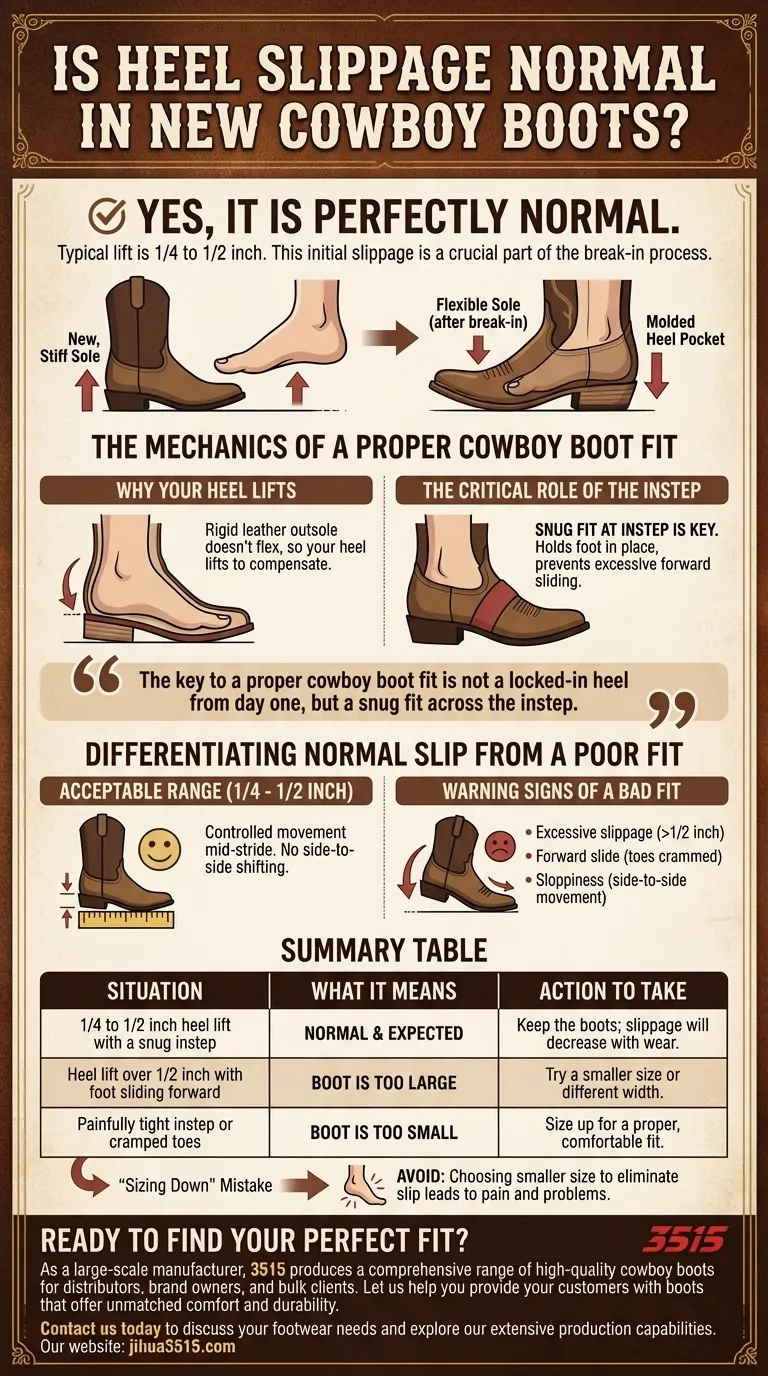
Yes, it is perfectly normal. New cowboy boots are expected to have some heel slippage, typically between a quarter and a half-inch. This initial lift occurs because the sole is stiff and the leather has not yet conformed to your foot. This slippage is a crucial part of the break-in process and will decrease significantly as the boot molds to your unique shape.
The key to a proper cowboy boot fit is not a locked-in heel from day one, but a snug fit across the instep. Initial heel slip is a temporary symptom of a new, stiff sole, not a sign of an incorrect size.
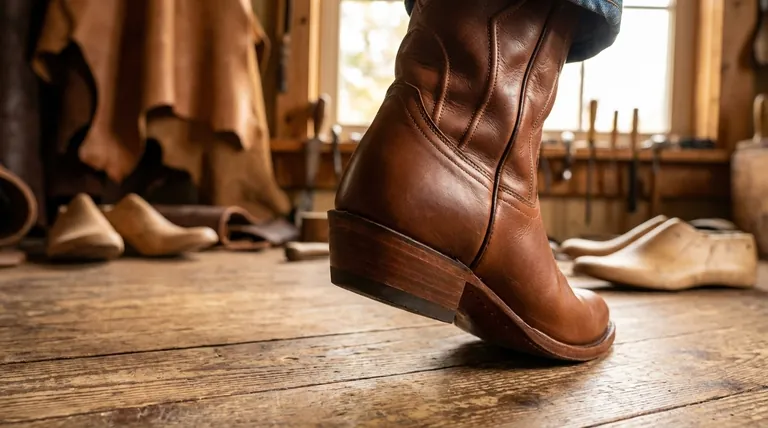
The Mechanics of a Proper Cowboy Boot Fit
Understanding why your heel slips is the first step to choosing the right boot. A cowboy boot is not built like a sneaker; its fit is based on a different set of principles centered on leather quality and traditional construction.
Why Your Heel Lifts
A brand-new cowboy boot has a rigid leather outsole that has not yet been flexed. When you take a step, your foot naturally bends at the ball. Because the new sole doesn't want to bend with it, your heel must lift up to compensate for the movement.
This is the primary source of heel slippage. It's a temporary interaction between your foot and the boot's structure.
The Critical Role of the Instep
The single most important factor in a cowboy boot's fit is the instep—the area over the top of your midfoot. A properly fitted boot should feel snug and secure here, like a firm handshake.
This snugness at the instep is what holds your foot in place. It prevents your foot from sliding forward excessively and keeps the boot anchored correctly.
How the Break-In Process Solves Slippage
As you wear your boots, two things happen. First, the leather outsole begins to soften and flex in the same place your foot does. Once the sole can bend with your step, your heel no longer needs to lift out to compensate.
Second, the leather in the heel counter molds around your heel, creating a custom-fit pocket. This combination of a flexible sole and a molded heel cup dramatically reduces and often eliminates the initial slippage.
Differentiating Normal Slip from a Poor Fit
While some slip is good, too much can indicate the boot is the wrong size or shape for your foot. Knowing the difference is essential.
The "Acceptable" Range
A lift of about 1/4 to 1/2 inch is the ideal range for a new boot. The movement should feel controlled and happen only when you are in mid-stride. Your heel should not be moving from side to side.
Warning Signs of a Bad Fit
You may have the wrong size if you experience these issues:
- Excessive slippage: Your heel lifts more than a half-inch.
- Forward slide: Your entire foot slides forward, cramming your toes into the front of the boot.
- Sloppiness: Your foot moves around inside the boot from side-to-side or feels loose even when standing still.
The "Sizing Down" Mistake
A common error is to choose a smaller size to eliminate that initial heel slip. This is a critical mistake. A boot that feels overly tight in the instep will only become more painful over time and may cause significant foot problems.
Common Pitfalls to Avoid
Navigating the unique feel of a new cowboy boot can be counterintuitive. Avoiding these common mistakes will ensure you get a comfortable, long-lasting fit.
Focusing Only on the Heel
Do not judge the fit of the boot based on heel slippage alone. The fit across the ball of your foot and, most importantly, the instep are far better indicators of the correct size.
Expecting a Sneaker-Like Feel
A cowboy boot should not fit like an athletic shoe. It is designed to hold your foot differently. There should be room for your toes to wiggle, and the initial stiffness is a sign of quality construction, not a poor fit.
Rushing the Decision
Walk around the store for several minutes. The leather will warm up, and you'll get a better sense of how the boot moves with your foot. A few steps are not enough to judge the fit properly.
Making the Right Choice for Your Foot
Use these guidelines to assess whether the heel slip you're feeling is a sign of a perfect fit or a problem.
- If you feel a slight lift (under 1/2 inch) with a snug, secure instep: You have likely found the correct size, and the slip will resolve with wear.
- If your heel lifts significantly and your whole foot slides forward: The boot is too large in volume or length, and you should try a smaller size or a different width.
- If your instep is painfully tight or your toes are cramped (even with heel slip): The boot is too small or the wrong shape for your foot, and you must size up.
Trust the process; a well-made boot with a bit of initial slip will break in to become one of the most comfortable pieces of footwear you own.
Summary Table:
| Situation | What It Means | Action to Take |
|---|---|---|
| 1/4 to 1/2 inch heel lift with a snug instep | Normal & Expected | Keep the boots; slippage will decrease with wear. |
| Heel lift over 1/2 inch with foot sliding forward | Boot is Too Large | Try a smaller size or different width. |
| Painfully tight instep or cramped toes | Boot is Too Small | Size up for a proper, comfortable fit. |
Ready to Find Your Perfect Fit?
As a large-scale manufacturer, 3515 produces a comprehensive range of high-quality cowboy boots for distributors, brand owners, and bulk clients. Our expertise ensures every pair is built with the proper construction that leads to an ideal, custom fit over time.
Let us help you provide your customers with boots that offer unmatched comfort and durability.
Contact us today to discuss your footwear needs and explore our extensive production capabilities.
Visual Guide
Related Products
- Durable Spiked Camouflage Boots Wholesale & Factory Production
- Wholesale High-Traction Camo Boots - Custom Manufacturer for Brands
- High-Traction Suede Tactical Boots Wholesale & Custom Manufacturing
- Wholesale Lightweight Tactical Boots Custom Manufacturer for Desert & Combat Use
- Durable Leather Tactical Boots Wholesale & Custom Manufacturing for Brands
People Also Ask
- How does boot height affect waterproofing? Choose the Right Height for Ultimate Protection
- What are the best types of shoes for different gardening conditions? Find Your Perfect Match.
- What role does camouflage play in hunting boots? It's More Than Just a Pattern
- What should you look for to ensure boots are fully waterproof? The Essential 2-Part System
- How does boot construction affect waterproofing? The Science Behind Truly Dry Feet