
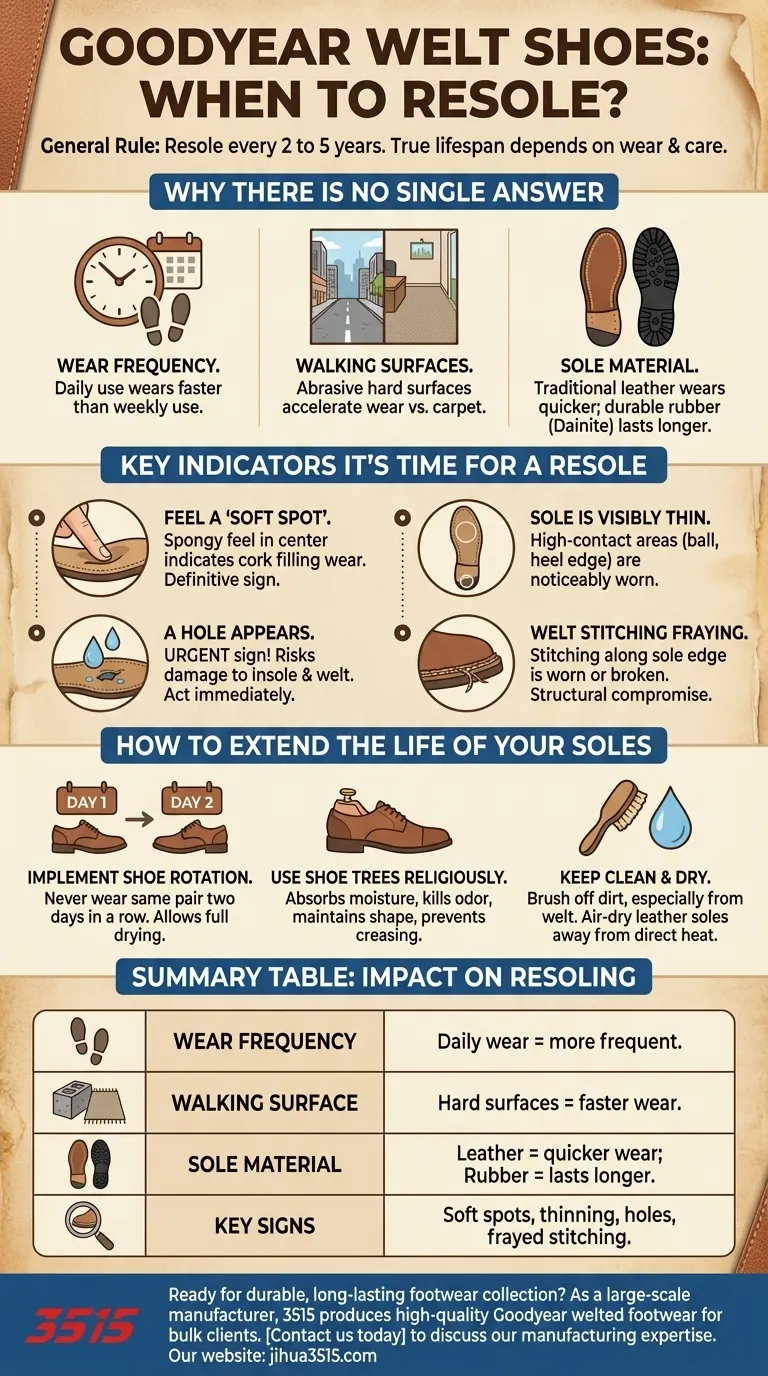
As a general rule, a pair of Goodyear welted shoes with regular wear should be resoled every 2 to 5 years. This wide range exists because the true lifespan of your soles is determined less by a calendar and more by how you wear and care for them.
The question isn't just when to resole your shoes, but understanding why. The "2-to-5-year" estimate is a starting point, but the real answer lies in recognizing the signs of wear and adopting habits that extend the life of your investment.
Why There Is No Single Answer
The lifespan of a shoe's sole is a direct result of the forces acting upon it. Several key factors will dramatically alter how quickly your soles wear down, making a one-size-fits-all timeline impractical.
The Role of Wear Frequency
The most significant factor is how often you wear the shoes. A pair worn once a week will last years longer than an identical pair worn five days a week for a daily commute.
The Impact of Walking Surfaces
Walking primarily on office carpet is vastly different from navigating concrete sidewalks and asphalt. Abrasive, hard surfaces will accelerate the wear on both leather and rubber soles.
The Material of the Sole
The original sole material plays a critical role. Traditional leather soles offer a classic look but will wear down more quickly, especially when exposed to moisture. Rubber soles (like Dainite or Commando) are inherently more durable and water-resistant, often lasting much longer.
Key Indicators It's Time for a Resole
Instead of relying on a calendar, learn to read the signs your shoes are giving you. Addressing wear proactively is the key to a long-lasting shoe.
You Feel a "Soft Spot"
If you press on the center of the sole and it feels spongy or soft, the cork filling inside the welt has compressed and worn away. This is a definitive sign that a resole is needed to restore the shoe's foundational support.
The Sole is Visibly Thin
Examine the areas of highest contact—typically the ball of the foot and the outer edge of the heel. If these areas are noticeably thinner than the rest of the sole, it's time to consult a cobbler.
A Hole Appears
This is the most urgent sign. Once a hole forms, water and debris can penetrate the shoe, damaging the cork, the welt, and the leather insole. This can make a future resole more complex and costly.
Welt Stitching is Fraying
Look at the stitching along the edge of the sole. If these threads are wearing away or breaking, the structural integrity is compromised. A resole is necessary to re-secure the sole to the welt.
How to Extend the Life of Your Soles
The longevity of a Goodyear welted shoe is not passive; it's the result of consistent care. Simple habits can dramatically increase the time between resoles.
Implement a Shoe Rotation
Never wear the same pair of leather shoes two days in a row. This gives the leather and the internal cork footbed a full 24-48 hours to dry out completely from perspiration, preventing premature breakdown.
Use Shoe Trees Religiously
A quality cedar shoe tree is non-negotiable. It absorbs residual moisture, kills odor-causing bacteria, and, most importantly, helps the shoe maintain its proper shape, preventing creasing and structural stress.
Keep Them Clean and Dry
At the end of the day, give your shoes a quick brush-down. This removes abrasive dirt and grime, especially from the welt channel where it can degrade the stitching. If you wear leather-soled shoes in the rain, allow them to air-dry naturally, away from direct heat.
Understanding the Trade-offs
Making the decision to resole involves balancing cost and long-term value.
The Cost of Waiting Too Long
Delaying a resole after a hole has formed is a false economy. It risks permanent damage to the shoe's internal structure—the insole and the welt—which can turn a standard repair into a much more expensive reconstruction, if it's even possible.
The Value of Proactive Maintenance
Think of a resole as routine maintenance, not an emergency repair. Addressing wear before it becomes critical ensures that only the sole needs replacing, preserving the integrity of the uppers and the foundational construction for decades of future use.
Making the Right Choice for Your Shoes
Your approach to resoling should be aligned with your goals for the footwear.
- If your primary focus is maximum longevity: Rotate your shoes, always use shoe trees, and send them for a resole at the first sign of a soft spot or significant thinning.
- If your primary focus is managing immediate cost: You can wait longer, but you must inspect the soles frequently and act immediately once a hole appears to avoid much higher repair costs later.
- If your primary focus is versatility: Use the resole process as an opportunity to adapt your shoes by changing from a leather sole to a more durable rubber sole for better traction and weather resistance.
By understanding these principles, you transform shoe ownership from a simple purchase into a long-term, sustainable investment.
Summary Table:
| Factor | Impact on Resoling Frequency |
|---|---|
| Wear Frequency | Daily wear requires more frequent resoling than occasional use. |
| Walking Surface | Hard surfaces like concrete wear soles faster than soft carpets. |
| Sole Material | Leather soles wear quicker; rubber soles (e.g., Dainite) last longer. |
| Key Signs to Resole | Soft spots, visible thinning, holes, or frayed welt stitching. |
Ready to build a durable, long-lasting footwear collection?
As a large-scale manufacturer, 3515 produces a comprehensive range of high-quality Goodyear welted footwear for distributors, brand owners, and bulk clients. Our production capabilities encompass all types of durable shoes and boots designed for longevity and easy maintenance.
Contact us today to discuss how our manufacturing expertise can provide the reliable, resole-ready footwear your customers demand.
Visual Guide
Related Products
- Durable Goodyear Welt Leather Work Boots for Wholesale & Private Label
- Wholesale Durable Leather Work Boots | 8-Inch Goodyear Welt Manufacturer
- Wholesale Durable & Breathable Training Shoes for Custom Brands
- Custom OEM Training Shoes Wholesale Manufacturer Durable & Breathable
- Lightweight Breathable Training Shoes for Wholesale & Custom OEM Manufacturing
People Also Ask
- What is the difference between full-grain and top-grain leather? Premium Material Guide for Boot Manufacturers
- What are the advantages of leather as an upper material for work boots? Unmatched Durability & Custom Comfort
- Why is it important to waterproof leather work boots? Protect Your Investment and Performance
- How should new leather work boots be broken in? A Guide to Comfort and Durability
- What are the advantages of leather uppers in work boots? Unmatched Durability & Protection



















