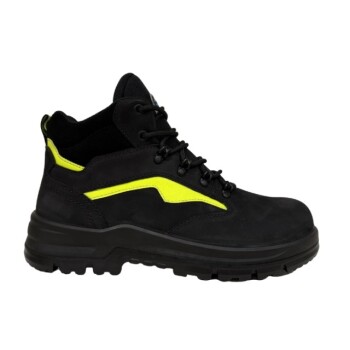
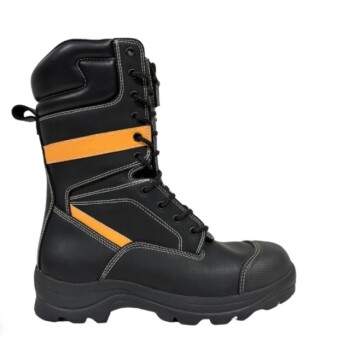
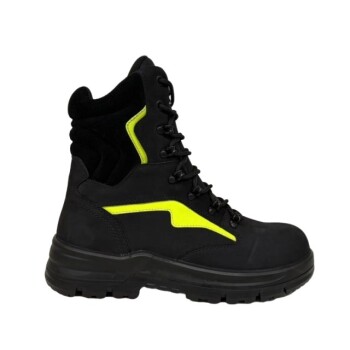
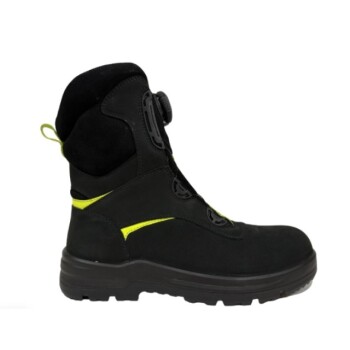
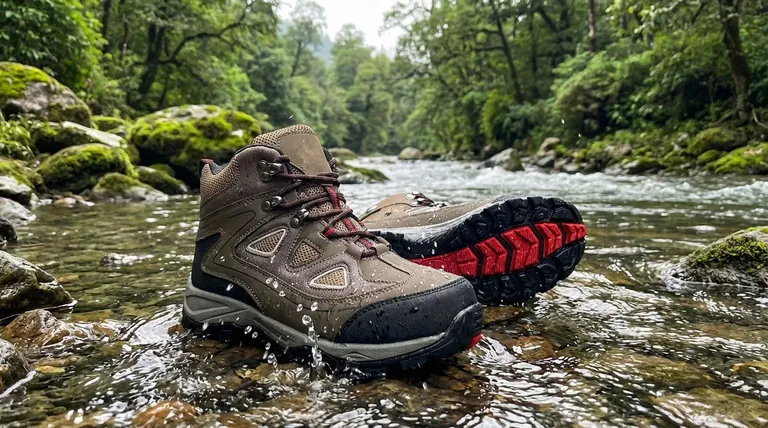
To put it directly, a standard pair of waterproof boots can typically withstand at least 1,000 mm of water pressure. This industry benchmark ensures the material can resist water penetration when you are walking through deep puddles, trekking in heavy snow, or crossing shallow streams.
The specific water pressure rating is only one part of the equation. True, real-world waterproof performance depends more on the boot's overall construction, including its height, seam sealing, and tongue design.
What "Water Pressure Rating" Actually Means
Understanding the technical rating helps clarify what your boots are designed to handle. This isn't an arbitrary number; it comes from a standardized industry test.
The Hydrostatic Head Test
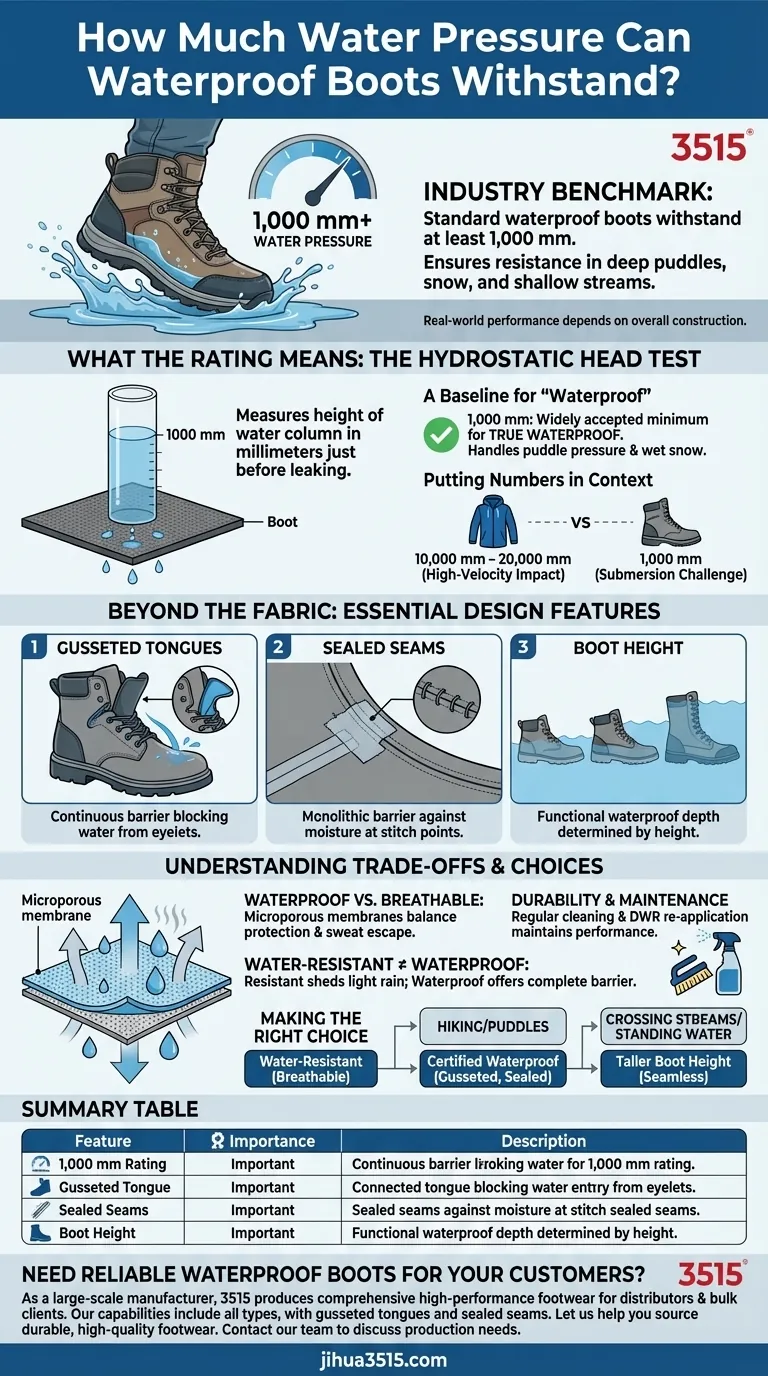
The "mm" rating comes from a procedure called the hydrostatic head test. In this test, a 1-inch diameter tube is placed on the boot's fabric, and water is added. The measurement in millimeters is the height the water column reached just before it began to leak through the material.
A Baseline for "Waterproof"
A rating of 1,000 mm is the widely accepted minimum for a fabric to be considered truly waterproof, not just water-resistant. This level is more than sufficient to handle the pressure exerted by standing in a puddle or the weight of wet snow.
Putting the Numbers in Context
While 1,000 mm is a solid baseline for footwear, you may see much higher numbers on other gear. For example, high-performance rain jackets or mountaineering tents can have ratings of 10,000 mm to 20,000 mm to withstand the force of driving wind and rain. Boots don't require such high ratings because the primary challenge is submersion, not high-velocity impact.
Beyond the Fabric: What Makes a Boot Truly Effective
A boot made from 20,000 mm fabric will still fail if its design has weak points. The construction is just as critical as the material itself.
Gusseted Tongues
This is a non-negotiable feature for waterproof integrity. A gusseted tongue is attached to the boot's upper along the sides, creating a continuous barrier that prevents water from seeping through the eyelets and laces. Without this, your boot is only as waterproof as its lowest lace hole.
Seam Sealing
Every stitch in a boot creates a tiny hole, which is a potential entry point for water. Quality waterproof boots have sealed or taped seams on the inside. This process covers the stitch holes and ensures the entire boot is a monolithic barrier against moisture.
Boot Height
The most advanced waterproof technology is useless if water can pour in over the top. The functional waterproof depth of your boot is determined by its height. An ankle-high boot is perfect for puddles, but you will need a mid or full-height boot for crossing streams.
Understanding the Trade-offs
No single boot is perfect for every situation. Choosing the right one means understanding the inherent compromises in its design.
Waterproof vs. Breathable
The classic trade-off in outdoor gear is waterproofing versus breathability. A completely impervious material like rubber is 100% waterproof but also traps all sweat inside. Modern boots use microporous membranes (like GORE-TEX) with pores large enough for water vapor (sweat) to escape but too small for water droplets to enter, striking a balance.
Durability and Maintenance
A boot's waterproof membrane can be compromised over time. Dirt and grit can abrade the material, and punctures can create leaks. Regular cleaning and re-applying a Durable Water Repellent (DWR) finish to the exterior will help maintain its performance.
Water-Resistant is Not Waterproof
It is crucial to distinguish between these terms. Water-resistant boots, often treated with a DWR coating, will shed light rain but will fail under sustained exposure or submersion. Waterproof boots are designed with materials and construction methods to provide a complete barrier against water entry.
Making the Right Choice for Your Goal
Focus on how the boot's complete design matches your intended activity, not just on a single number.
- If your primary focus is daily wear and occasional rain: A water-resistant boot is likely sufficient and will offer superior breathability.
- If your primary focus is hiking through wet grass, puddles, or snow: Look for a certified waterproof boot with a gusseted tongue and sealed seams.
- If your primary focus is crossing streams or working in standing water: Prioritize a taller boot height and seamless construction, as the depth of submersion is your main challenge.
Ultimately, choosing the right boot is about matching its complete design system to the environment you plan to face.
Summary Table:
| Feature | Importance |
|---|---|
| 1,000 mm Water Pressure Rating | Minimum industry standard for waterproof integrity. |
| Gusseted Tongue | Prevents water from seeping in through the laces. |
| Sealed Seams | Essential for blocking water entry at stitch points. |
| Boot Height | Determines the functional depth of waterproof protection. |
Need reliable waterproof boots for your customers?
As a large-scale manufacturer, 3515 produces a comprehensive range of high-performance footwear for distributors, brand owners, and bulk clients. Our production capabilities encompass all types of waterproof boots, built with gusseted tongues and sealed seams to ensure lasting protection.
Let us help you source durable, high-quality footwear that meets your exact specifications. Contact our team today to discuss your production needs.
Visual Guide
Related Products
- Premium Wholesale Waterproof Safety Boots High Performance Protection for Industrial Markets
- High Performance Fire-Retardant Waterproof Safety Boots
- Wholesale Premium Waterproof Nubuck Safety Shoes Boots
- Premium Flame-Retardant Waterproof Safety Boots and Shoes
- Durable Waterproof Rain Boots | Custom Manufacturer for Wholesale & Brands
People Also Ask
- What weather and chemical protections do premium boots offer? Your Complete Guide to Safety & Performance
- Why are waterproof safety boots recommended for certain work environments? Essential Protection for Wet & Hazardous Jobs
- What are the primary protective functions of industrial safety boots in oil palm plantations? Master Rough Terrain Safety
- Why are oil-resistant and anti-slip properties critical for industrial safety boots? Expert Outsole Engineering Guide
- What are the best types of shoes for different gardening conditions? Find Your Perfect Match.