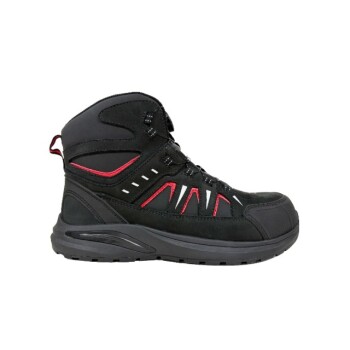
utilizing a 50th percentile male body model is the foundational strategy for creating industrial footwear that balances standardized fit with physiological performance. By basing designs on the average physical dimensions and metabolic heat output of the workforce, manufacturers can create boots that offer superior ergonomic support and efficient thermal regulation, directly addressing the physical demands of harsh environments like mining.
By standardizing design parameters around the 50th percentile, manufacturers replace estimation with anatomical precision. This ensures work boots are optimized not just for static fit, but for the dynamic heat management required to reduce fatigue and maintain worker safety.
Optimizing Anatomical Fit
Standardization of Dimensions
The core advantage of using a 50th percentile model is the establishment of a reliable baseline for anatomical dimensions.
Instead of designing for an abstract concept of a foot, engineers use specific, standardized measurements that represent the median worker.
This allows for the creation of footwear volume and arch support that align with the physical reality of the largest segment of the workforce.
Achieving Superior Fit
When the boot cavity matches the statistical average of the user population, unnecessary friction and pressure points are minimized.
This superior fit secures the foot properly within the boot, preventing the internal sliding that often leads to blisters and musculoskeletal strain.
Managing Thermal Physiology
Accounting for Heat Output
Ergonomics extends beyond physical shape; it includes how the body interacts with the environment.
The 50th percentile model provides critical data on physiological heat output, allowing designers to predict how much heat an average worker generates during intense labor.
Efficient Heat Dissipation
Using these thermal parameters, manufacturers can engineer ventilation systems and material choices that specifically target that projected heat load.
This results in more efficient heat dissipation, preventing the accumulation of heat and moisture inside the boot which can lead to skin maceration and discomfort.
The Impact on Worker Performance
Reducing Physical Fatigue
The combination of anatomical alignment and thermal regulation creates a compounding benefit for the worker.
When the body does not have to fight against poor fit or overheating, energy is conserved, leading to a measurable reduction in physical fatigue.
Enhancing Comfort in Harsh Climates
For industries like mining, environmental stressors are already high.
By neutralizing the stress from the footwear itself, the 50th percentile design approach significantly enhances comfort, allowing workers to focus on their tasks rather than their equipment.
Understanding the Trade-offs
The Limits of the "Average"
While designing for the 50th percentile covers the majority of the workforce, it is statistically an exclusionary approach for outliers.
Workers who fall into the 5th or 95th percentiles (very small or very large dimensions) may find that these optimized designs offer a suboptimal fit.
Standardization vs. Customization
Reliance on a single model maximizes efficiency for mass production but sacrifices the precision of bespoke equipment.
It is a utilitarian calculation: the greatest good for the greatest number, which may require supplementary solutions for workers with non-standard physiology.
Making the Right Choice for Your Team
Applying These Principles to Procurement
When selecting industrial footwear, understanding the design philosophy helps in assessing potential performance.
- If your primary focus is workforce-wide safety: Prioritize boots designed around the 50th percentile model to ensure the highest probability of fit and thermal protection for the majority of your team.
- If your primary focus is individual outlier support: Recognize that "average" designs may fail extreme sizes, and allocate budget for specialized footwear for workers falling outside the standard bell curve.
Standardization provides the baseline for industrial ergonomics, ensuring that the gear works as hard as the people wearing it.
Summary Table:
| Ergonomic Factor | 50th Percentile Application | Performance Benefit |
|---|---|---|
| Anatomical Fit | Standardizes median foot volume and arch height | Minimizes friction, pressure points, and blisters |
| Thermal Regulation | Models average physiological heat output | Enables efficient sweat evaporation and heat dissipation |
| Energy Conservation | Aligns boot mechanics with median gait | Reduces musculoskeletal strain and physical fatigue |
| Environmental Prep | Optimizes materials for high-stress labor | Enhances comfort in extreme climates like mining |
Partner with 3515 for Ergonomically Optimized Footwear Solutions
As a large-scale manufacturer serving distributors and brand owners, 3515 leverages advanced anatomical modeling to deliver superior safety and comfort. Our comprehensive production capabilities allow us to translate 50th percentile data into high-performance footwear across our entire range.
Whether you need our flagship Safety Shoes, rugged tactical boots, or professional dress footwear, we provide the scale and precision your brand requires. Contact us today to discuss your bulk requirements and discover how our manufacturing expertise can enhance your product lineup.
References
- Adam Wróblewski, Anna Janicka. CFD Analysis of the Forced Airflow and Temperature Distribution in the Air-Conditioned Operator’s Cabin of the Stationary Rock Breaker in Underground Mine under Increasing Heat Flux. DOI: 10.3390/en16093814
This article is also based on technical information from 3515 Knowledge Base .
Related Products
- Durable Leather Moc Toe Work Boots for Wholesale & Custom Manufacturing
- Durable Leather Work Boots for Wholesale & Custom Manufacturing
- Durable Leather Work Boots for Wholesale & Custom OEM Manufacturing
- Wholesale Customizable Safety Boots Durable & Protective Footwear Manufacturing
- Customizable Anti-Smash Safety Boots for Wholesale & Private Label Manufacturing
People Also Ask
- What are moc toe work boots designed for? Superior Comfort and Mobility for Tradespeople
- What are the key features to look for when purchasing moc toe boots? A Guide to Durability & Fit
- How did moc toe boots originate? A Legacy of Workwear Durability and Style
- What clothing items complement the Outdoorsman/Heritage Look with moc toe boots? Build a Timeless, Rugged Wardrobe
- What types of outfits can moc toe boots be worn with? Versatile Style Guide