
Beyond impact protection, certified motorcycle footwear fundamentally enhances your control and confidence while riding. Its specialized construction provides a stable platform that improves your physical connection to the motorcycle, allowing for more precise inputs and better overall handling in any situation.
While the primary reason for certified footwear is crash safety, its true value is revealed every time you ride. The specialized design offers superior grip, feel, and stability, transforming your connection with the machine from tentative to confident.
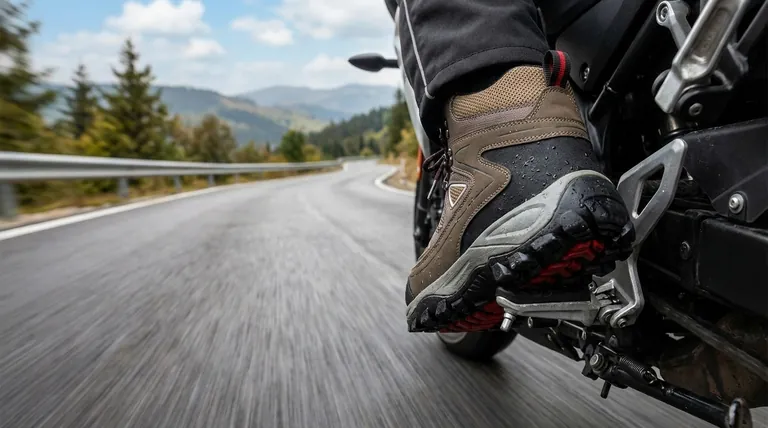
The Anatomy of Control: How Boots Connect You to the Bike
The claim that proper boots improve handling isn't just a feeling; it's a result of specific engineering choices that differentiate them from any other type of footwear. These features work together to translate your movements into precise commands for the motorcycle.
The Critical Role of Sole Design
A certified boot's sole is more than just rubber. It is specifically formulated to be oil-resistant and non-slip, providing a secure grip on the footpegs even in wet or adverse conditions.
This reliable footing eliminates the subtle foot movements that can happen with street shoes, giving you a stable base for shifting your weight and controlling the bike through turns.
Torsional Stiffness and Support
One of the most important, yet least visible, features is torsional stiffness. This is the boot's resistance to twisting forces.
A stiff boot prevents your foot from flexing unnaturally on the peg, ensuring that the energy from your leg is transferred directly and efficiently to the shifter or rear brake. This rigidity provides crucial ankle support and allows for more forceful, precise control inputs.
Enhanced Shifter and Brake Feel
Dedicated riding boots feature a reinforced shifter pad on the toe box. This not only protects the boot from wear but also distributes the pressure of the shift lever, providing better tactile feedback.
This design allows for smoother, more consistent gear changes and finer modulation of the rear brake, which is critical for advanced control techniques and low-speed maneuvering.
Understanding the Trade-offs: Certified Boots vs. Casual Footwear
Many riders believe any sturdy, over-the-ankle boot will suffice. However, understanding the design differences reveals why this assumption compromises both safety and control.
The Illusion of "Sturdy" Work Boots
While they may seem tough, work boots are designed for walking and impact protection on a job site, not for riding. They lack the necessary torsional stiffness, their soles can degrade from contact with oil and gas, and their exposed laces pose a significant snagging hazard.
The Deception of Hiking Boots
Hiking boots are engineered for flexibility to accommodate the motion of walking. This is the exact opposite of what you need on a motorcycle, where a rigid platform is essential for control. Their aggressive tread, designed for dirt, can also dangerously catch on serrated footpegs.
The Comfort vs. Control Equation
Certified riding boots are often stiffer and less comfortable for walking than casual shoes. This is a deliberate engineering trade-off. The rigidity required for on-bike control and protection necessarily compromises off-bike walking comfort—it is a feature, not a flaw.
Making the Right Choice for Your Goal
Selecting the right footwear depends entirely on how you ride. Consider your primary use case to find the optimal balance of features.
- If your primary focus is urban commuting: Look for certified riding shoes or short boots that offer core protection and control features while providing better off-bike walking comfort.
- If your primary focus is touring or long-distance travel: Prioritize boots with maximum support, proven waterproofing, and an ergonomic design for sustained comfort in the saddle.
- If your primary focus is performance or track riding: Seek the highest level of certification with extreme torsional stiffness and armor for uncompromising control and protection at speed.
Investing in certified footwear is an investment in your skill, confidence, and connection with every single ride.
Summary Table:
| Feature | Benefit for Riding |
|---|---|
| Oil-Resistant, Non-Slip Sole | Provides a secure grip on footpegs, even in wet conditions. |
| Torsional Stiffness | Transfers leg energy efficiently for precise gear shifts and brake control. |
| Reinforced Shifter Pad | Offers better tactile feedback for smoother gear changes. |
| Ankle Support & Rigidity | Creates a stable platform for confident weight shifting and cornering. |
Elevate Your Ride with Precision-Engineered Footwear
As a large-scale manufacturer, 3515 produces a comprehensive range of certified motorcycle boots for distributors, brand owners, and bulk clients. Our production capabilities ensure top-tier quality, combining essential safety with the advanced control features detailed above.
Ready to equip your customers with footwear that builds confidence and enhances performance?
Contact us today to discuss your specific needs and discover how 3515 can be your trusted partner in premium motorcycle footwear.
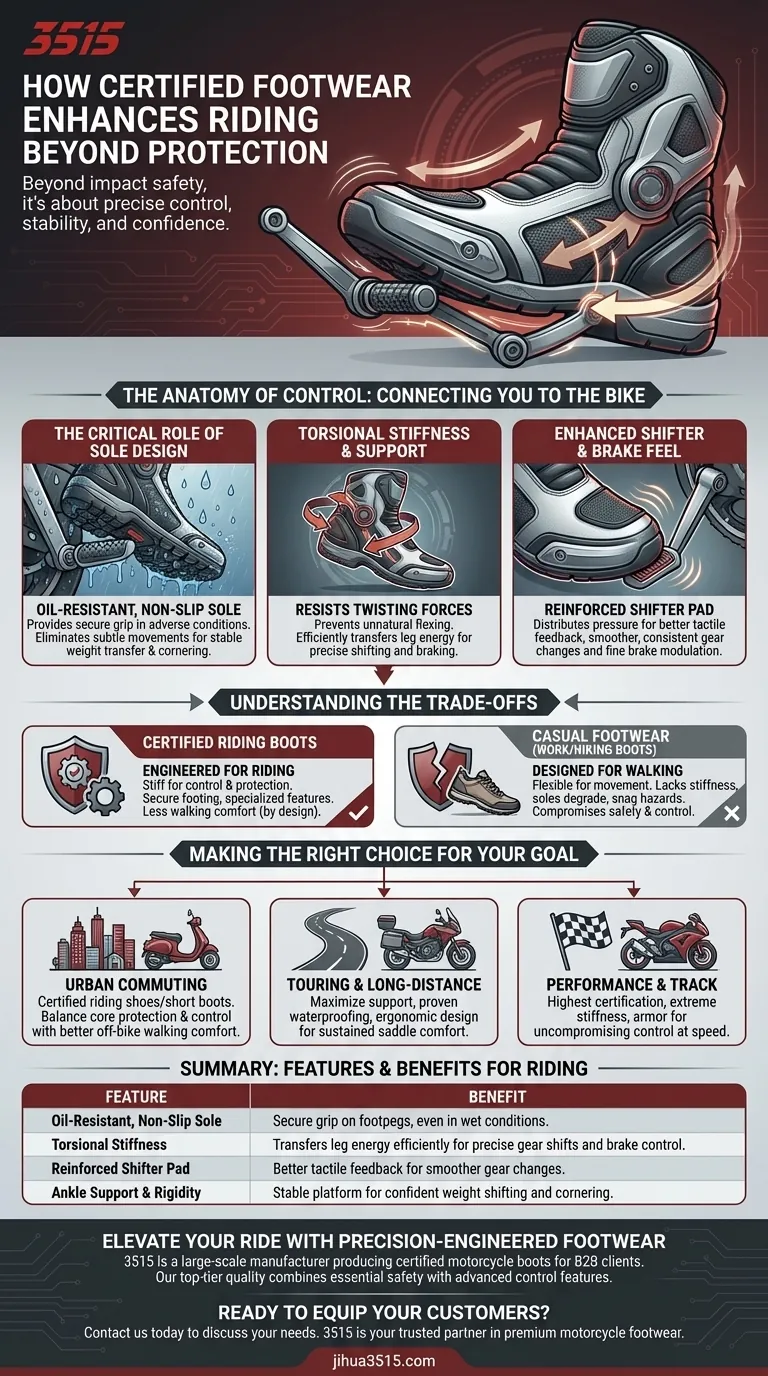
Visual Guide
Related Products
- High Performance Fire-Retardant Waterproof Safety Boots
- Durable Goodyear Welt Leather Work Boots for Wholesale & Private Label
- Heavy-Duty Waterproof Nubuck Safety Boots Safety Shoes for Bulk Supply
- Wholesale Tactical Boots High-Traction & Reflective for Bulk & Brand Orders
- Premium Wholesale Tactical Style Safety Shoes Boots with Quick Lacing
People Also Ask
- Why are waterproof safety boots recommended for certain work environments? Essential Protection for Wet & Hazardous Jobs
- What roles do 3D vision systems and industrial robots play in the manufacturing of fire safety boots? Smart Automation
- How should you maintain waterproof boots? A Simple 3-Step Guide to Long-Lasting Performance
- What is the difference between waterproof and water-resistant boots? Choose the Right Footwear for Any Condition
- What should you look for to ensure boots are fully waterproof? The Essential 2-Part System



















