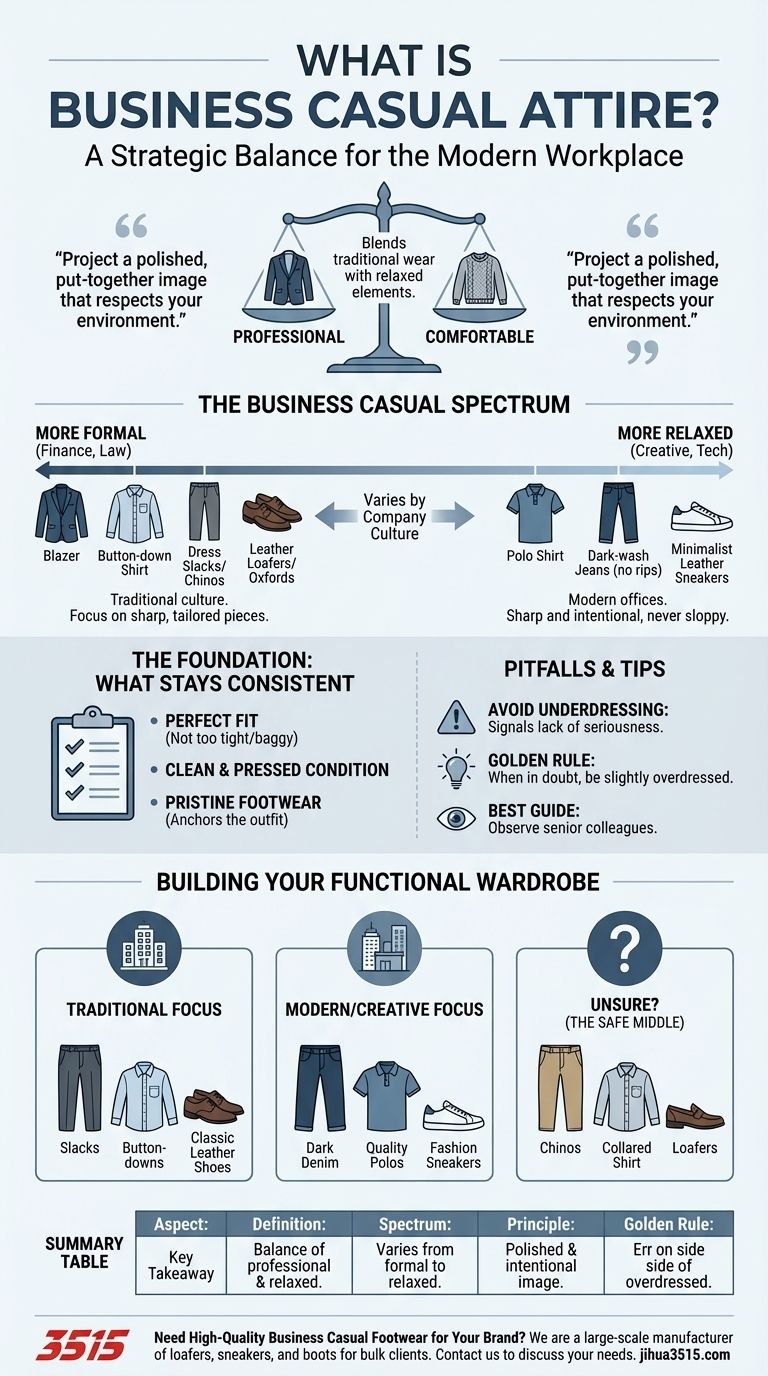
Business casual is a dress code of strategic balance. It blends traditional business wear with more relaxed, modern elements to create an appearance that is professional yet comfortable. It generally means avoiding a full suit and tie, but it always excludes overtly casual items like athletic sneakers, t-shirts, and ripped clothing.
The core principle of business casual is not to follow a rigid checklist, but to project a polished, put-together image that respects your professional environment without the formality of a suit.

Deconstructing the "Business Casual" Spectrum
The most common point of confusion is that "business casual" is not a single, universal standard. It exists on a spectrum that varies widely depending on company culture, industry, and even geographic location. Understanding this spectrum is key to getting it right.
The More Formal End of the Spectrum
In industries like finance or law, or in companies with a more traditional culture, business casual leans heavily toward "business."
Key pieces often include dress slacks or chinos, a collared button-down dress shirt, and potentially a blazer or sport coat. Footwear is typically a quality pair of leather dress shoes, such as loafers or oxfords.
The More Relaxed End of the Spectrum
In creative fields, tech startups, or more modern offices, the "casual" element has more influence.
This may include dark-wash, well-fitting jeans (with no rips or fading), polo shirts, knit sweaters, and even clean, minimalist leather sneakers. The emphasis remains on looking sharp and intentional, not sloppy.
The Foundation: What Stays Consistent
Regardless of where your workplace falls on the spectrum, a few principles are non-negotiable.
The fit of your clothing is paramount; avoid anything excessively tight or baggy. All attire should be clean, pressed, and in good condition. Footwear, in particular, anchors the entire outfit and should always be clean and well-maintained.
Understanding the Trade-offs and Pitfalls
Navigating an ambiguous dress code requires situational awareness. The biggest risk is misinterpreting the company culture and making a poor impression.
The Danger of Underdressing
Appearing too casual can signal a lack of seriousness or respect for the professional environment. It can subtly impact how colleagues and superiors perceive your competence and commitment.
The "When in Doubt" Principle
It is always safer to be slightly overdressed than underdressed. If you are new to a company or unsure of the expectations for a particular day, err on the side of a more formal business casual look. You can always remove a blazer, but you cannot add one you didn't bring.
The Most Reliable Guide: Observation
The best way to calibrate your attire is to observe what your managers and respected senior colleagues are wearing. Their daily choices provide the most accurate definition of your specific workplace's standard.
Making the Right Choice for Your Goal
Use your workplace environment as your guide to build a functional and appropriate wardrobe.
- If your primary focus is a traditional office: Invest in core pieces like well-fitting slacks, a few quality button-down shirts, and classic leather shoes.
- If your primary focus is a modern or creative workplace: You have more flexibility with dark denim, high-quality polos, and clean, fashionable sneakers.
- If you are unsure of the environment: Start with the universal middle ground of chinos, a collared shirt, and loafers, then adjust based on what you see.
Ultimately, business casual is about communicating professionalism and competence through your appearance.
Summary Table:
| Aspect | Key Takeaway |
|---|---|
| Definition | A balance between professional and relaxed elements, excluding overly casual items. |
| Spectrum | Ranges from formal (e.g., slacks, blazer) to relaxed (e.g., dark jeans, quality sneakers). |
| Core Principle | Project a polished, intentional image that respects your workplace culture. |
| Golden Rule | When in doubt, err on the side of being slightly overdressed. |
Need High-Quality Business Casual Footwear for Your Brand or Store?
As a large-scale manufacturer, 3515 produces a comprehensive range of footwear for distributors, brand owners, and bulk clients. Whether your customers need classic leather loafers for a formal office or minimalist leather sneakers for a creative environment, our production capabilities encompass all types of professional shoes and boots. We ensure quality, comfort, and style to help your clients make the right impression.
Contact us today to discuss your footwear needs and elevate your product line with reliable, professional styles.
Visual Guide