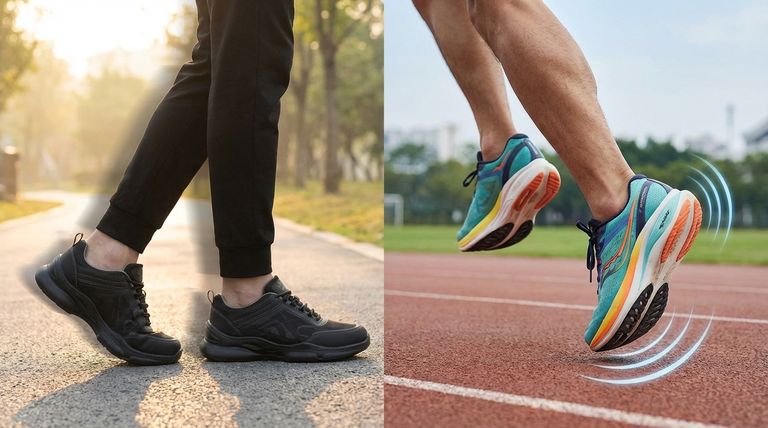
Fundamentally, the difference lies in how each shoe manages impact and foot trajectory. Walking shoes are engineered for stability and a rolling heel-to-toe motion, featuring flatter soles, evenly distributed cushioning, and flexible forefeet. Conversely, running shoes are built for shock absorption and propulsion, utilizing thicker soles, specialized durable materials, and curved shapes to handle high-impact forces and drive the runner forward.
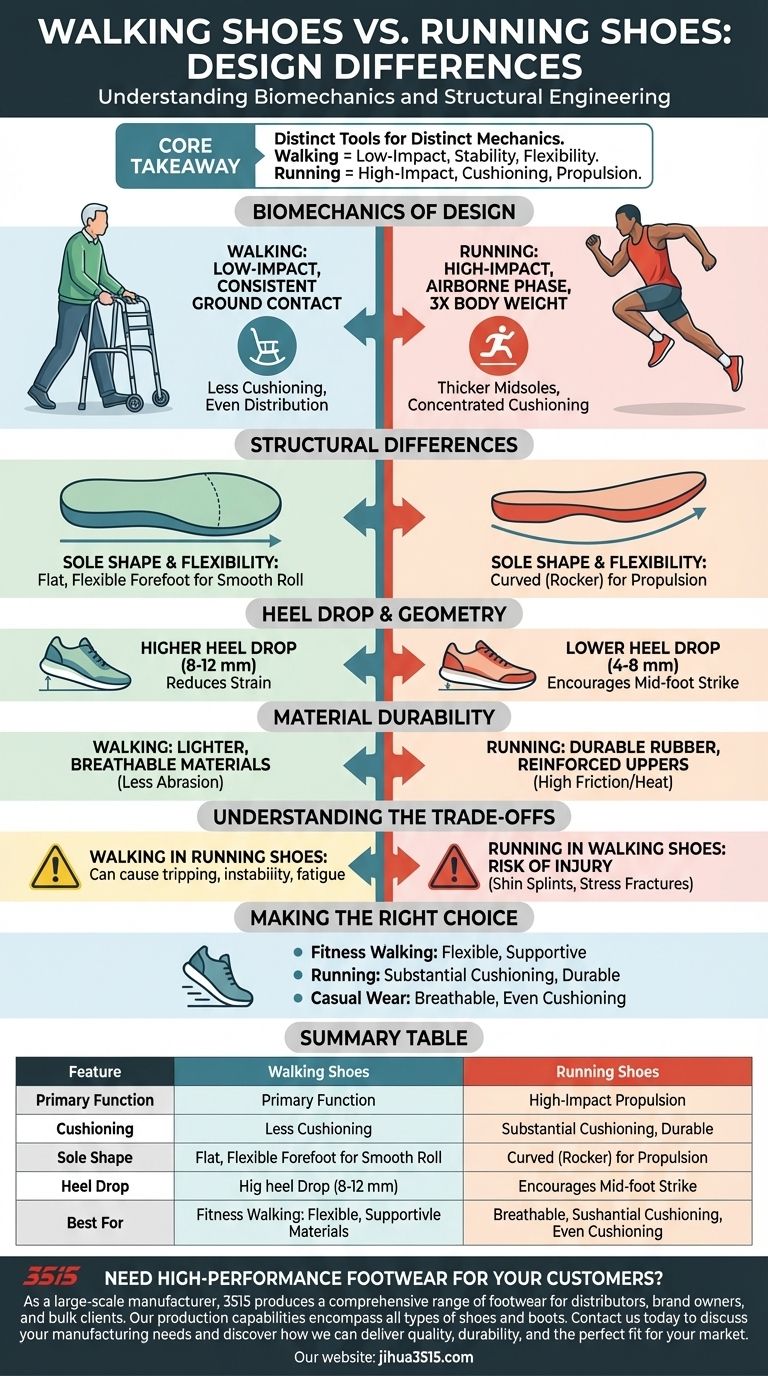
Core Takeaway While they may look similar, these shoes function as distinct tools for distinct mechanics. Walking is a low-impact activity requiring arch support and flexibility, whereas running is a high-impact series of jumps requiring significant cushioning and energy return.
The Biomechanics of Design
To understand the design, you must understand the movement. Walking keeps one foot on the ground at all times, creating a consistent "rocking chair" motion. Running involves an airborne phase, resulting in impact forces of roughly three times your body weight upon landing.
Impact and Cushioning Needs
Because walking is a low-impact activity, walking shoes require less total cushioning than running shoes. Instead of massive shock absorption, they prioritize comfort over long durations.
Running shoes must manage high-intensity forces. Therefore, they feature thicker midsoles and specialized cushioning technologies—ranging from minimal to maximal—to protect joints from repetitive pounding.
Cushioning Distribution
The placement of the foam matters as much as the amount. Walking shoes typically feature even cushioning throughout the footbed to support the entire foot during the ground-contact phase.
Running shoes often concentrate cushioning in specific zones, such as the heel and forefoot, to mitigate shock where the foot strikes and pushes off most aggressively.
Structural Differences
Beyond the foam, the physical architecture of the shoe dictates how your foot moves.
Sole Shape and Flexibility
Walking shoes generally have flatter soles to maximize ground contact, which enhances stability. They are designed with high flexibility in the forefoot to allow for a smooth, natural toe-off.
Running shoes frequently feature curved soles or a "rocker" shape. This curvature acts as a mechanism to propel the runner forward efficiently, smoothing the transition from landing to takeoff.
Heel Drop and Geometry
"Heel drop" refers to the height difference between the heel and the toe. Walking shoes typically utilize a higher heel drop (8-12 mm). This reduces strain on the Achilles tendon during the hard heel strike characteristic of walking.
Running shoes often feature a lower heel drop (4-8 mm). This design encourages a flatter landing or a mid-foot strike, which helps maintain momentum and supports natural running gaits.
Material Durability
Running shoes are subjected to intense friction and heat. Consequently, they utilize highly durable rubber compounds on the outsole and reinforced uppers to prevent rapid breakdown.
Walking shoes face less abrasion. While still well-made, they often use lighter, more breathable materials that prioritize weight reduction and airflow over heavy-duty reinforcement.
Understanding the Trade-offs
It is a common misconception that because running shoes are "technical," they are better for everything. This is incorrect.
The Risk of Interchangeability
These shoes are not interchangeable. The design features that make a running shoe fast can make a walker unstable.
Walking in Running Shoes
You can walk in running shoes, but the extra cushioning and curved sole may cause you to trip or feel unstable. The "springy" feel designed for running can be fatiguing during a slow walk.
Running in Walking Shoes
You should never run in walking shoes. The lack of impact protection and the rigid midsole can lead to immediate discomfort and eventual injury, such as shin splints or stress fractures.
Making the Right Choice for Your Goal
Selecting the correct footwear is about matching the tool to the primary mechanical stress your body will endure.
- If your primary focus is fitness walking: Choose a shoe with a flexible forefoot and a supportive, flat heel to encourage a smooth, stable rolling motion.
- If your primary focus is running (even short distances): Prioritize a shoe with substantial shock absorption and a durable outsole to protect your joints from high-impact forces.
- If your primary focus is casual, all-day wear: Look for a walking shoe with breathable uppers and even cushioning to reduce foot fatigue during long periods of standing.
Ultimately, respect the engineering: use a shock absorber for impact and a stabilizer for walking.
Summary Table:
| Feature | Walking Shoes | Running Shoes |
|---|---|---|
| Primary Function | Stability & Rolling Motion | Shock Absorption & Propulsion |
| Cushioning | Evenly Distributed | Concentrated in Heel/Forefoot |
| Sole Shape | Flat & Flexible | Curved (Rocker) |
| Heel Drop | Higher (8-12 mm) | Lower (4-8 mm) |
| Best For | Low-impact, all-day wear | High-impact, repetitive motion |
Need high-performance footwear for your customers?
As a large-scale manufacturer, 3515 produces a comprehensive range of footwear for distributors, brand owners, and bulk clients. Our production capabilities encompass all types of shoes and boots, ensuring you get the right tool for the right activity—whether it's a stable walking shoe or a cushioned running shoe.
Contact us today to discuss your manufacturing needs and discover how we can deliver quality, durability, and the perfect fit for your market.
Visual Guide
Related Products
- Wholesale Durable Camouflage Canvas Shoes with High-Traction Cleated Rubber Sole
- Durable Rubber Sole Outdoor Shoes Wholesale & Custom Manufacturing
- Premium Suede Sport Safety Shoes for Wholesale & Bulk Orders
- Durable Goodyear Welt Leather Work Boots for Wholesale & Private Label
- Wholesale Comfortable Business Casual Shoes Custom Manufacturing
People Also Ask
- Why is the selection of high-strength fabric materials necessary in the production of canvas shoes and training shoes?
- What are the properties of canvas as a shoe material? A Guide to Lightweight Comfort & Style
- Can canvas shoes be worn in rainy conditions? The Truth About Water Resistance
- What are some examples of vulcanized shoes? Discover the Flexibility and Board Feel of Classic Sneakers
- What are the characteristics of canvas as a shoe material? A Guide to Lightweight, Breathable Footwear