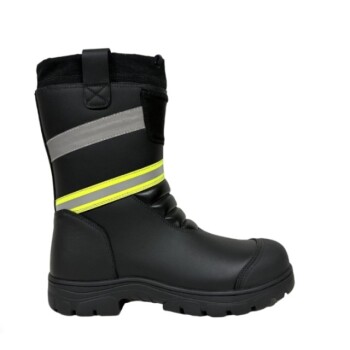
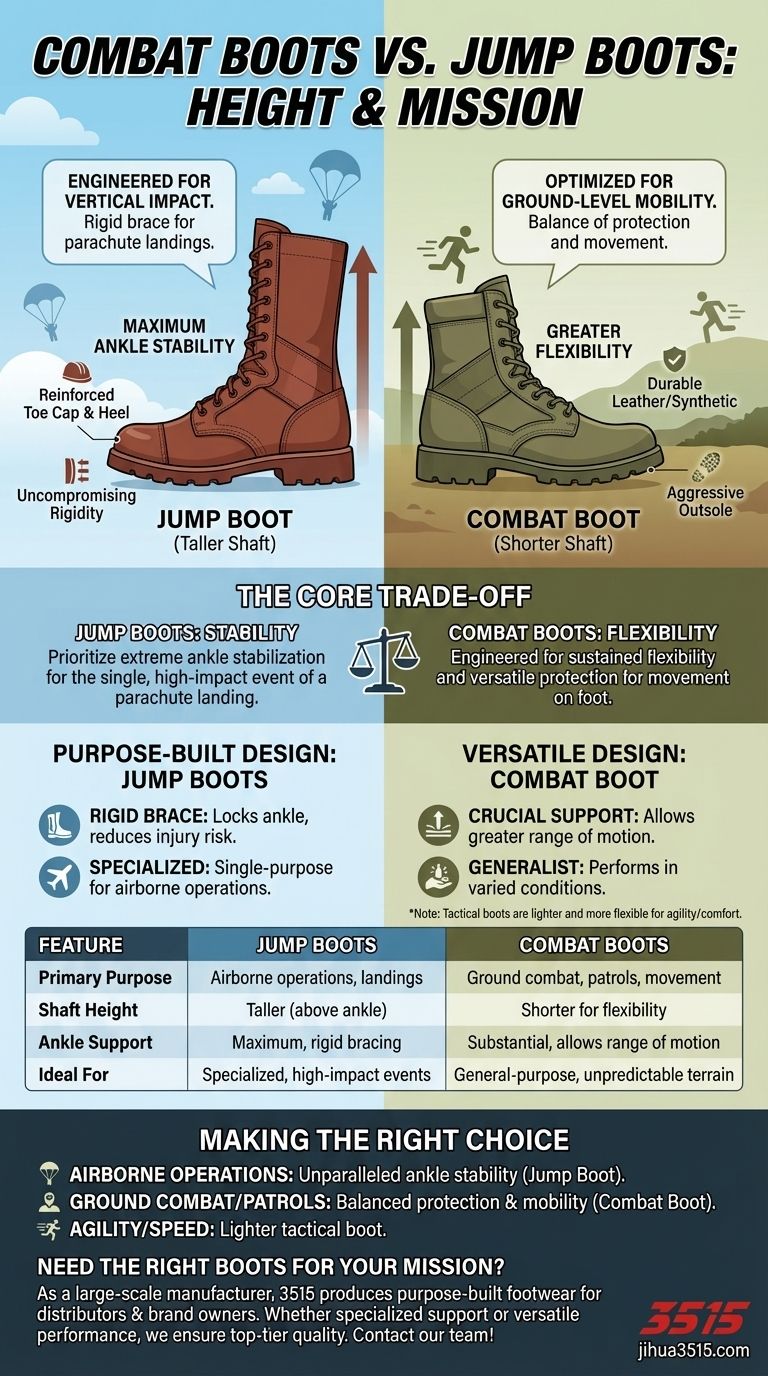
The fundamental difference between combat boots and jump boots lies in their height, a design choice directly dictated by their intended mission. Jump boots feature a significantly taller shaft to provide maximum ankle stability for airborne operations, while standard combat boots have a shorter shaft to allow for greater flexibility and comfort during ground-level movement across varied terrain.
The core trade-off is simple: Jump boots prioritize extreme ankle stabilization for the single, high-impact event of a parachute landing, while combat boots are engineered for the sustained flexibility and versatile protection required for movement on foot.
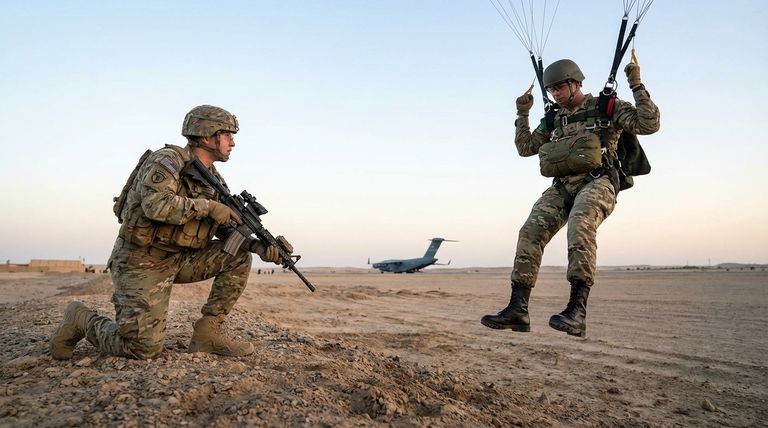
The Purpose-Built Design of Jump Boots
Jump boots are a highly specialized piece of equipment, with every design feature centered on the unique dangers of a parachute landing. Their height is their most defining characteristic.
Engineered for Vertical Impact
The taller shaft, extending well above the ankle, acts as a rigid brace. Its purpose is to lock the ankle in place, drastically reducing the risk of sprains, fractures, or other injuries during the uncontrolled and high-impact moment of landing.
Uncompromising Rigidity and Support
To achieve this level of protection, jump boots are inherently more rigid than combat boots. They often feature reinforced toe caps and heels to absorb impact and protect the foot from hazards upon landing. This rigidity is a feature, not a flaw, but it comes at the cost of long-distance walking comfort.
The Versatile Design of the Combat Boot
Where jump boots are specialists, modern combat boots are generalists, designed to perform well in a wide variety of conditions and environments. Their design reflects a balance between protection and mobility.
Optimized for Ground-Level Mobility
The shorter shaft of a combat boot provides crucial ankle support but stops short of the extreme height of a jump boot. This design choice is deliberate, allowing for a greater range of motion, which is essential for running, climbing, and navigating uneven ground.
A Balance of Protection and Performance
Combat boots are built for durability and protection. They are typically made from full-grain leather or rugged synthetic blends and feature aggressive outsoles for superior traction. While they offer substantial ankle support, their primary goal is to protect the soldier's foot during demanding field operations without hindering movement.
A Note on "Tactical" vs. "Combat" Boots
The term "tactical boot" often refers to a lighter, more flexible boot. While combat boots are built for the extreme rigors of military deployment, tactical boots are often favored for law enforcement or training, where agility and comfort over long shifts are prioritized over maximum durability.
Understanding the Trade-offs
Choosing between these boot types involves accepting a set of functional compromises. The right boot is always the one that matches the specific demands of the mission.
Stability vs. Flexibility
This is the central trade-off. Jump boots sacrifice flexibility to gain the highest possible level of ankle stabilization. Combat boots sacrifice some of that top-end stability to provide the flexibility needed for efficient movement on the ground.
Specialized vs. General-Purpose
A jump boot is a single-purpose tool designed to excel at one specific, high-risk task. A combat boot is a multi-purpose tool designed to be a reliable and effective solution for a wide range of unpredictable challenges.
Making the Right Choice for Your Goal
Your operational requirement is the only factor that matters when selecting the appropriate footwear.
- If your primary focus is airborne operations: You require the unparalleled ankle stability of a purpose-built jump boot.
- If your primary focus is versatile ground combat or extended patrols: The balanced protection and mobility of a standard combat boot are essential.
- If your primary focus is agility, speed, and comfort in less extreme environments: A lighter tactical boot may be the most suitable option.
Ultimately, a boot's design is a direct reflection of the problems it is intended to solve.
Summary Table:
| Feature | Jump Boots | Combat Boots |
|---|---|---|
| Primary Purpose | Airborne operations, parachute landings | Ground combat, extended patrols, versatile movement |
| Shaft Height | Taller (above ankle) for maximum stability | Shorter for greater flexibility and mobility |
| Ankle Support | Maximum, rigid bracing | Substantial, but allows for range of motion |
| Ideal For | Specialized, high-impact events | General-purpose, unpredictable terrain |
Need the right boots for your mission? As a large-scale manufacturer, 3515 produces a comprehensive range of purpose-built footwear for distributors, brand owners, and bulk clients. Whether you require the specialized ankle support of jump boots or the versatile performance of combat boots, our production capabilities ensure top-tier quality and durability. Contact our team today to discuss your specific requirements and get a quote!
Visual Guide
Related Products
- Durable Military Combat Boots with Water Drainage for Wholesale & OEM
- Durable Leather Tactical Boots Wholesale & Custom Manufacturing for Brands
- High-Traction Suede Tactical Boots Wholesale & Custom Manufacturing
- Wholesale Lightweight Tactical Boots Custom Manufacturer for Desert & Combat Use
- Durable Mid-Cut Tactical Boots for Wholesale & Private Label
People Also Ask
- Why must gait validation for military applications be conducted in combat boots? Ensure Data Accuracy for Soldiers
- What are the common types of combat boots? Find the Right Boot for Your Mission
- What factors should be considered when choosing military boots for hiking? Durability vs. Weight for Your Terrain
- What are the key considerations when choosing military boots? Prioritize Compliance, Environment & Fit
- How should the midfoot and heel fit in military boots? Achieve a Snug, Secure Fit for Blister Prevention