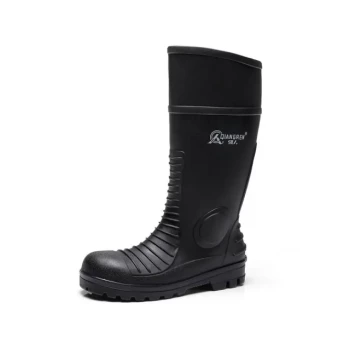
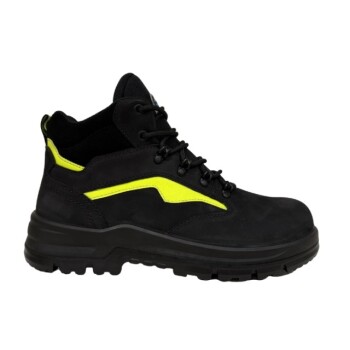
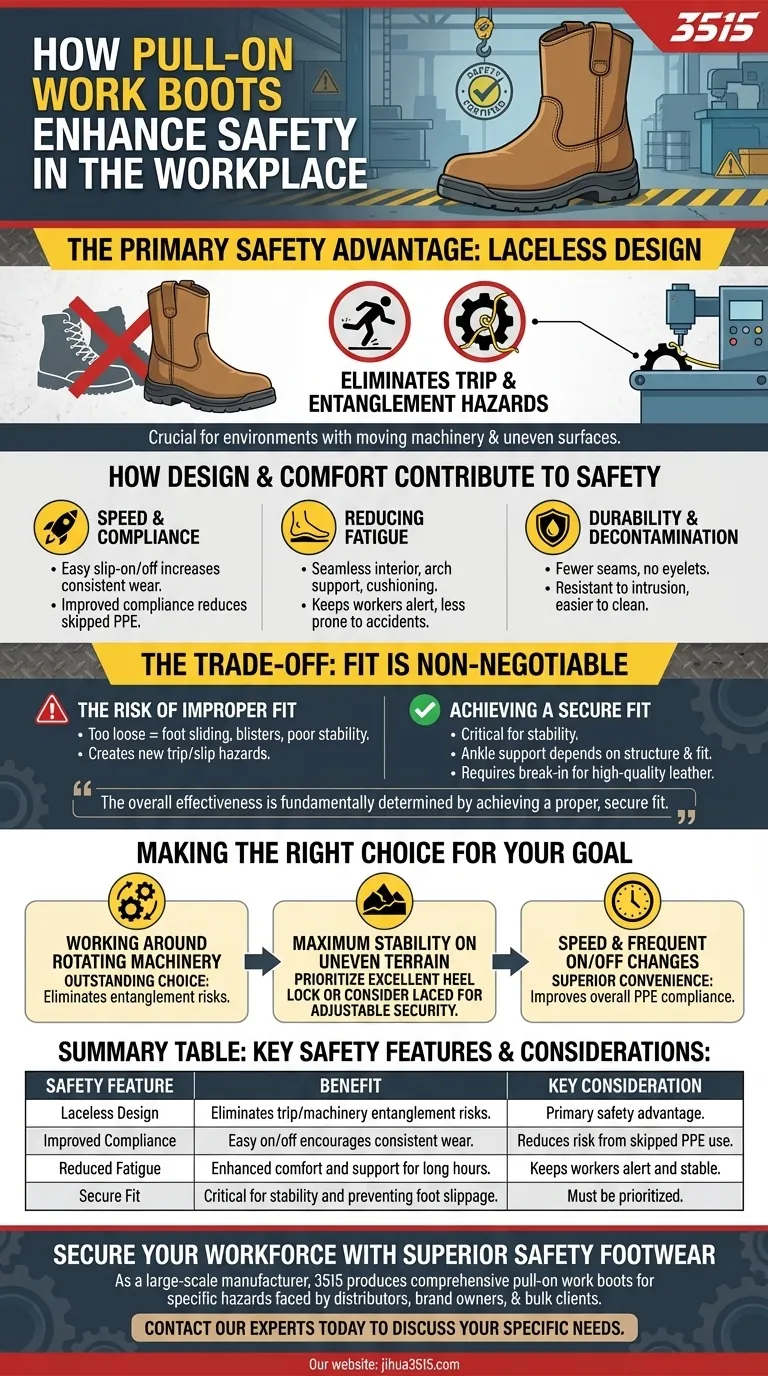
The primary safety advantage of pull-on work boots is their laceless design, which directly eliminates the trip and entanglement hazards present with traditional laced boots. This single design choice removes a common, yet often overlooked, point of failure in personal protective equipment, especially in environments with moving machinery or uneven surfaces.
While the absence of laces provides a clear and immediate safety benefit, the overall effectiveness of a pull-on boot is fundamentally determined by achieving a proper, secure fit. Without it, you may trade one hazard for another.
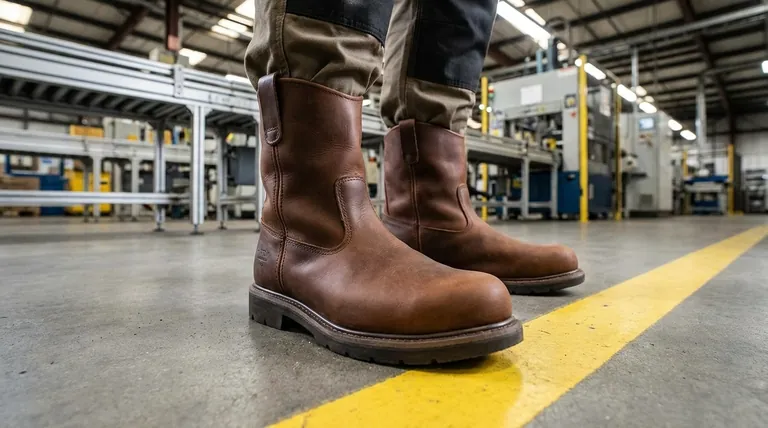
The Core Safety Benefit: Eliminating Lace-Related Hazards
The most significant safety enhancement offered by pull-on boots is the removal of laces. This addresses two critical and frequent causes of workplace incidents.
Reducing Trip and Fall Risks
Untied or overly long laces are a direct cause of trips and falls. A pull-on boot’s solid, uninterrupted exterior completely removes this variable, providing a cleaner and safer profile for walking and moving around a job site.
Preventing Machinery Entanglement
For workers operating or working near rotating equipment, such as drills, lathes, or conveyors, a loose shoelace can be catastrophic. The laceless design of pull-on boots ensures there are no dangling components that can get caught, pulling the worker into dangerous machinery.
How Design and Comfort Contribute to Safety
Beyond the absence of laces, other features of pull-on boots contribute to a safer work environment, often by reducing worker fatigue and encouraging proper use.
Speed and Compliance
The ease of slipping the boots on and off increases the likelihood that workers will wear them consistently and correctly. When PPE is convenient, compliance rates improve, reducing the chance someone forgoes their safety footwear for a "quick" task.
Reducing Fatigue
A well-designed pull-on boot often features a seamless interior, enhanced arch support, and modern cushioning. This focus on comfort helps reduce foot and leg fatigue for those who spend long hours on their feet, keeping them more alert and less prone to accidents.
Durability and Decontamination
Fewer seams and no eyelets mean there are fewer points of failure. This can make the boot more resistant to water, mud, and chemical intrusion. The smooth surface is also typically easier and faster to clean and decontaminate.
Understanding the Trade-offs: Fit is Non-Negotiable
The primary advantage of pull-on boots is also their main challenge. The lack of an adjustable lacing system means that achieving a perfect fit is absolutely critical to its safety performance.
The Ankle Support Challenge
Without laces to tighten the boot, ankle support is entirely dependent on the boot's structure and its fit to your specific foot and ankle shape. A poor fit can lead to a lack of stability on uneven ground.
The Risk of an Improper Fit
If a pull-on boot is too loose, your foot can slide inside the boot. This not only causes blisters and discomfort but also compromises your balance and stability, potentially creating a new trip or slip hazard.
The Critical Break-in Period
Many high-quality pull-on boots, particularly leather ones, require a significant break-in period. During this time, the boot molds to your foot to create the necessary snug fit. It is essential to ensure the fit is correct from the start.
Making the Right Choice for Your Goal
To leverage the safety benefits of pull-on boots, you must match the boot's design to your work environment and prioritize fit above all else.
- If your primary focus is working around rotating machinery: The laceless design of a pull-on boot is an outstanding choice to eliminate entanglement risks.
- If your primary focus is maximum stability on uneven terrain: You must prioritize a pull-on model renowned for its exceptional heel lock and structured ankle support, or consider that a laced boot may offer more adjustable security.
- If your primary focus is speed and frequent on/off changes: Pull-on boots provide superior convenience, which can improve overall PPE compliance and reduce time-wasting hassles.
Ultimately, the safest boot is one that eliminates job-specific hazards while providing a secure, comfortable fit for the entire workday.
Summary Table:
| Safety Feature | Benefit | Key Consideration |
|---|---|---|
| Laceless Design | Eliminates trip and machinery entanglement risks. | Primary safety advantage. |
| Improved Compliance | Easy on/off encourages consistent wear. | Reduces risk from skipped PPE use. |
| Reduced Fatigue | Enhanced comfort and support for long hours. | Keeps workers alert and stable. |
| Secure Fit | Critical for stability and preventing foot slippage. | Must be prioritized when selecting a boot. |
Secure Your Workforce with Superior Safety Footwear
As a large-scale manufacturer, 3515 produces a comprehensive range of pull-on work boots designed for the specific hazards faced by distributors, brand owners, and bulk clients. Our production capabilities ensure durable, comfortable, and compliant boots that protect your team and enhance productivity.
Let us help you equip your workforce with the right protection. Contact our experts today to discuss your specific needs and receive a customized solution.
Visual Guide
Related Products
- Wholesale Leather Work Boots with Customizable Wedge Sole for Brands
- Durable Leather Moc Toe Work Boots for Wholesale & Custom Manufacturing
- Durable Leather Work Boots for Wholesale & Custom Manufacturing
- Durable Moc-Toe Wedge Work Boots | Wholesale Manufacturing for Brands
- Durable Goodyear Welt Leather Work Boots for Wholesale & Private Label
People Also Ask
- What is the difference between full-grain and top-grain leather? Premium Material Guide for Boot Manufacturers
- What are the advantages of leather as an upper material for work boots? Unmatched Durability & Custom Comfort
- How can leather work boots be protected from environmental elements? A 3-Step Guide to Lasting Durability
- What is the complete process for deep cleaning leather work boots? A Step-by-Step Guide to Preserve Your Investment
- What are the key qualities of leather for work boots? Superior Durability, Breathability & Custom Fit