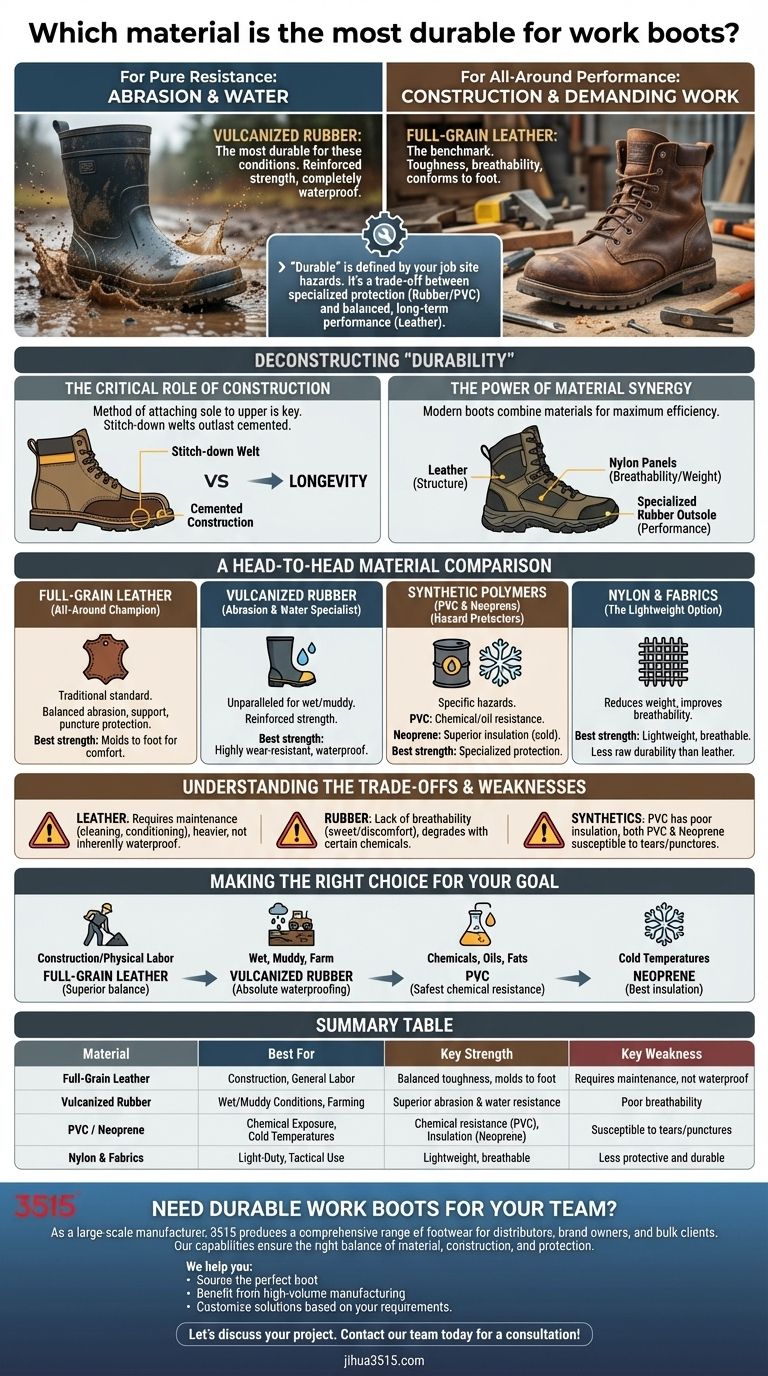
For pure resistance to abrasion and water, vulcanized rubber is the most durable material for work boots. However, for all-around performance in demanding work environments like construction, full-grain leather is the benchmark due to its unique combination of toughness, breathability, and ability to conform to your foot over time.
The most "durable" work boot material is not a single substance but is defined by your specific job site hazards. The choice is a trade-off between the specialized protection of rubber or PVC and the balanced, long-term performance of high-quality leather.
Deconstructing "Durability": More Than Just Material
True durability in a work boot comes from a combination of its material and its construction. A boot made from the toughest material will fail quickly if it's poorly assembled.
The Critical Role of Construction
The method used to attach the sole to the boot's upper is a primary indicator of longevity. Techniques like stitch-down welts create a robust, often repairable bond that significantly outlasts cheaper cemented construction.
The Power of Material Synergy
Modern high-performance boots, such as tactical models, rarely use a single material. They often combine leather for structure, nylon panels for breathability and reduced weight, and a specialized rubber compound for the outsole to maximize performance.
A Head-to-Head Material Comparison
Each material offers a distinct set of strengths tailored to different work environments. Understanding these differences is key to making the right choice.
Full-Grain Leather: The All-Around Champion
Leather is the traditional standard for high-quality work boots. It offers an excellent balance of abrasion resistance, support, and puncture protection. Its greatest advantage is its ability to mold to the shape of your foot, providing unmatched long-term comfort.
Vulcanized Rubber: The Abrasion & Water Specialist
For environments that are consistently wet, muddy, or involve significant surface wear, rubber is unparalleled. The vulcanization process reinforces its strength, making it highly resistant to wear and tear. It provides a completely waterproof barrier.
Synthetic Polymers (PVC & Neoprene): The Hazard Protectors
These materials are chosen for specific environmental hazards. PVC offers the best resistance to chemicals, oils, and animal fats, making it ideal for food processing or industrial cleaning. Neoprene provides superior insulation, trapping heat effectively in cold conditions.
Nylon & Fabrics: The Lightweight Option
Used to reduce weight and improve breathability, nylon is often found in tactical or lighter-duty boots. While tough, it does not offer the same level of raw durability and protection as a full-grain leather upper.
Understanding the Trade-offs
No single material is perfect for every situation. Being aware of the inherent weaknesses of each material is crucial for selecting a boot that won't fail you.
Leather's Weakness
High-quality leather requires maintenance, such as cleaning and conditioning, to prevent it from drying out and cracking. It is also heavier than synthetic options and is not inherently waterproof without a separate membrane liner.
Rubber's Downside
The primary drawback of rubber is its lack of breathability. This can lead to significant sweat and discomfort during long workdays. While tough against abrasion, it can degrade when exposed to certain oils and chemicals.
Synthetics' Limitations
PVC provides very little insulation, making it unsuitable for cold weather work. Both PVC and neoprene are more susceptible to tears and punctures than leather or high-quality rubber, making them less ideal for rugged, physically demanding environments.
Making the Right Choice for Your Goal
Your work environment is the ultimate guide. Select the material that directly counters the primary challenges and hazards you face every day.
- If your primary focus is construction or demanding physical labor: Choose full-grain leather for its superior balance of protection, support, and long-term comfort.
- If your primary focus is wet, muddy, or farm conditions: Select vulcanized rubber for its absolute waterproofing and high resistance to abrasion.
- If your primary focus is exposure to chemicals, oils, or fats: PVC is the safest choice, offering the most reliable chemical resistance.
- If your primary focus is working in cold temperatures: Look for neoprene boots to get the best insulation and keep your feet warm.
Choosing the right work boot means matching the material's strengths directly to the demands of your job.
Summary Table:
| Material | Best For | Key Strength | Key Weakness |
|---|---|---|---|
| Full-Grain Leather | Construction, General Labor | Balanced toughness, molds to foot | Requires maintenance, not waterproof |
| Vulcanized Rubber | Wet/Muddy Conditions, Farming | Superior abrasion & water resistance | Poor breathability |
| PVC / Neoprene | Chemical Exposure, Cold Temperatures | Chemical resistance (PVC), Insulation (Neoprene) | Susceptible to tears/punctures |
| Nylon & Fabrics | Light-Duty, Tactical Use | Lightweight, breathable | Less protective and durable |
Need Durable Work Boots for Your Team?
As a large-scale manufacturer, 3515 produces a comprehensive range of durable footwear for distributors, brand owners, and bulk clients. Our production capabilities encompass all types of work boots and shoes, ensuring you get the right balance of material, construction, and protection for your specific needs.
We help you:
- Source the perfect boot for any work environment, from construction sites to chemical plants.
- Benefit from high-volume manufacturing with consistent quality and competitive pricing.
- Customize solutions based on your unique requirements and branding.
Let's discuss your project. Contact our team today for a consultation!
Visual Guide
Related Products
- Durable Leather Work Boots for Wholesale & Custom Manufacturing
- Durable Leather Work Boots for Wholesale & Custom OEM Manufacturing
- Durable Leather Work Boots Wholesale Manufacturer & Custom Factory
- Durable Leather Moc Toe Work Boots for Wholesale & Custom Manufacturing
- Wholesale Leather Work Boots with Customizable Wedge Sole for Brands
People Also Ask
- What is the difference between full-grain and top-grain leather? Premium Material Guide for Boot Manufacturers
- What are the common workplace hazards that can be mitigated with the right work boots? Protect Your Workforce
- What are the common foot issues workers face due to uncomfortable work boots? Prevent Pain & Deformities
- What are the advantages of leather versus synthetic work boots? A Guide to Choosing the Right Material
- What are the key components of modern work boots? Engineered for Ultimate Durability and Comfort