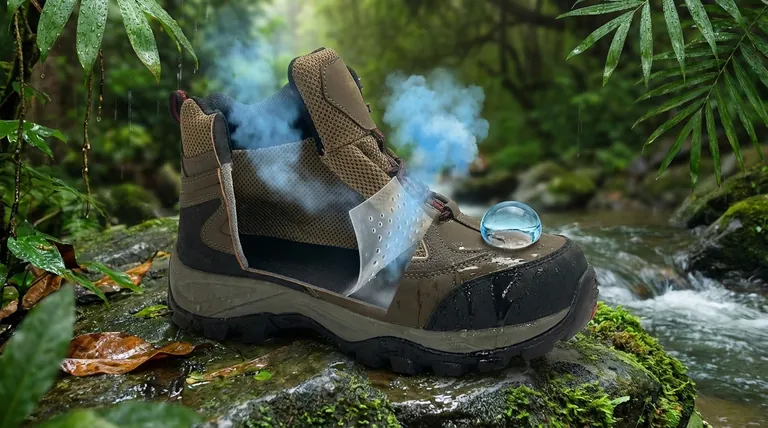
The key to a waterproof boot's performance is a specialized membrane built with microscopic pores. These pores are engineered to be large enough for individual water vapor molecules from your sweat to escape, yet far too small for larger liquid water droplets from the outside to penetrate. This creates a one-way street for moisture, keeping your feet dry from both internal sweat and external weather.
A waterproof membrane is not a coating, but a distinct inner layer designed to solve a dual problem: blocking external water while allowing internal sweat vapor to escape. The boot's true performance, however, depends on the outer material working in concert with this membrane.
The Science of Selective Permeability
At its core, a waterproof boot membrane works on a simple principle of size. It is a physical barrier that selectively allows some things to pass through while blocking others.
The Role of Microscopic Pores
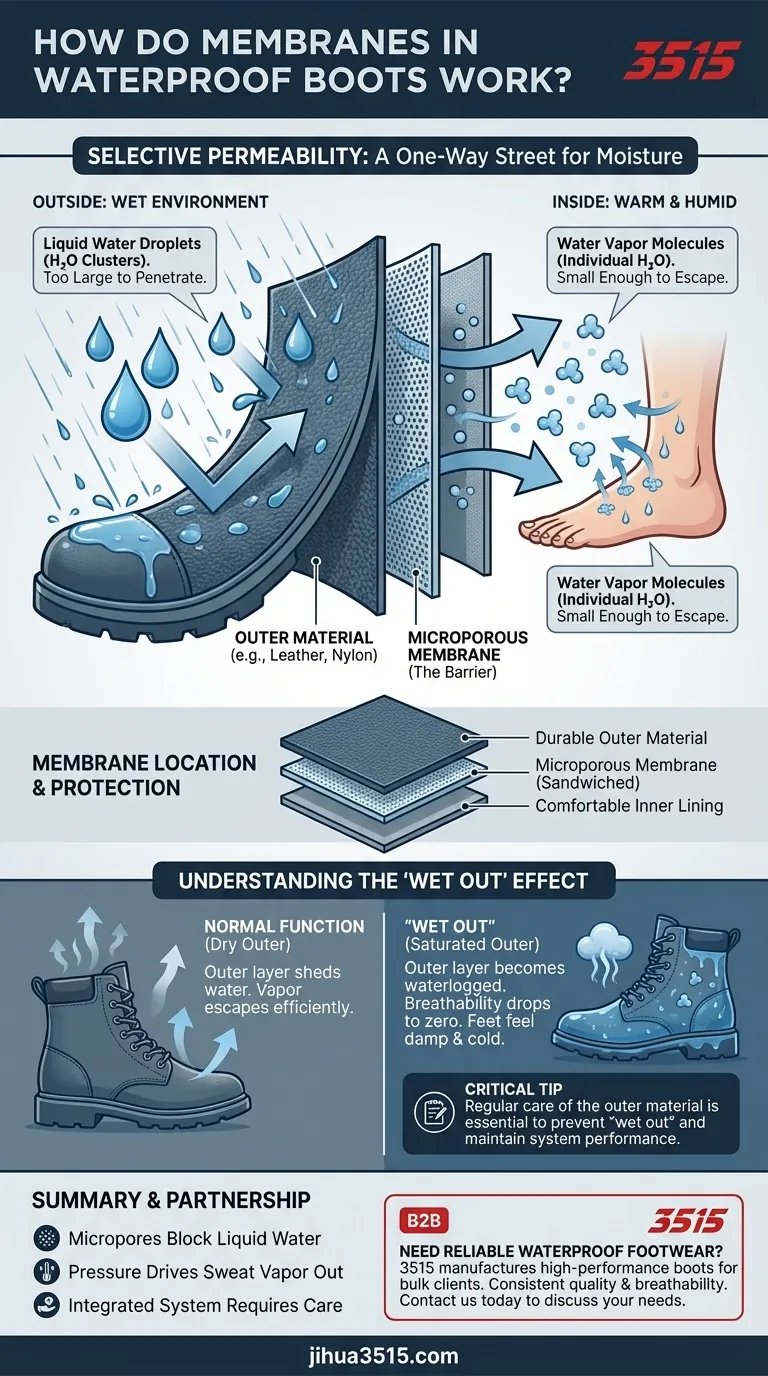
The defining feature of a waterproof membrane is its microporous structure. A water droplet from rain or a puddle is a massive collection of H₂O molecules bonded together. In contrast, water vapor—the gaseous form of water in your sweat—consists of individual, un-bonded H₂O molecules.
The pores in the membrane are precisely sized to be smaller than the smallest water droplet but significantly larger than a single molecule of water vapor.
How Sweat Escapes
The heat and humidity inside your boot create a high-pressure environment. This pressure differential actively drives the smaller water vapor molecules from the high-pressure interior outward through the membrane's pores to the lower-pressure air outside.
The Membrane's Hidden Location
The membrane itself is a delicate layer. To protect it from abrasion and punctures, it is almost always sandwiched between a durable outer material (like leather or nylon) and a comfortable inner lining. It is a critical component you can't see, but its performance is essential.
Understanding the Limitations and Trade-offs
A common misunderstanding is that the membrane alone makes a boot "waterproof." In reality, it is part of a system, and it has critical limitations you must understand.
The Membrane vs. The Outer Layer
The waterproof membrane's job is to keep your foot dry, not the boot's exterior. The outer material—the leather or fabric you see—is not inherently waterproof and can become completely saturated with water. This is a crucial distinction.
The "Wet Out" Effect
When the boot's outer material becomes waterlogged, it's a phenomenon called "wet out." While the membrane will still prevent liquid water from reaching your foot, two negative things happen:
- The boot becomes heavy and cold.
- The saturated outer layer's breathability drops to zero, trapping your sweat vapor. Your foot will feel damp and clammy from its own perspiration.
The Need for Proper Care
Because the membrane does not protect the boot's upper material, that outer layer is vulnerable to damage from the elements. As stated in the references, regular cleaning and conditioning of the upper is essential to maintain the boot's overall water resistance and structural integrity.
How to Keep Your Feet Truly Dry
Effective waterproofing relies on the entire boot functioning as a system. This means caring for the outer layer is just as important as having a high-quality internal membrane.
- If your primary focus is maximum protection in wet conditions: Choose a boot with a quality membrane and be diligent about cleaning and re-treating the outer material to prevent it from "wetting out."
- If your primary focus is comfort in mostly dry or hot climates: A non-waterproof but highly breathable boot may be a better choice, as even the best membrane will reduce overall airflow.
- If your primary focus is long-term durability: Regularly condition your boot's upper material, especially leather, as the membrane cannot protect it from damage caused by repeated saturation and drying.
True waterproof performance is achieved by understanding and maintaining the entire boot as an integrated system.
Summary Table:
| Key Concept | How It Works | Practical Implication |
|---|---|---|
| Microporous Membrane | Pores are smaller than water droplets but larger than vapor molecules. | Creates a one-way barrier, keeping feet dry from rain and sweat. |
| "Wet Out" Effect | The outer material (leather/nylon) can become saturated with water. | Boot feels heavy, cold, and breathability drops. Outer layer needs regular care. |
| Integrated System | Membrane works with the outer material and inner lining. | True waterproof performance depends on the entire boot, not just the membrane. |
Need Reliable Waterproof Footwear for Your Market?
As a large-scale manufacturer, 3515 produces a comprehensive range of durable and high-performance waterproof boots for distributors, brand owners, and bulk clients. Our production capabilities ensure consistent quality and breathability, perfect for demanding environments.
Let us help you equip your customers with boots they can trust.
Contact us today to discuss your specific needs and explore our catalog.
Visual Guide
Related Products
- High Performance Fire-Retardant Waterproof Safety Boots
- Premium Wholesale Waterproof Safety Boots High Performance Protection for Industrial Markets
- Premium Flame-Retardant Waterproof Safety Boots and Shoes
- Premium Waterproof High-Cut Industrial Safety Boots for Wholesale and Bulk Orders
- Wholesale Waterproof Tactical Boots Custom Suede & High-Traction Soles
People Also Ask
- Why are waterproof safety boots recommended for certain work environments? Essential Protection for Wet & Hazardous Jobs
- What roles do 3D vision systems and industrial robots play in the manufacturing of fire safety boots? Smart Automation
- What is the difference between waterproof, water-resistant, and water-repellent boots? Choose the Right Protection for Your Feet
- What is the difference between waterproof and water-resistant boots? Choose the Right Footwear for Any Condition
- What should you look for to ensure boots are fully waterproof? The Essential 2-Part System