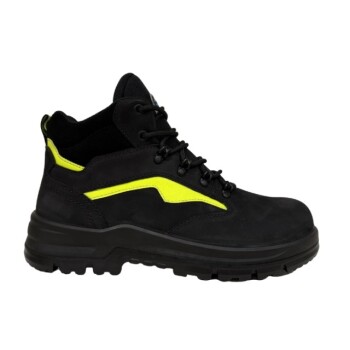
At their core, heavy-duty work boots reduce foot fatigue through a system of engineered support and impact absorption. They are designed not merely as a protective shell but as a tool that manages the immense stress your feet endure over a long workday, preventing the muscle strain and discomfort that leads to exhaustion.
The primary function of a quality work boot in reducing fatigue is to maintain proper foot mechanics. By providing a stable structure and absorbing shock, the boot does the work that your muscles and ligaments would otherwise be forced to do, conserving your energy and preventing pain from the ground up.
The Foundation: Structural Support and Stability
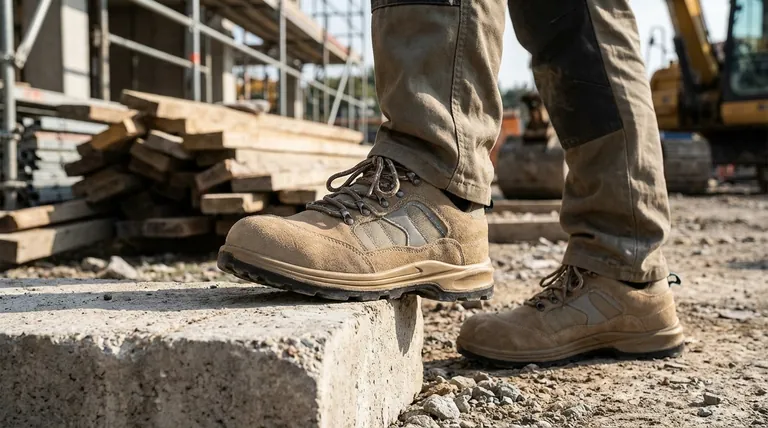
A work boot's first job is to create a stable platform for your foot. This structural integrity is what prevents the micro-movements and muscle strain that accumulate into significant fatigue over thousands of steps.
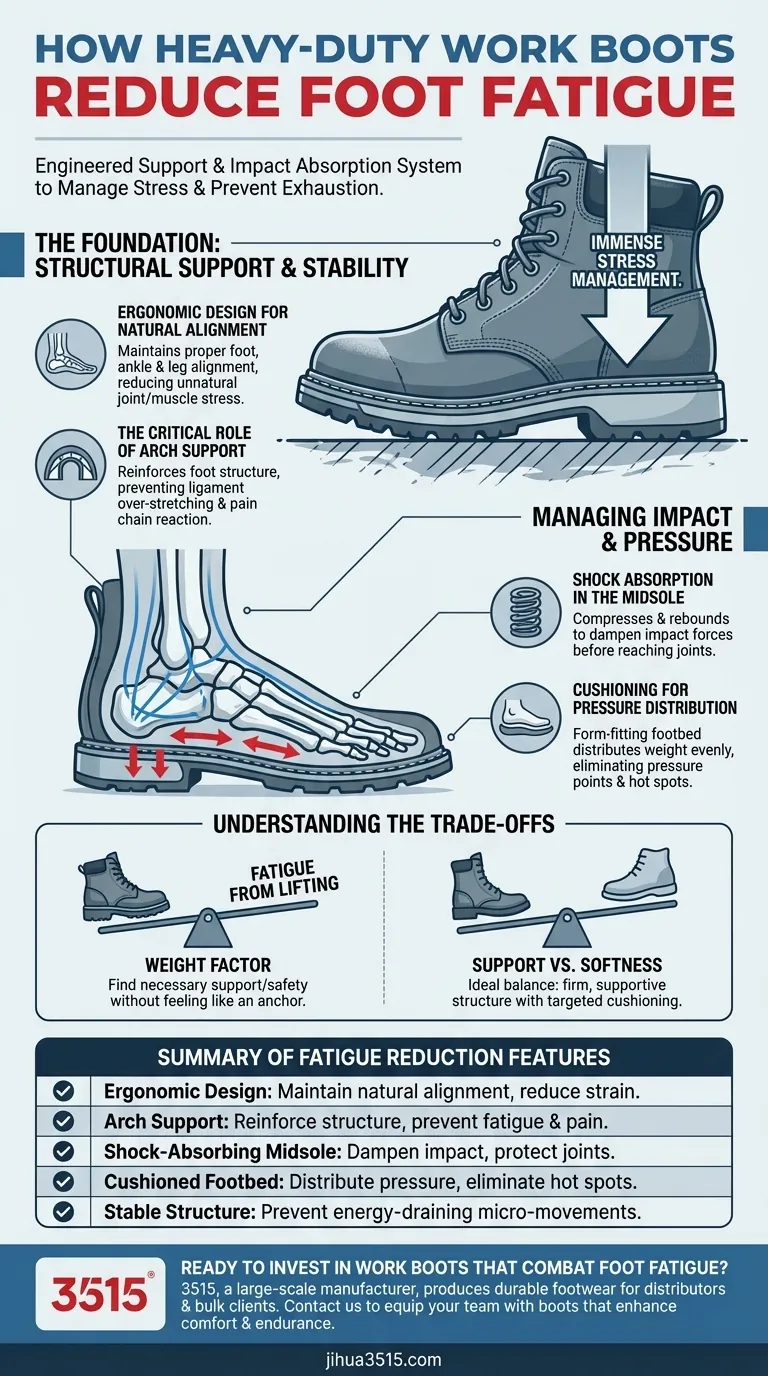
Ergonomic Design for Natural Alignment
Properly designed work boots follow the natural contours of the human foot. This ergonomic shape helps keep your foot, ankle, and leg in proper alignment, reducing unnatural stress on your joints and muscles.
Without this alignment, your body constantly makes small, subconscious adjustments to maintain balance, which consumes energy and leads to fatigue.
The Critical Role of Arch Support
The arch of your foot is a natural shock absorber. However, standing or walking for hours, especially on hard surfaces like concrete, can cause it to fatigue and collapse.
Work boots with built-in arch support reinforce this structure. This prevents the ligaments from over-stretching and stops the chain reaction of pain that can travel to your knees, hips, and lower back.
Managing Impact and Pressure
Every step you take sends a shockwave up through your body. Work boots are engineered to dampen these forces and distribute pressure evenly across the sole of your foot, preventing an exhausting pounding.
Shock Absorption in the Midsole
The midsole is the workhorse of fatigue reduction. Materials in this layer are specifically designed to compress and rebound, absorbing the shock of impact before it reaches your joints.
This function is similar to the suspension in a car, smoothing out the bumps so the occupant—in this case, your skeletal system—doesn't feel every jolt.
Cushioning for Pressure Distribution
When you stand in one place for long periods, your body weight creates intense pressure points on your heels and the balls of your feet.
A form-fitting, cushioned footbed distributes this pressure over a wider surface area. By eliminating these "hot spots," the boot prevents the localized muscle pain and nerve compression that are major sources of discomfort and fatigue.
Understanding the Trade-offs
While advanced features are beneficial, it's crucial to understand that no single boot is perfect for every situation. The key is finding the right balance for your specific needs.
The Weight Factor
A boot loaded with protective features like steel toes and thick soles can become heavy. While protective, excessive weight can cause its own form of fatigue, as you have to lift more with every step.
The goal is to find a boot that provides the necessary support and safety without feeling like an anchor.
Support vs. Softness
There is a critical balance between cushioning and support. A boot that is too soft may feel comfortable initially but can lack the structural integrity needed for proper arch and ankle support, leading to strain over time.
Conversely, a boot that is too rigid may not provide enough shock absorption. The ideal boot offers firm, supportive structure combined with targeted cushioning.
Making the Right Choice for Your Task
Ultimately, the best work boot is one that matches the demands of your job. Consider your primary activities to guide your decision.
- If your primary focus is standing on hard surfaces: Prioritize boots with maximum cushioning and shock-absorbing midsoles to distribute pressure.
- If your primary focus is walking on uneven terrain: Emphasize strong arch support and ankle stability to prevent twists and maintain alignment.
- If your primary focus is a mix of dynamic activities: Look for a balanced boot that combines moderate support with flexible, lightweight materials.
Investing in the right work boot is a direct investment in your daily energy, focus, and long-term physical health.
Summary Table:
| Fatigue Reduction Feature | Key Benefit |
|---|---|
| Ergonomic Design | Maintains natural foot alignment, reducing muscle strain. |
| Arch Support | Reinforces foot structure, preventing ligament fatigue and pain. |
| Shock-Absorbing Midsole | Dampens impact forces, protecting joints from constant jolts. |
| Cushioned Footbed | Distributes pressure evenly, eliminating painful hot spots. |
| Stable Structure | Prevents micro-movements that lead to energy drain over time. |
Ready to invest in work boots that combat foot fatigue?
As a large-scale manufacturer, 3515 produces a comprehensive range of durable footwear designed specifically for distributors, brand owners, and bulk clients. Our production capabilities encompass all types of safety and work boots engineered with the precise support, cushioning, and stability your workforce needs to stay productive and pain-free.
Let us help you equip your team with boots that enhance comfort, endurance, and long-term health. Contact 3515 today to discuss your footwear requirements and discover our manufacturing solutions.
Visual Guide
Related Products
- Wholesale Heavy-Duty Waterproof Steel Toe Work Boots OEM Manufacturer
- Durable Leather Work Boots for Wholesale & Custom Manufacturing
- Durable Leather Work Boots for Wholesale & Custom OEM Manufacturing
- Wholesale Customizable Safety Boots Durable & Protective Footwear Manufacturing
- Durable Leather Work Boots Wholesale Manufacturer & Custom Factory
People Also Ask
- What are the pros and cons of steel toe work boots? A Guide to Maximum Protection vs. Comfort
- What are the different types of steel toe work boots? Choose the Right Boot for Your Job
- What is the history of steel toe work boots? From German Invention to Modern Safety Standard
- How much weight can steel toe work boots withstand? Unpacking the 3,372 lb. Safety Standard
- What are some common myths about steel toe work boots? Debunked for Modern Workers