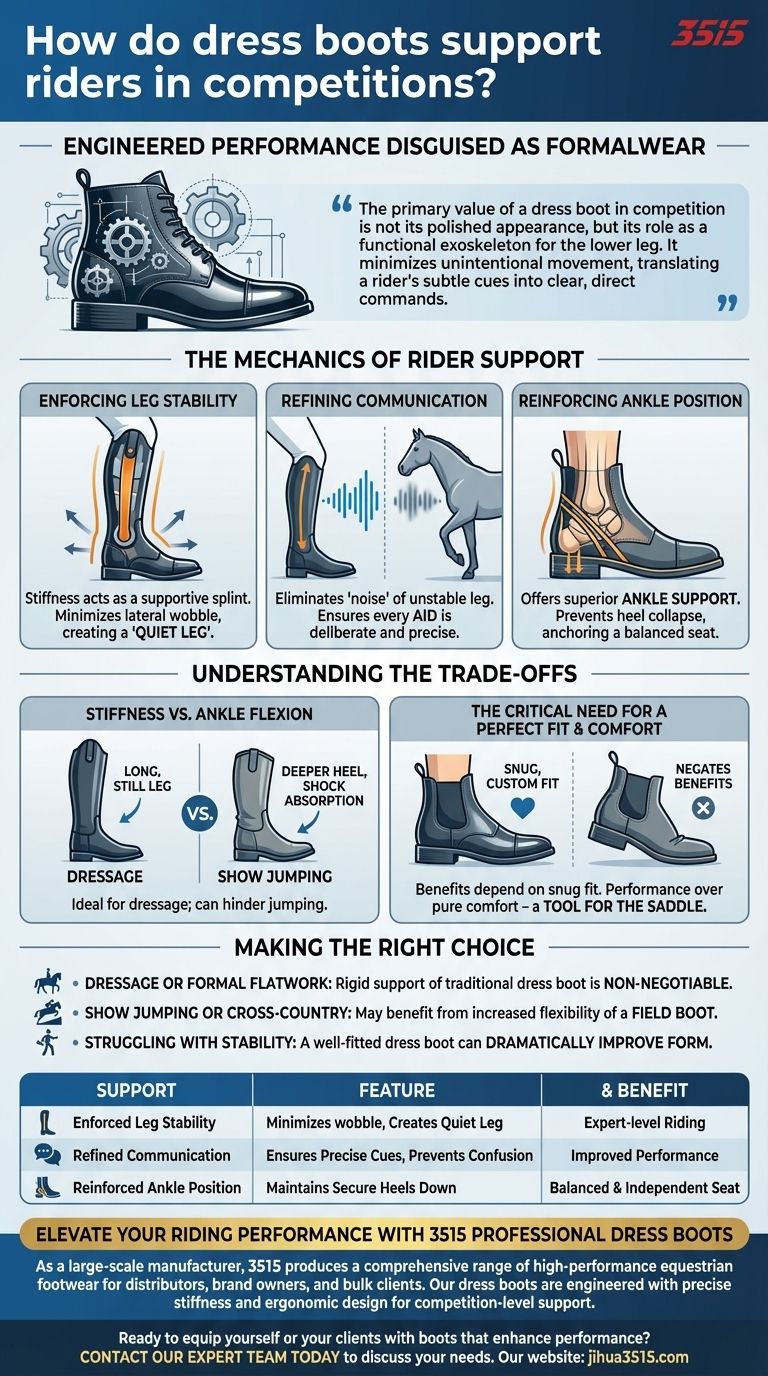
In the world of competitive riding, a dress boot is engineered performance equipment disguised as formalwear. Its core function is to provide unwavering structural support through a combination of stiff construction and a precise, snug fit, which stabilizes the rider's lower leg, enhances posture, and enables clearer communication with the horse.
The primary value of a dress boot in competition is not its polished appearance, but its role as a functional exoskeleton for the lower leg. It minimizes unintentional movement, translating a rider's subtle cues into clear, direct commands.
The Mechanics of Rider Support
To understand a dress boot's impact, you must see it as a tool for biomechanical efficiency. Its design directly addresses the foundational elements of a correct and effective riding position.
Enforcing Leg Stability
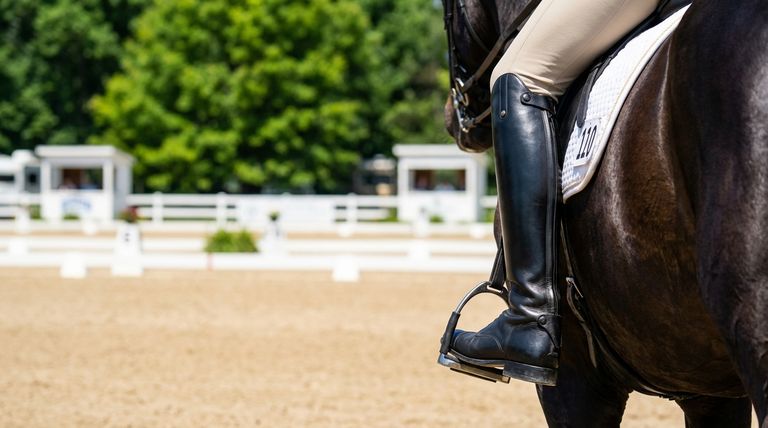
The most critical feature of a dress boot is its stiffness. This rigid construction acts like a supportive splint around the rider's calf and ankle.
This minimizes lateral wobble and prevents the lower leg from shifting unintentionally, creating what is known as a "quiet leg"—the hallmark of an expert rider.
Refining Communication
A quiet leg is an effective leg. By eliminating extraneous muscle tension and movement, the boot ensures that every cue, or aid, delivered by the rider's leg is deliberate and precise.
This clarity prevents the horse from becoming confused or desensitized by the constant, unintentional "noise" of an unstable leg.
Reinforcing Ankle Position
Dress boots offer significantly more ankle support than their laced counterparts, field boots. This structure helps prevent the rider's heel from dropping too far or collapsing inward.
This is particularly beneficial for riders with weaker ankles, as it helps them maintain a secure "heels down" position, which is the anchor for a balanced and independent seat.
Understanding the Trade-offs
While highly effective, the design of a dress boot presents specific trade-offs that are important for riders to consider based on their discipline and anatomy.
Stiffness vs. Ankle Flexion
The very stiffness that provides support inherently limits ankle flexibility. This is ideal for a discipline like dressage, which demands a long, still leg.
However, for disciplines like show jumping, which require a deeper heel and more ankle flexion to absorb the shock of landing, this rigidity can be a hindrance.
The Critical Need for a Perfect Fit
A dress boot's benefits are entirely dependent on a snug, almost custom fit. If the boot is too loose, the rider's leg will simply move around inside it, negating all supportive benefits.
If it is too tight, it can restrict circulation and cause significant discomfort. The break-in period for a stiff new boot can be considerable.
Function Over Pure Comfort
While modern boots incorporate ergonomic designs and cushioned insoles, their primary purpose is performance, not all-day comfort.
The stiff leather and uncompromising structure mean they are less comfortable for walking around than softer boots. They are a tool for the saddle.
Making the Right Choice for Your Goal
Selecting the right boot is about aligning the equipment's design with your specific competitive discipline and personal needs.
- If your primary focus is dressage or formal flatwork: The rigid support of a traditional dress boot is non-negotiable for maintaining a quiet, effective leg.
- If your primary focus is show jumping or cross-country: You may benefit more from the increased ankle flexibility of a field boot, though some riders prefer dress boots for their versatility.
- If you struggle with leg stability or have weaker ankles: A well-fitted dress boot can provide the external support needed to dramatically improve your form, confidence, and communication.
Ultimately, the right boot serves as a silent partner, enhancing your natural aids and allowing for a more harmonious connection with your horse.
Summary Table:
| Support Feature | Benefit for the Rider | Impact on Performance |
|---|---|---|
| Enforced Leg Stability | Minimizes lateral wobble and unintentional movement | Creates a "quiet leg" for expert-level riding |
| Refined Communication | Ensures every cue is deliberate and precise | Prevents horse confusion and desensitization |
| Reinforced Ankle Position | Maintains secure "heels down" posture | Anchors a balanced and independent seat |
Elevate Your Riding Performance with 3515 Professional Dress Boots
As a large-scale manufacturer, 3515 produces a comprehensive range of high-performance equestrian footwear for distributors, brand owners, and bulk clients. Our dress boots are engineered with the precise stiffness and ergonomic design required for competition-level support, helping you achieve a quieter leg and clearer communication with your horse.
Ready to equip yourself or your clients with boots that enhance performance? Contact our expert team today to discuss your specific needs and discover how our manufacturing capabilities can deliver the perfect fit for your competitive goals.
Visual Guide
Related Products
- Wholesale Comfort Dress Shoes with Dial Closure for Custom Manufacturing
- Wholesale Perforated Comfort Dress Shoes | Custom Derby Shoe Manufacturer
- Custom Manufactured Air Cushion Leather Business Shoes for Wholesale
- Wholesale Classic Leather Lace-Up Ankle Boots for Brand Manufacturing
- Wholesale Tactical Boots High-Traction & Reflective for Bulk & Brand Orders
People Also Ask
- How do comfort dress shoes differ from traditional dress shoes? Discover the Ergonomic Advantage
- Which dress shoe styles are suitable for wearing with jeans? A Guide to Smart-Casual Style
- What features make dress shoes suitable for standing all day? Achieve All-Day Comfort with Anatomical Design
- What are the benefits of resoling dress shoes? Extend Life & Boost Comfort
- What recent trends have influenced traditional dress shoe designs? The Shift to Modern Comfort