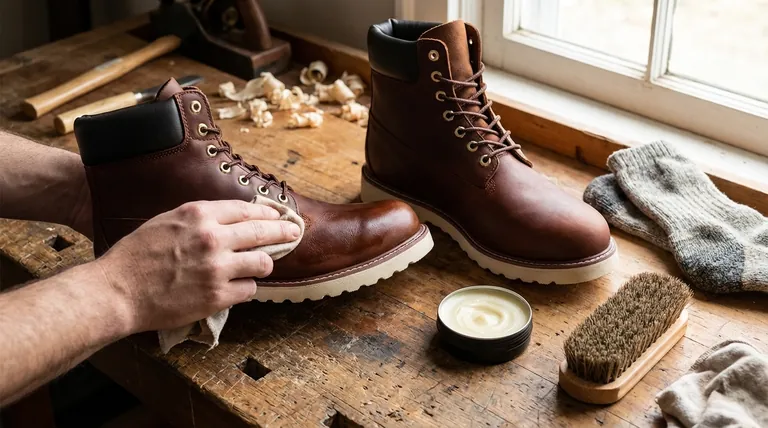
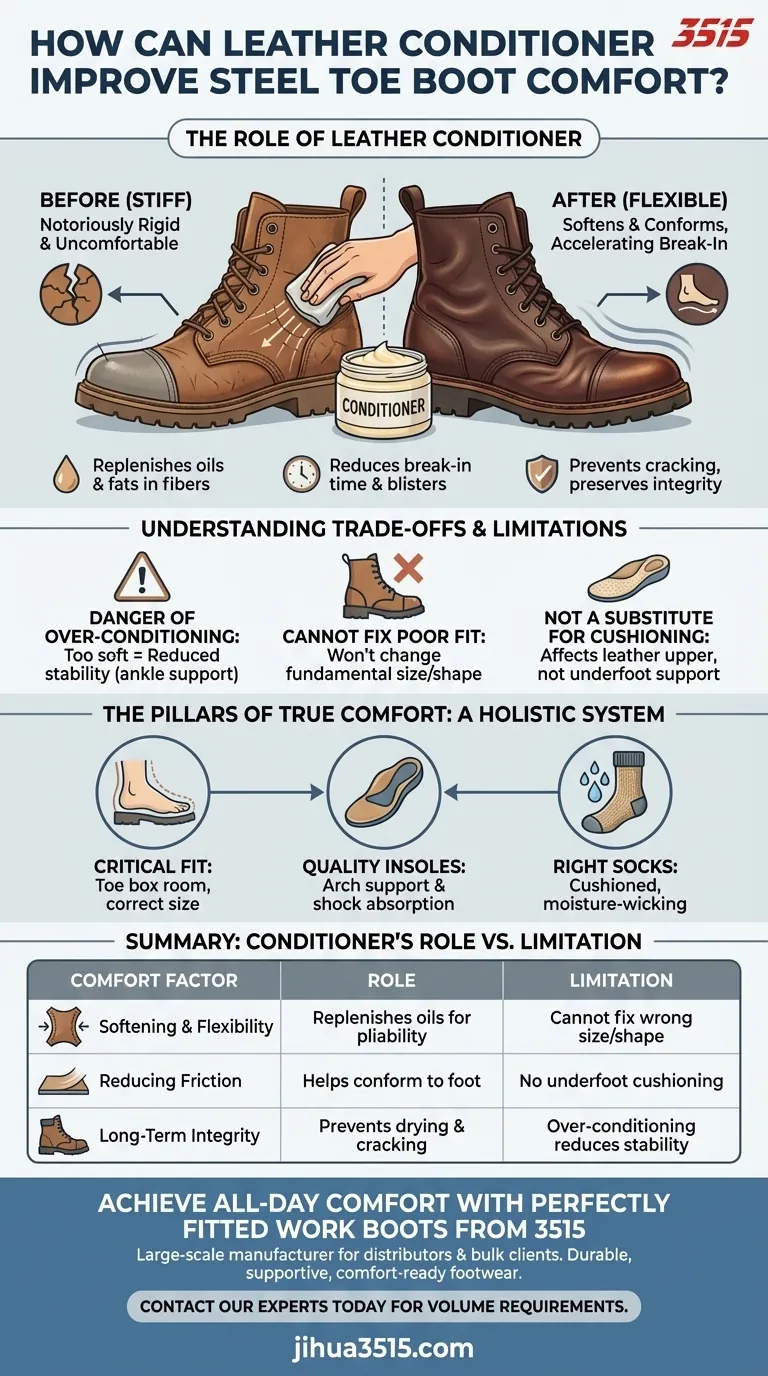
To be direct, leather conditioner improves the comfort of steel toe boots by making the stiff leather softer and more pliable. This increased flexibility allows the boot to conform more naturally to the shape of your foot, reducing friction and pressure points, especially during the critical break-in period.
While leather conditioner is an essential maintenance tool for enhancing flexibility, it is only one component of boot comfort. The foundation of true, all-day comfort is a combination of proper fit, quality insoles, and the right socks.
The Role of Leather Conditioner
Conditioner works by replenishing the oils and fats within the leather's fibers. This process has a direct impact on how the boot feels on your foot.
Softening Stiff Materials
New work boots, particularly those made from thick, durable leather, are notoriously rigid. A quality conditioner penetrates the leather, making it significantly more flexible and reducing the stiffness that causes discomfort.
Aiding the Break-In Period
The pliability introduced by conditioning accelerates the break-in process. A softer boot will mold to the unique movements of your foot and ankle much faster, minimizing the blisters and soreness associated with new boots.
Preserving Structural Integrity
Dry, cracked leather is not only uncomfortable but also compromises the boot's protective qualities. Regular conditioning prevents the leather from drying out, extending the boot's lifespan and maintaining its intended structure for consistent support.
Understanding the Trade-offs and Limitations
Using a conditioner is a balancing act. It is a valuable tool, but it is not a cure-all for every comfort issue and has its own set of risks if used improperly.
The Danger of Over-Conditioning
Applying too much conditioner can make the leather overly soft. This can compromise the structural support of the boot, particularly around the ankle, reducing the stability and protection you rely on in a work environment.
Conditioner Cannot Fix a Poor Fit
No amount of leather conditioner can change the fundamental size or shape of a boot. If the boot is too short, narrow, or simply the wrong shape for your foot, conditioning will not resolve the underlying problem.
It's Not a Substitute for Cushioning
The primary source of underfoot comfort and shock absorption comes from the boot's insole and midsole. Conditioner affects the leather upper, not the platform you stand on all day.
The Pillars of True Steel Toe Boot Comfort
To solve boot discomfort systemically, you must look beyond just the leather and address the entire ecosystem of your footwear.
The Critical Importance of Fit
This is the non-negotiable foundation of comfort. Your boots must have enough room in the toe box to prevent your toes from hitting the steel cap. Always measure your feet at the end of the day while wearing your typical work socks, as feet can swell.
Upgrading Your Insoles
Factory insoles are often basic placeholders. Investing in high-quality insoles or custom orthotics provides the specific arch support and cushioning your foot needs, dramatically reducing fatigue and soreness.
The Right Socks Matter
Never underestimate the power of good socks. Choose cushioned, moisture-wicking socks (like merino wool or synthetics) to keep your feet dry, prevent blisters, and add an extra layer of shock absorption.
How to Apply This to Your Goal
Your strategy for achieving comfort depends on the specific problem you are facing.
- If your primary focus is breaking in new, stiff boots: Use a leather conditioner to soften the material and wear the boots for short periods, gradually increasing the time.
- If your primary focus is reducing foot fatigue and soreness: Your first step should be to upgrade your insoles for better arch support and cushioning.
- If your primary focus is preventing blisters and general discomfort: Ensure your boots are the correct size and pair them with high-quality, moisture-wicking socks.
Ultimately, achieving lasting comfort in steel toe boots requires a holistic approach that treats conditioning as one part of a complete system.
Summary Table:
| Comfort Factor | Role of Leather Conditioner | Key Limitation |
|---|---|---|
| Softening & Flexibility | Replenishes oils to make leather pliable, aiding break-in. | Cannot fix a boot that is the wrong size or shape. |
| Reducing Friction | Helps boot conform to foot shape, minimizing pressure points. | Does not provide underfoot cushioning (that's the insole's job). |
| Long-Term Integrity | Prevents dry, cracked leather to maintain support and protection. | Over-conditioning can make leather too soft, reducing stability. |
Achieve all-day comfort with perfectly fitted work boots from 3515.
As a large-scale manufacturer, we produce a comprehensive range of durable footwear for distributors, brand owners, and bulk clients. Our expertise ensures every pair offers the ideal combination of supportive structure, flexible materials, and comfort-ready features from the start.
Let us help you equip your team with boots that don't need breaking in. Contact our experts today to discuss your specific needs and volume requirements.
Visual Guide
Related Products
- Durable Steel Toe Safety Boots Wholesale & Custom Manufacturing
- Wholesale Durable Breathable Safety Boots Custom OEM Manufacturer
- Wholesale Durable 6-Inch Work Boots | Custom & Private Label Manufacturer
- Puncture-Resistant Velcro Safety Boots for Wholesale & Custom Manufacturing
- Premium Sport Style Safety Boots for Bulk Orders
People Also Ask
- Why are industrial safety boots with steel toes necessary for machine operators? Essential Foot Protection for Safety
- Why is it mandatory to wear safety shoes with steel toe protection during metal loading? Prevent Crushing Injuries
- What are the main materials used in steel toe safety shoes? A Guide to Protective Footwear Construction
- What are the characteristics of steel toe safety boots? Maximum Protection, Key Trade-offs
- Is it true that steel toes can cause toes to get cut off? Debunking the Dangerous Myth